PUBLISHER: Mordor Intelligence | PRODUCT CODE: 2097146

PUBLISHER: Mordor Intelligence | PRODUCT CODE: 2097146
Business Jet MRO - Market Share Analysis, Industry Trends & Statistics, Growth Forecasts (2026 - 2031)
According to Mordor Intelligence, the business jet MRO market size is expected to grow from USD 30.12 billion in 2025 to USD 31.09 billion in 2026 and is forecasted to reach USD 36.39 billion by 2031 at a 3.20% CAGR over 2026-2031.
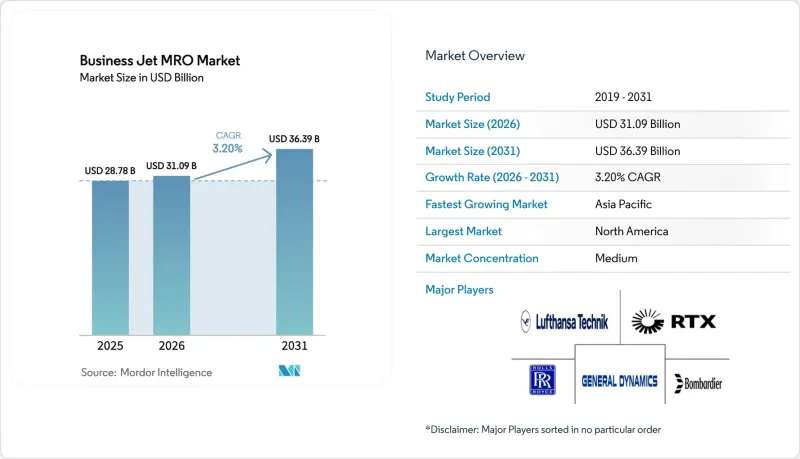
This report is Segmented by MRO Type (Engine MRO, Component MRO, Interior MRO, Airframe MRO, and Field Maintenance), Body Type (Large Jets, Mid-Size Jet, and Light/Very Light Jet), Service Provider (OEM-Affiliated and Independent), and Geography (North America, Europe, Asia-Pacific, South America, and Middle East and Africa). The Market Forecasts are Provided in Terms of Value (USD).
Global Business Jet MRO Market Trends and Insights
Aging Global Business Jet Fleet Increasing Demand for Heavy Maintenance
More than 8,000 in-service business jets have surpassed 15 years of operation, and the average age of aircraft listed for resale reached 22 years in 2024. Reaching the 12- to 15-year mark necessitates significant airframe inspections, gear overhauls, and corrosion control measures, shifting capital allocation toward maintenance instead of replacement. OEM order backlogs stretching up to two years, coupled with elevated pre-owned inventory dominated by older airframes, are reinforcing this life-extension strategy. Regulatory oversight under FAA Part 91 K and EASA Part-M prevents operators from deferring mandatory intervals, locking in stable heavy-check demand. Shops equipped for legacy platforms such as the Gulfstream G-IV and Bombardier Challenger 600 series are therefore entering a multi-year upcycle.
Rising Flight Hours and Growth in Fractional Operations Sustaining Aircraft Utilization
Business aviation flight activity increased by 3% in 2025, with fractional fleets accounting for a disproportionate share. NetJets alone logged roughly 190,000 flight hours from March to May 2025, keeping utilization more than 10% above pre-2020 baselines. Fractional missions average 1.5- to 2.5-hour legs, which doubles cycle counts compared to owner-flown aircraft and accelerates component wear. Each 100-hour uptick translates into more than thousands of USD in additional spending on engine borescope inspections, brake replacements, and avionics health checks. Charter and fractional operators prioritize dispatch reliability, driving demand for 24-hour AOG support and rotable pools that independent shops monetize via inventory-backed service agreements. The trend is most pronounced in the light jet category, where lower acquisition costs align with the economics of shared ownership.
Shortage of Skilled Maintenance Technicians Increasing Costs and Turnaround Times
An aging technician workforce and insufficient training-pipeline throughput are elevating wage costs and stretching shop schedules. Entry-level AMT salaries approach more than thousands of USD, while turbine-rated specialists can command six-figure packages, yet demand still outpaces supply across North America and Europe. Turnaround times for complex engine visits have lengthened and occasionally breach 300 days, forcing operators to lease spares or accept extended downtime. Independent shops launched apprenticeship programs and partnerships with community colleges; however, producing a fully licensed technician can take up to two years, which delays relief.
Other drivers and restraints analyzed in the detailed report include:
- Increasing Complexity of Engines and Avionics Driving Higher MRO Expenditure
- OEM Delivery Backlogs Extending Operational Life of In-Service Aircraft
- Persistent Spare-Parts Supply Disruptions Extending Maintenance Lead Times
For complete list of drivers and restraints, kindly check the Table Of Contents.
Segment Analysis
Engine MRO accounted for 56.58% of the business jet MRO market share in 2025, as turbofan overhauls are high-cost and recur every 3,500 to 5,000 flight hours. Component work is forecast to accelerate at a 4.84% CAGR, reflecting avionics obsolescence and the popularity of rotable pools that slash replacement costs by up to 70%. Landing-gear, hydraulic, and flight-control overhauls are converging as aging airframes enter their second maintenance cycle, while cabin refurbishments add incremental revenue as operators delay fleet renewal.
The business jet MRO market benefits from predictive-maintenance platforms, which focus spending on components with measurable deterioration, thereby concentrating revenue in shops that can integrate data analytics. Although engine programs remain the most significant contributor to the business jet MRO market size, power-by-the-hour contracts cap transactional growth, shifting incremental opportunity toward avionics upgrades required by evolving cybersecurity mandates.
Complete Report Scope:
- By MRO Type
- Engine MRO
- Component MRO
- Interior MRO
- Airframe MRO
- Field Maintenance
- By Body Type
- Large Jets
- Mid-Size Jet
- Light/Very Light Jet
- By Service Provider
- OEM-Affiliated MRO
- Independent MRO
- By Geography
- North America
- United States
- Canada
- Mexico
- Europe
- United Kingdom
- France
- Germany
- Italy
- Spain
- Rest of Europe
- Asia-Pacific
- China
- India
- Japan
- South Korea
- Australia
- Rest of Asia-Pacific
- South America
- Brazil
- Rest of South America
- Middle East and Africa
- Middle East
- United Arab Emirates
- Saudi Arabia
- Rest of Middle East
- Africa
- South Africa
- Rest of Africa
- Middle East
- North America
Geography Analysis
North America captured 58.76% of the business jet MRO market size in 2025, supported by a fleet comprising 66% of the world's 24,000 business jets and an extensive network of FAA Part 145 stations. Gulfstream's Savannah expansion, which opened in 2024, adds capacity for 26 additional aircraft, underscoring the OEM's commitment to co-locating production and service. US shops face escalating labor costs driven by technician shortages, pressures that encourage investment in automation and digital work-order management, yet threaten smaller facilities lacking scale.
The Asia-Pacific is forecasted to lead the business jet MRO market at a 5.24% CAGR through 2031, as China's fleet is expected to increase by 41% to approximately 350 aircraft, and India is projected to add incremental units each year. ST Engineering's third Philippine hangar and Lufthansa Technik's planned Clark facility reflect aggressive infrastructure build-out, while bilateral airworthiness accords with Australia and Singapore streamline cross-border certifications. Skill-short training pipelines persist as a near-term bottleneck. Yet, demand for heavy checks, connectivity retrofits, and special-mission conversions continues to migrate toward the region as operators seek proximity and shorter ferry times.
Europe maintains steady demand anchored by the UK, Germany, and France, where Jet Aviation, SR Technics, and Lufthansa Technik service both regional and intercontinental fleets. EASA's unified regulatory framework underpins operator confidence, though Brexit-driven dual approvals add paperwork for UK-based shops. South America's activity is concentrated in Brazil around Embraer's service hubs, but macroeconomic volatility constrains capital announcements. The Middle East, benefiting from VIP completions and government ISR programs, offers high-margin projects for providers with security-cleared facilities. At the same time, Africa's contribution remains centered on South Africa's established cluster.
- Bombardier Inc.
- General Dynamics Corporation
- Textron Aviation
- Dassault Aviation
- Embraer S.A.
- Lufthansa Technik AG
- StandardAero
- Duncan Aviation Inc.
- West Star Aviation, LLC
- Rolls-Royce Holdings plc
- RTX Corporation
- Flexjet, LLC
- Comlux Aviation Services LLC
- ExecuJet Aviation Group AG
- DC AVIATION GmbH
- Atlas Air Service AG
- Western Aircraft Inc.
Additional Benefits:
- The market estimate (ME) sheet in Excel format
- 3 months of analyst support
TABLE OF CONTENTS
1 INTRODUCTION
- 1.1 Study Assumptions and Market Definition
- 1.2 Scope of the Study
2 RESEARCH METHODOLOGY
3 EXECUTIVE SUMMARY
4 MARKET LANDSCAPE
- 4.1 Market Overview
- 4.2 Market Drivers
- 4.2.1 Aging global business jet fleet is increasing demand for heavy maintenance
- 4.2.2 Rising flight hours and growth in fractional operations are sustaining aircraft utilization
- 4.2.3 Increasing complexity of engines and avionics is driving higher MRO expenditure
- 4.2.4 OEM delivery backlogs are extending the operational life of in-service aircraft
- 4.2.5 Growing demand for cabin connectivity retrofits is generating incremental MRO revenues
- 4.2.6 Special mission conversion of older business jets is creating niche maintenance demand
- 4.3 Market Restraints
- 4.3.1 Shortage of skilled maintenance technicians is increasing costs and turnaround times
- 4.3.2 Persistent spare parts supply disruptions are extending maintenance lead times
- 4.3.3 Rising avionics certification and cybersecurity compliance costs are elevating MRO expenses
- 4.3.4 Expansion of OEM power-by-the-hour programs is limiting addressable opportunities for independent MROs
- 4.4 Value Chain Analysis
- 4.5 Regulatory Landscape
- 4.6 Technological Outlook
- 4.7 Porter's Five Forces Analysis
- 4.7.1 Bargaining Power of Suppliers
- 4.7.2 Bargaining Power of Buyers
- 4.7.3 Threat of New Entrants
- 4.7.4 Threat of Substitutes
- 4.7.5 Competitive Rivalry
5 MARKET SIZE AND GROWTH FORECASTS (VALUE)
- 5.1 By MRO Type
- 5.1.1 Engine MRO
- 5.1.2 Component MRO
- 5.1.3 Interior MRO
- 5.1.4 Airframe MRO
- 5.1.5 Field Maintenance
- 5.2 By Body Type
- 5.2.1 Large Jets
- 5.2.2 Mid-Size Jet
- 5.2.3 Light/Very Light Jet
- 5.3 By Service Provider
- 5.3.1 OEM-Affiliated MRO
- 5.3.2 Independent MRO
- 5.4 By Geography
- 5.4.1 North America
- 5.4.1.1 United States
- 5.4.1.2 Canada
- 5.4.1.3 Mexico
- 5.4.2 Europe
- 5.4.2.1 United Kingdom
- 5.4.2.2 France
- 5.4.2.3 Germany
- 5.4.2.4 Italy
- 5.4.2.5 Spain
- 5.4.2.6 Rest of Europe
- 5.4.3 Asia-Pacific
- 5.4.3.1 China
- 5.4.3.2 India
- 5.4.3.3 Japan
- 5.4.3.4 South Korea
- 5.4.3.5 Australia
- 5.4.3.6 Rest of Asia-Pacific
- 5.4.4 South America
- 5.4.4.1 Brazil
- 5.4.4.2 Rest of South America
- 5.4.5 Middle East and Africa
- 5.4.5.1 Middle East
- 5.4.5.1.1 United Arab Emirates
- 5.4.5.1.2 Saudi Arabia
- 5.4.5.1.3 Rest of Middle East
- 5.4.5.2 Africa
- 5.4.5.2.1 South Africa
- 5.4.5.2.2 Rest of Africa
- 5.4.5.1 Middle East
- 5.4.1 North America
6 COMPETITIVE LANDSCAPE
- 6.1 Market Concentration
- 6.2 Strategic Moves
- 6.3 Market Share Analysis
- 6.4 Company Profiles (includes Global-level Overview, Market-level overview, Core Segments, Financials as available, Strategic Information, Market Rank/Share for key companies, Products and Services, and Recent Developments)
- 6.4.1 Bombardier Inc.
- 6.4.2 General Dynamics Corporation
- 6.4.3 Textron Aviation
- 6.4.4 Dassault Aviation
- 6.4.5 Embraer S.A.
- 6.4.6 Lufthansa Technik AG
- 6.4.7 StandardAero
- 6.4.8 Duncan Aviation Inc.
- 6.4.9 West Star Aviation, LLC
- 6.4.10 Rolls-Royce Holdings plc
- 6.4.11 RTX Corporation
- 6.4.12 Flexjet, LLC
- 6.4.13 Comlux Aviation Services LLC
- 6.4.14 ExecuJet Aviation Group AG
- 6.4.15 DC AVIATION GmbH
- 6.4.16 Atlas Air Service AG
- 6.4.17 Western Aircraft Inc.
7 MARKET OPPORTUNITIES AND FUTURE OUTLOOK
- 7.1 White-space and Unmet-Need Assessment

