PUBLISHER: Mordor Intelligence | PRODUCT CODE: 2097188

PUBLISHER: Mordor Intelligence | PRODUCT CODE: 2097188
Southeast Asia Aircraft MRO - Market Share Analysis, Industry Trends & Statistics, Growth Forecasts (2026 - 2031)
According to Mordor Intelligence, the Southeast Asia aircraft MRO market size is expected to grow from USD 4.35 billion in 2025 to USD 4.84 billion in 2026 and is forecasted to reach USD 8.00 billion by 2031 at a 10.58% CAGR over 2026-2031.
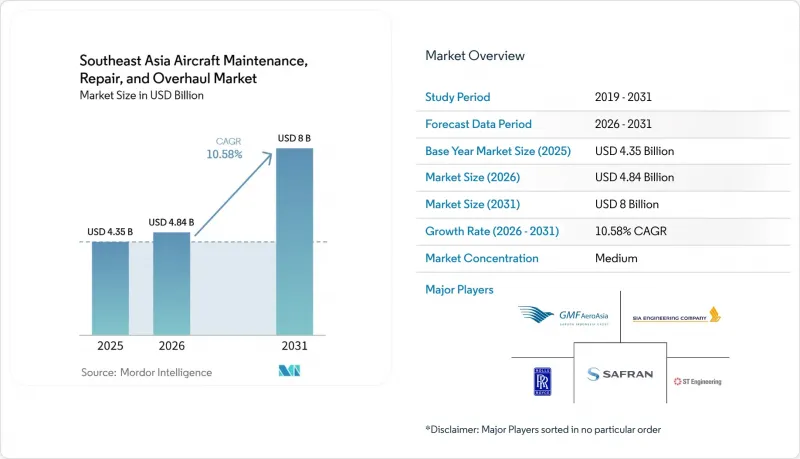
This report is Segmented by Aircraft Class (Fixed-Wing and Rotary-Wing), MRO Type (Airframe Heavy Maintenance, Engine Maintenance, and More), Application (Commercial Passenger, Commercial Cargo/Freighter, and More), Service Provider (Airline-Affiliated MRO, Independent Third-Party MRO, and More), and Geography (Malaysia, and More). The Market Forecasts are Provided in Terms of Value (USD).
Southeast Asia Aircraft MRO Market Trends and Insights
Passenger-Fleet Up-Gauging to LEAP-Powered Narrow-Bodies
Carriers across the region are accelerating the switch from CFM56 and V2500 engines to LEAP-1A and LEAP-1B units, banking on 15% lower fuel burn and lower carbon intensity. GE Aerospace is spending USD 75 million to double LEAP maintenance throughput in Malaysia and Singapore and to install two new test cells by 2027. ST Engineering obtained the first independent LEAP certification in Southeast Asia, positioning Seletar as a neutral hub for more than 500 annual shop visits. While the upgrade improves efficiency, the unique CMC liner, fine-mesh fuel nozzles, and additional borescope ports require specialized tooling and 18-24 months of technician retraining. CFM's durability enhancement kit, certified in 2024, extends on-wing time by 2,000 cycles but obliges operators to adopt digital twins to monitor blade-cooling margins.
Expansion of Airline-Affiliated Internal MRO Capacity
Currency swings, particularly the IDR currency's 7% decline against the USD in 2025, prompted carriers to reclaim component and line maintenance to mitigate exposure. GMF AeroAsia's USD 1.50 billion plan will include adding four hangars at Soekarno-Hatta and a 24/7 component shop in Kertajati by 2030. Thai Airways is collaborating with Airbus to establish a widebody maintenance depot within U-Tapao Aviation City, aiming to capture one-fifth of regional revenue by 2028. SIA Engineering lifted quarterly revenue 12% year-on-year to SGD 325.50 million (USD 252.91 million) in FY2024/25 by shifting A350 and B787 checks in-house. The trend squeezes independents on narrow-body slots, yet frees up space in widebody and freighter conversions where airline shops lack the necessary tooling depth.
Long-Cycle Labor Shortages for LEAP/GTF Technicians
Borescope-rated technician roles shrank 12% during the pandemic and have yet to recover. Training a fresh recruit to LEAP or GTF standard takes roughly two years, and certification queues at national regulators add another six to nine months. Pratt & Whitney's powder-metal recall grounded an average of 350 aircraft during 2025-26, resulting in 1,200 unplanned shop visits and exhausting available talent. The Asian Development Bank warns that the region must add 15,000 technicians by 2030 to keep up with fleet growth. ST Engineering's 2024 apprenticeship scheme aims to train 500 LEAP-certified staff by 2027, but attrition rates exceed 15% as experienced staff migrate to higher-paying Middle East jobs.
Other drivers and restraints analyzed in the detailed report include:
- Digital-Twin and Predictive-Maintenance ROI
- Singapore-Malaysia Cross-Border Tax Incentives
- HPT-Blade Supply Bottlenecks
For complete list of drivers and restraints, kindly check the Table Of Contents.
Segment Analysis
Fixed-wing aircraft still dominated revenue, accounting for 92.56% in 2025; however, helicopter maintenance is growing at an annual rate of 11.87%, a clear outlier within the Southeast Asia aircraft MRO market. Weststar Aviation's tie-up with Leonardo will create Malaysia's first regional center capable of supporting 200 AW139, AW169, and AW189 heavy checks annually by 2028. Bell's Asia Service Center in Singapore expanded to 15,500 square meters and completed 180 helicopter overhauls in 2025. Growth drivers include offshore energy demand, medical evacuation services, and a rising need for search-and-rescue (SAR) readiness. Safran Helicopter Engines processed 320 Arriel and Makila shop visits in 2025, up 14% year-on-year. Meanwhile, Sikorsky and its local partner, MyCopter, opened an S-76 support center in Malaysia in 2024, ensuring 72-hour engine-swap availability for offshore operators. The Southeast Asia aircraft MRO market size for rotary-wing assets is therefore expected to become material well before 2031.
Component services are projected to grow at a 12.25% CAGR through 2031, outpacing engines, even though engines accounted for 45.74% of 2025 spend in the Southeast Asia aircraft MRO market. Digital twins trigger part replacements at the first sign of abnormal vibration or thermal stress, cutting AOG events by roughly one-quarter and shifting revenue toward avionics, landing-gear, and APU shops. ST Engineering now processes 80,000 parts across 23,500 part numbers annually and maintains a USD 300 million rotable inventory to uphold its 48-hour turnaround promise.
Predictive maintenance favors smaller work scopes performed more often, a pattern that keeps bays busy but with shorter dwell times. Asia Pacific Aircraft Component Services, a joint venture between SIA Engineering and SR Technics, became a Honeywell channel partner in 2024 and is scaling a 600-part-number facility in Malaysia. GMF AeroAsia entered the APU market in 2025 under a Honeywell agreement, targeting 150 visits per year by 2027. As a result, the Southeast Asia aircraft MRO market size for component work is projected to expand faster than any other service line over the forecast period.
Complete Report Scope:
- By Aircraft Class
- Fixed-wing
- Rotary-wing
- By MRO Type
- Airframe Heavy Maintenance
- Engine Maintenance
- Component Maintenance
- Line and Routine Checks
- Modifications and Upgrades
- By Application
- Commercial Passenger
- Commercial Cargo/Freighter
- Military Aviation
- General Aviation
- By Service Provider
- Airline-affiliated MRO
- Independent Third-party MRO
- OEM-Captive MRO
- Military Depots
- By Geography
- Malaysia
- Indonesia
- Singapore
- Thailand
- Philippines
- Vietnam
List of Companies Covered in this Report:
- Singapore Technologies Engineering Ltd.
- SIA Engineering Company
- Singapore Aero Engine Services Private Limited
- StandardAero, Inc.
- PT GMF AeroAsia Tbk (Garuda Indonesia)
- Triumph Group
- Safran SA
- Rolls-Royce Holdings plc
- ExecuJet MRO Services (Dassault Aviation SA)
- AVIA SOLUTIONS GROUP PLC
- Subang MRO Sdn Bhd
- Asia Digital Engineering Sdn Bhd
- Sepang Aircraft Engineering Sdn Bhd
- Asia AeroTechnic Sdn Bhd
- AAR CORP.
- Textron Inc.
- Lufthansa Technik AG
Additional Benefits:
- The market estimate (ME) sheet in Excel format
- 3 months of analyst support
TABLE OF CONTENTS
1 INTRODUCTION
- 1.1 Study Assumptions and Market Definition
- 1.2 Scope of the Study
2 RESEARCH METHODOLOGY
3 EXECUTIVE SUMMARY
4 MARKET LANDSCAPE
- 4.1 Market Overview
- 4.2 Market Drivers
- 4.2.1 Passenger-fleet up-gauging to LEAP-powered narrowbody aircraft
- 4.2.2 Expansion of airline-affiliated "internal MRO" capacity to reduce third-party spend
- 4.2.3 Digital-twin and predictive-maintenance ROI exceeding 15% on turnaround times
- 4.2.4 Singapore-Malaysia cross-border tax incentives for engine-test-cell investment
- 4.2.5 OEM "open-ecosystem" programs (CFM, Pratt & Whitney) certifying new SEA independents
- 4.2.6 Up-cycle in freighter conversions driving heavy-check volumes
- 4.3 Market Restraints
- 4.3.1 Long-cycle labor shortages for LEAP/GTF borescope-rated technicians
- 4.3.2 Supply-chain bottlenecks in HPT blades extending TAT for more than 300 days
- 4.3.3 Currency-linked cost pressure on imported spare parts
- 4.3.4 Rising sustainability compliance costs for chromium-free strip and paint processes
- 4.4 Value Chain Analysis
- 4.5 Regulatory Outlook
- 4.6 Technological Outlook
- 4.7 Porter's Five Forces Analysis
- 4.7.1 Bargaining Power of Suppliers
- 4.7.2 Bargaining Power of Buyers
- 4.7.3 Threat of New Entrants
- 4.7.4 Threat of Substitute Products
- 4.7.5 Competitive Rivalry
5 MARKET SIZE AND GROWTH FORECASTS (VALUE)
- 5.1 By Aircraft Class
- 5.1.1 Fixed-wing
- 5.1.2 Rotary-wing
- 5.2 By MRO Type
- 5.2.1 Airframe Heavy Maintenance
- 5.2.2 Engine Maintenance
- 5.2.3 Component Maintenance
- 5.2.4 Line and Routine Checks
- 5.2.5 Modifications and Upgrades
- 5.3 By Application
- 5.3.1 Commercial Passenger
- 5.3.2 Commercial Cargo/Freighter
- 5.3.3 Military Aviation
- 5.3.4 General Aviation
- 5.4 By Service Provider
- 5.4.1 Airline-affiliated MRO
- 5.4.2 Independent Third-party MRO
- 5.4.3 OEM-Captive MRO
- 5.4.4 Military Depots
- 5.5 By Geography
- 5.5.1 Malaysia
- 5.5.2 Indonesia
- 5.5.3 Singapore
- 5.5.4 Thailand
- 5.5.5 Philippines
- 5.5.6 Vietnam
6 COMPETITIVE LANDSCAPE
- 6.1 Market Concentration
- 6.2 Strategic Moves
- 6.3 Market Share Analysis
- 6.4 Company Profiles (includes Global level Overview, Market level overview, Core Segments, Financials as available, Strategic Information, Market Rank/Share for key companies, Products and Services, and Recent Developments)
- 6.4.1 Singapore Technologies Engineering Ltd.
- 6.4.2 SIA Engineering Company
- 6.4.3 Singapore Aero Engine Services Private Limited
- 6.4.4 StandardAero, Inc.
- 6.4.5 PT GMF AeroAsia Tbk (Garuda Indonesia)
- 6.4.6 Triumph Group
- 6.4.7 Safran SA
- 6.4.8 Rolls-Royce Holdings plc
- 6.4.9 ExecuJet MRO Services (Dassault Aviation SA)
- 6.4.10 AVIA SOLUTIONS GROUP PLC
- 6.4.11 Subang MRO Sdn Bhd
- 6.4.12 Asia Digital Engineering Sdn Bhd
- 6.4.13 Sepang Aircraft Engineering Sdn Bhd
- 6.4.14 Asia AeroTechnic Sdn Bhd
- 6.4.15 AAR CORP.
- 6.4.16 Textron Inc.
- 6.4.17 Lufthansa Technik AG
7 MARKET OPPORTUNITIES AND FUTURE OUTLOOK
- 7.1 White-space and Unmet-need Assessment

