PUBLISHER: Mordor Intelligence | PRODUCT CODE: 2097184

PUBLISHER: Mordor Intelligence | PRODUCT CODE: 2097184
North America Coworking Spaces - Market Share Analysis, Industry Trends & Statistics, Growth Forecasts (2026 - 2031)
According to Mordor Intelligence, the North America coworking spaces market size was valued at USD 6.59 billion in 2025 and is estimated to grow from USD 7.21 billion in 2026 to reach USD 11.31 billion by 2031, at a CAGR of 9.42% during the forecast period (2026-2031).
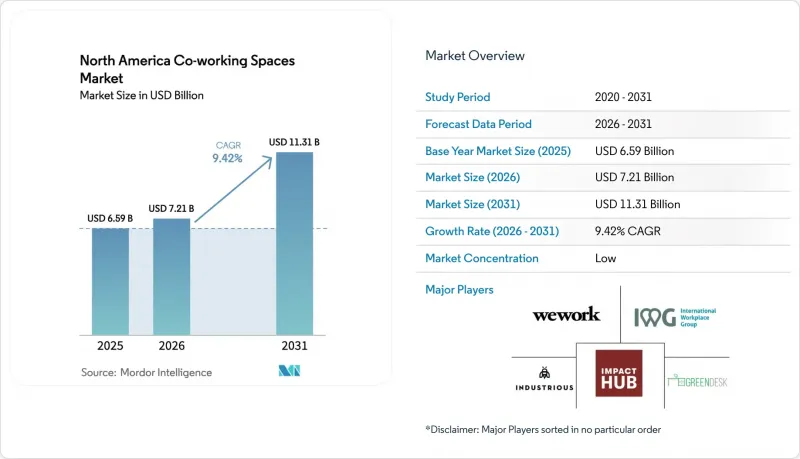
This report is Segmented by Size and Scale of Facility (Small, Medium, Large), by Sector (Information Technology (IT and ITES), BFSI, and More), by End Use (Freelancers, Enterprises, Startups, and Others), and by Geography (United States, Canada, Mexico). Market Forecasts are Provided in Terms of Value (USD).
North America Coworking Spaces Market Trends and Insights
Hybrid Work Normalization Pushing Enterprises and SMEs to Flexible, Short-Term Space
U.S. office badge data stabilized at roughly 60-70% of 2019 levels during 2025, prompting employers to hard-code two-to-three-day schedules and trim owned footprints while securing on-demand capacity through memberships. Fortune 500 firms increasingly embed co-working within portfolio playbooks, driving multi-location agreements that replace one-off leases. New business applications topped 535,000 in November 2025, keeping the pipeline of entrepreneurial customers strong. Government return-to-office directives ripple into private-sector norms and lift demand in Washington, D.C., and other capital-adjacent cities. The net effect is a durable reorientation toward variable real estate that can flex with head-count swings and project cycles.
Flight-to-Quality: Amenitized, Well-Located Hubs Outperform Legacy Offices
Class A downtown towers with wellness amenities, transit adjacency, and advanced digital infrastructure soak up a majority of new leasing, whereas aging Class B/C stock suffers widening vacancies. Operators able to secure premium space gain pricing power and enterprise credibility. Industrious's 240,000-square-foot deal at Tower 49 in mid-2024 typifies flight-to-quality reallocations, repurposing WeWork's former flagship into an enterprise-grade hub. WeWork's new "work-lounge" product, launched in July 2024, embeds co-working amenities for all tenants in a building, signaling an integrated rather than stand-alone future. Superior environments now set the competitive bar and push lagging landlords toward upgrade or demolition decisions.
Economic Uncertainty and Tech Downsizing Creating Churn and Occupancy Volatility
Layoffs exceeding 386,000 across the tech sector from 2023 to early 2025 shrank seat demand in core innovation hubs and pushed Silicon Valley vacancy to nearly 20%. Start-ups downgraded from private offices to hot desks, elevating churn and compressing average revenue per workstation. Venture funding skewed to late-stage rounds, drying seed-stage pipelines that once filled early co-working cohorts. Operators mitigated risk by leaning into multi-year enterprise deals and diversifying geographically. Nonetheless, near-term volatility remains a headwind for occupancy forecasts.
Other drivers and restraints analyzed in the detailed report include:
- Cost Optimization via Capex-Light Expansion versus Long Leases
- Rise of Distributed Teams and Sunbelt Nodes Boosting Secondary-Market Demand
- Higher Borrowing Costs and TI/Capex Needs Pressuring Operator Unit Economics
For complete list of drivers and restraints, kindly check the Table Of Contents.
Segment Analysis
Large facilities exceeding 50,000 square feet captured 32% of the North America Coworking Spaces Market in 2025, second only to the medium-scale cohort at 45.7%. They benefit from landlord co-investment, floor-to-ceiling amenity sets, and the capacity to dedicate entire floors to Fortune 500 tenants seeking privacy without long leases. The segment is set to deliver the fastest 10.33% CAGR through 2031, fueled by corporate "hub-and-spoke" models and the repositioning of towers from single-tenant to multi-tenant flex operations. The United States provides a deep bench of underutilized downtown high-rises ripe for conversion, while Mexico City landlords similarly retrofit obsolete stock into multi-floor coworking to meet near-shoring demand. Operators leverage economies of scale-concierge desks, cafe bars, podcast studios-to lift yield per square foot. Medium-scale sites will continue to anchor suburban and neighborhood nodes where demand is steadier, but transaction sizes are smaller.
Large hubs also enable providers to roll out technology platforms for access control, space analytics, and event management across a larger area, enhancing the user experience and data capture. CBRE's Industrious integration exemplifies this scale play: the USD 800 million deal folds large-format flex suites into a USD 20 billion global services engine. WeWork's re-entry strategy similarly focuses on 100,000-square-foot flagship sites in resilient metros. Over the forecast horizon, the segment's share is expected to edge toward 40% as smaller downtown floors convert or close, reaffirming the North America Coworking Spaces Market's gravitation to scale.
Complete Report Scope:
- By Size & Scale of Facility
- Small
- Medium
- Large
- By Sector
- Information Technology (IT & ITES)
- BFSI
- Business Consulting & Professional Service
- Other Services (Retail, Lifesciences, Energy, Legal)
- By End Use
- Freelancers
- Enterprises
- Start-ups & Others
- By Country
- United States
- Canada
- Mexico
List of Companies Covered in this Report:
- WeWork Inc.
- IWG plc (Regus, HQ, Spaces)
- Industrious LLC
- Impact Hub GmbH
- Green Desk
- Knotel Inc.
- Serendipity Labs Inc.
- Techspace Holding Co.
- Mix Pace
- District Cowork
- Office Evolution Franchising Inc.
- Venture X Franchising LLC
- Workbox Company LLC
- Workbar LLC
- Premier Workspaces LLC
- COhatch LLC
- Convene Inc.
- CommonGrounds Workplace LLC
- LiquidSpace Inc.
- Expansive Workspace LLC
Additional Benefits:
- The market estimate (ME) sheet in Excel format
- 3 months of analyst support
TABLE OF CONTENTS
1 Introduction
- 1.1 Study Assumptions & Market Definition
- 1.2 Scope of the Study
2 Research Methodology
3 Executive Summary
4 Market Landscape
- 4.1 Market Overview
- 4.2 Market Drivers
- 4.2.1 Hybrid work normalization pushing enterprises and SMEs to flexible, short-term space.
- 4.2.2 Flight-to-quality: amenitized, well-located hubs outperform legacy offices.
- 4.2.3 Cost optimization-capex-light expansion vs. traditional long leases and fit-outs.
- 4.2.4 Rise of distributed teams and suburban/sunbelt nodes boosting secondary-market demand.
- 4.2.5 Landlords partnering with operators to activate underused assets and offer flex suites.
- 4.3 Market Restraints
- 4.3.1 Economic uncertainty and tech downsizing creating churn and occupancy volatility.
- 4.3.2 Higher borrowing costs and TI/capex needs pressuring operator/unit economics.
- 4.3.3 Competitive supply and thin brand differentiation driving price pressure in core metros.
- 4.4 Value / Supply-Chain Analysis
- 4.5 Regulatory Landscape
- 4.6 Technological Outlook
- 4.7 Porter's Five Forces
- 4.7.1 Threat of New Entrants
- 4.7.2 Bargaining Power of Buyers
- 4.7.3 Bargaining Power of Suppliers
- 4.7.4 Threat of Substitutes
- 4.7.5 Intensity of Competitive Rivalry
5 Market Size & Growth Forecasts (Value, USD)
- 5.1 By Size & Scale of Facility
- 5.1.1 Small
- 5.1.2 Medium
- 5.1.3 Large
- 5.2 By Sector
- 5.2.1 Information Technology (IT & ITES)
- 5.2.2 BFSI
- 5.2.3 Business Consulting & Professional Service
- 5.2.4 Other Services (Retail, Lifesciences, Energy, Legal)
- 5.3 By End Use
- 5.3.1 Freelancers
- 5.3.2 Enterprises
- 5.3.3 Start-ups & Others
- 5.4 By Country
- 5.4.1 United States
- 5.4.2 Canada
- 5.4.3 Mexico
6 Competitive Landscape
- 6.1 Market Concentration
- 6.2 Strategic Moves
- 6.3 Market Share Analysis
- 6.4 Company Profiles (includes Global level Overview, Market level overview, Core Segments, Financials as available, Strategic Information, Products & Services, and Recent Developments)
- 6.4.1 WeWork Inc.
- 6.4.2 IWG plc (Regus, HQ, Spaces)
- 6.4.3 Industrious LLC
- 6.4.4 Impact Hub GmbH
- 6.4.5 Green Desk
- 6.4.6 Knotel Inc.
- 6.4.7 Serendipity Labs Inc.
- 6.4.8 Techspace Holding Co.
- 6.4.9 Mix Pace
- 6.4.10 District Cowork
- 6.4.11 Office Evolution Franchising Inc.
- 6.4.12 Venture X Franchising LLC
- 6.4.13 Workbox Company LLC
- 6.4.14 Workbar LLC
- 6.4.15 Premier Workspaces LLC
- 6.4.16 COhatch LLC
- 6.4.17 Convene Inc.
- 6.4.18 CommonGrounds Workplace LLC
- 6.4.19 LiquidSpace Inc.
- 6.4.20 Expansive Workspace LLC
7 Market Opportunities & Future Outlook
- 7.1 White-space & Unmet-need Assessment

