PUBLISHER: Mordor Intelligence | PRODUCT CODE: 2097401

PUBLISHER: Mordor Intelligence | PRODUCT CODE: 2097401
South America Coworking Office Spaces - Market Share Analysis, Industry Trends & Statistics, Growth Forecasts (2026 - 2031)
According to Mordor Intelligence, South America coworking office spaces market size was valued at USD 1.10 billion in 2025 and is estimated to grow from USD 1.25 billion in 2026 to USD 2.25 billion by 2031, at a CAGR of 12% during the forecast period (2026-2031).
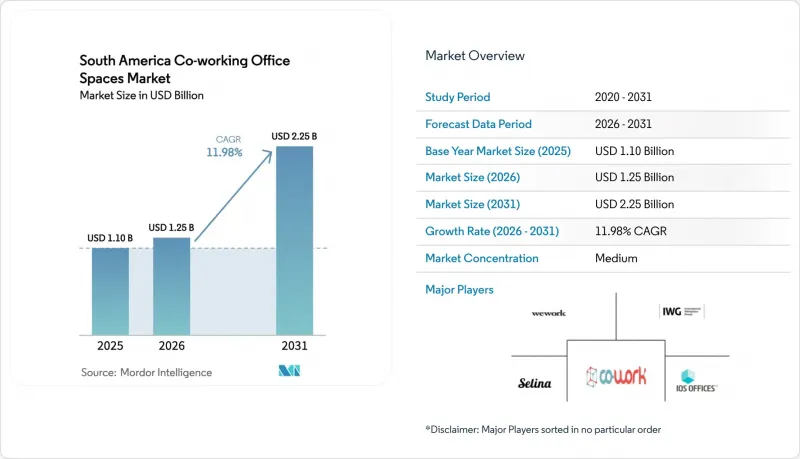
This report is Segmented by Size & Scale of Facility (Small, Medium, and Large), by Sector (IT and ITES, BFSI, Business Consulting & Professional Service, and Other Services), by End Use (Freelancers, Enterprises, Start Ups, and Others), by Country (Brazil, Argentina, Chile, Colombia, Peru and Rest of South America). The Market Forecasts are Provided in Terms of Value (USD).
South America Coworking Office Spaces Market Trends and Insights
Rapid Growth of Start-ups and SMEs in Brazil
Brazil's technology scene generated more than 1.7 million IT and BPO positions by 2025, creating a steady pipeline of small teams that prefer pay-as-you-go desks to multi-year leases. SEBRAE subsidies and municipal incubators have nudged informal ventures toward formal space equipped with business services. Early-stage funding has contracted, yet the share flowing to Florianopolis, Belo Horizonte, and other secondary hubs has risen, forcing operators to seed locations outside Sao Paulo's core. Residential developers are now pre-leasing common areas as co-working zones, ensuring residents have professional offices within walking distance. Together, these forces expand the South American co-working office space market by absorbing latent suburban demand while stabilizing operator revenue during Brazil's volatile credit cycle.
Hybrid Work Models Boosting Demand for Flexible Short-term Leases
Global attendance norms have settled around 4 days a week, giving occupiers clarity to right-size headquarters and outsource overflow to flexible centers. Sao Paulo posted 250,000 m2 of leasing in 2024, the highest since 2019, led by tech and services tenants. Enterprises are splitting portfolios: core teams stay in owned towers, while agile squads rotate through co-working memberships that can be tweaked quarterly. IWG captured this shift by signing 899 mostly suburban centers in 2024 under franchise deals that avoid lease liabilities. Operators that package reserved desks, on-demand rooms, and digital mail handling are now harvesting multi-threaded revenue streams from the same client, fortifying the South America Coworking Office Spaces Market against economic swings.
High Competition and Oversupply Risk in Sao Paulo CBDs
Vacancy rates reached 48.16% in Chacara Santo Antonio and 43.64% in Itaim during Q4 2024, prompting landlords to offer rent-free months and improvement allowances. WeWork's September 2024 evictions highlighted how overstretching into soft districts erodes margins when dues cannot keep pace with lease obligations. With 250,000 m2 of fresh stock arriving in 2025, pressure on weak nodes will persist. Operators must avoid the siren song of low headline rents in distressed corridors and instead pivot to high-occupancy zones such as Faria Lima, where asking rents average BRL 283.85/m2 (USD 56.8) per month and vacancy is only 10.4%. Disciplined site selection shields the broader South America Coworking Office Spaces Market from destabilizing price wars in Brazil's largest city.
Other drivers and restraints analyzed in the detailed report include:
- Investor-Developer Partnerships Expanding Grade-A Supply in Tier-1 Metros
- Government-funded Creative-economy Districts Catalyzing Boutique Hubs in Chile and Colombia
- Limited Penetration in Secondary and Interior Cities Despite Latent Demand
For complete list of drivers and restraints, kindly check the Table Of Contents.
Segment Analysis
The medium category captured 46% of the South America Coworking Office Spaces Market share in 2025, reflecting its sweet spot for 20- to 100-person teams. Large formats, however, are projected to log a 12.7% CAGR between 2026 and 2031, the quickest of any size class. In practice, corporations now outsource entire floors as managed campuses, bundling reception, IT, cleaning, and security into a predictable monthly invoice. IWG's capital-light signings and Selina's Remote Year acquisition illustrate how franchising and hospitality hybrids can stretch this model across suburban belts. Operators that tier portfolios-micro hubs for freelancers, mid-size suites for scale-ups, and campus floors for corporates-keep customers within the South American co-working office space ecosystem as it matures.
Large facilities generally exceed 5,000 m2 and combine private suites with communal cafes and event terraces. During 2024-2025, new deliveries such as JK Square offered co-working tenants early-move-in incentives, effectively subsidizing fit-outs while towers leased up. Medium centers, often 2,000-5,000 m2, remain the workhorse, balancing cost and amenity depth. Small hubs under 2,000 m2 proliferate in 15-minute-city districts, converting retail shells into 10- to 30-desk lofts that capture local freelancers. This tiered spectrum underpins the enduring breadth of the South American coworking office space market.
Complete Report Scope:
- By Size & Scale of Facility
- Small
- Medium
- Large
- By Sector
- Information Technology & ITES
- BFSI (Banking, Financial Services and Insurance)
- Business Consulting & Professional Services
- Other Services (Retail, Life-sciences, Energy, Legal, etc.)
- By End Use
- Freelancers / Individuals
- Enterprises
- Start-ups & Others
- By Country
- Brazil
- Argentina
- Chile
- Colombia
- Peru
- Rest of South America
List of Companies Covered in this Report:
- WeWork Inc.
- IWG plc (Regus, Spaces)
- Selina Hospitality
- Co-Work LatAm
- IOS OFFICES
- Urban Station
- AreaTres
- UOffice
- Impact Hub
- Krismar Business Center
- Co-Work Bogota
- Work&Go
- Nube Coworking
- Punktla
- Distrito Ofice
- MyOffice Chile
- Spaces Argentina
- Selina Co-work
- The Executive Centre (LatAm)
- Cowork Peru
Additional Benefits:
- The market estimate (ME) sheet in Excel format
- 3 months of analyst support
TABLE OF CONTENTS
1 Introduction
- 1.1 Study Assumptions & Market Definition
- 1.2 Scope of the Study
2 Research Methodology
3 Executive Summary
4 Market Landscape
- 4.1 Market Overview
- 4.2 Market Drivers
- 4.2.1 Rapid growth of start-ups & SMEs in Brazil (mainstream)
- 4.2.2 Hybrid work models boosting demand for flexible short-term leases (mainstream)
- 4.2.3 Investor-developer partnerships expanding Grade-A supply in tier-1 metros (mainstream)
- 4.2.4 Government-funded creative-economy districts catalysing boutique hubs in Chile & Colombia (under-radar)
- 4.2.5 "15-minute-city" zoning pilots driving neighbourhood micro-hubs (under-radar)
- 4.3 Market Restraints
- 4.3.1 High competition & oversupply risk in Sao Paulo CBDs (mainstream)
- 4.3.2 Limited penetration in secondary & interior cities despite latent demand (mainstream)
- 4.3.3 Complex title-registration & zoning compliance delaying expansion (under-radar)
- 4.3.4 Urban-security & insurance cost spikes increasing fit-out cap-ex (under-radar)
- 4.4 Value / Supply-Chain Analysis
- 4.4.1 Overview
- 4.4.2 Real-Estate Developers & Asset Owners - Key Insights
- 4.4.3 Workspace Design & Technology Consultants - Key Insights
- 4.4.4 Modular Furniture & Smart-office Solution Providers - Key Insights
- 4.5 Government Regulations & Initiatives
- 4.6 Technological Innovations
- 4.7 Key Office-real-estate Metrics (Supply, Rents, Prices, Occupancy/Vacancy %)
- 4.8 Impact of Remote Working on Space Demand
- 4.9 Porter's Five Forces
- 4.9.1 Bargaining Power of Suppliers
- 4.9.2 Bargaining Power of Buyers
- 4.9.3 Threat of New Entrants
- 4.9.4 Threat of Substitutes
- 4.9.5 Intensity of Competitive Rivalry
5 Market Size & Growth Forecasts (Value, USD Million)
- 5.1 By Size & Scale of Facility
- 5.1.1 Small
- 5.1.2 Medium
- 5.1.3 Large
- 5.2 By Sector
- 5.2.1 Information Technology & ITES
- 5.2.2 BFSI (Banking, Financial Services and Insurance)
- 5.2.3 Business Consulting & Professional Services
- 5.2.4 Other Services (Retail, Life-sciences, Energy, Legal, etc.)
- 5.3 By End Use
- 5.3.1 Freelancers / Individuals
- 5.3.2 Enterprises
- 5.3.3 Start-ups & Others
- 5.4 By Country
- 5.4.1 Brazil
- 5.4.2 Argentina
- 5.4.3 Chile
- 5.4.4 Colombia
- 5.4.5 Peru
- 5.4.6 Rest of South America
6 Competitive Landscape
- 6.1 Market Concentration
- 6.2 Strategic Moves
- 6.3 Company Profiles (includes Global level Overview, Market level overview, Core Segments, Financials as available, Strategic Information, Market Rank/Share for key companies, Products & Services, and Recent Developments)
- 6.3.1 WeWork Inc.
- 6.3.2 IWG plc (Regus, Spaces)
- 6.3.3 Selina Hospitality
- 6.3.4 Co-Work LatAm
- 6.3.5 IOS OFFICES
- 6.3.6 Urban Station
- 6.3.7 AreaTres
- 6.3.8 UOffice
- 6.3.9 Impact Hub
- 6.3.10 Krismar Business Center
- 6.3.11 Co-Work Bogota
- 6.3.12 Work&Go
- 6.3.13 Nube Coworking
- 6.3.14 Punktla
- 6.3.15 Distrito Ofice
- 6.3.16 MyOffice Chile
- 6.3.17 Spaces Argentina
- 6.3.18 Selina Co-work
- 6.3.19 The Executive Centre (LatAm)
- 6.3.20 Cowork Peru
7 Market Opportunities & Future Outlook
- 7.1 White-space & Unmet-need Assessment
- 7.2 Decentralised neighbourhood micro-hubs & hybrid subscriptions

