PUBLISHER: Mordor Intelligence | PRODUCT CODE: 2100674

PUBLISHER: Mordor Intelligence | PRODUCT CODE: 2100674
India Coworking Office Spaces - Market Share Analysis, Industry Trends & Statistics, Growth Forecasts (2026 - 2031)
According to Mordor Intelligence, India co-working office space market size in 2026 is estimated at USD 4.53 billion, growing from 2025 value of USD 3.98 billion with 2031 projections showing USD 8.7 billion, growing at 13.94% CAGR over 2026-2031.
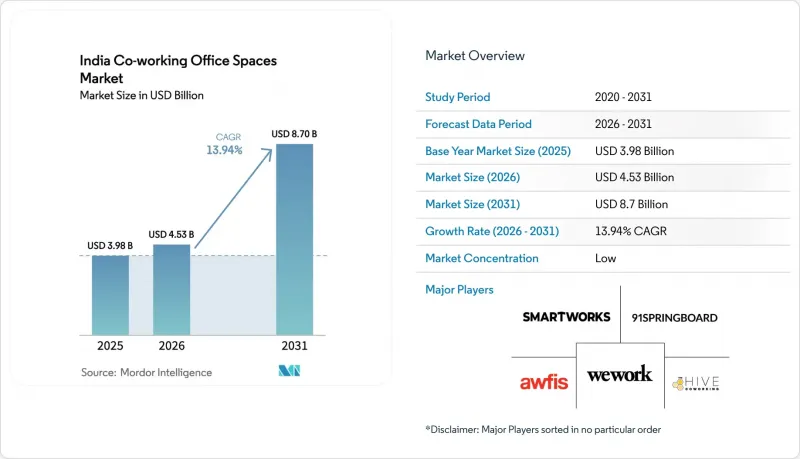
This report is Segmented by Size & Scale of Facility (Small, Medium, and Large), by Sector (IT and ITES, BFSI, Business Consulting & Professional Service, and Other Services), by End Use (Freelancers, Enterprises, Start Ups, and Others), by City (Mumbai, Delhi NCR, Pune, Bengaluru, Hyderabad, Chennai, Kolkata, Ahmedabad and Rest of India). The Market Forecasts are Provided in Terms of Value (USD).
India Coworking Office Spaces Market Trends and Insights
Rapid growth of start-ups and SMEs is driving demand for cost-effective co-working spaces
India is expected to host more than 200,000 start-ups by 2030, a 2.6-fold jump on current numbers, and roughly half of today's 115,000 registered start-ups sit in tier-2 and tier-3 cities. These young firms favor co-working to avoid deposits that can top INR 500,000 for conventional offices, given flex seats cost INR 3,000-8,000 per month. Government programs such as the Startup India Seed Fund (INR 945 crore) are funneling founders toward incubators that operate from shared workspaces. Commercial rents have risen 30-50% in major cities since mid-2023, further tilting SMEs toward flexible solutions. As the traditional office cost curve steepens faster than co-working tariffs, the India co-working office space market continues to widen its customer base organically.
Strong adoption by IT, e-commerce, and professional services firms in Bengaluru, Hyderabad, and Gurugram
Enterprise co-working transactions booked 103,665 seats in FY23, with IT-BPM accounting for 40% of deals and achieving 20% year-on-year growth. Bengaluru, Hyderabad, and Pune together form 78% of enterprise leases, sustaining a five-year 41% CAGR in flex demand. Traditional sectors such as airlines and cement have joined the trend, underscoring its breadth. About 20% of Indian job listings now specify hybrid formats, prompting professional-services firms to situate teams close to clients via co-working hubs. The India co-working office space market, therefore, benefits from a steady pipeline of large-seat requirements anchored by technology and consulting tenants.
High competition and oversupply risk in top metros are leading to pricing pressures
With more than 500 operators crowding metros, price tension is acute. Mumbai rents have climbed 27% since FY20, yet occupancy pressure forces discounting. Bengaluru's vacancy is scarce, but newcomers erode pricing power even as operating costs inflate 30-50% year-on-year. Smaller firms lacking scale risk margin compression, prompting consolidation waves and selective exits. The oversupply overhang is likely to restrain near-term uplift in the India co-working office space market.
Other drivers and restraints analyzed in the detailed report include:
- Hybrid work models are increasing the preference for flexible and short-term leasing options
- Investor and developer partnerships are expanding Grade A co-working supply in metro cities
- Limited penetration in tier-2 and tier-3 cities despite rising demand potential
For complete list of drivers and restraints, kindly check the Table Of Contents.
Segment Analysis
Large facilities accounted for 52.65% of 2025 revenue, reflecting enterprise appetite for single-location campuses that deliver dedicated meeting suites and advanced tech services. Operators monetize at scale through higher seat density and ancillary services, keeping utilization above 85% despite price competition. Meanwhile, medium facilities are growing fastest at a 14.62% CAGR through 2031 as mid-market firms and project teams want professional amenities without premium metro rents. This cohort often signs 12- to 24-month commitments that improve operators' cash-flow visibility.
Smaller centers remain relevant for freelancers and early-stage start-ups but face higher per-seat costs and limited service breadth. Technology investment also tilts toward larger footprints; IoT sensors, touch-free entry, and usage analytics are standard in campus-scale assets, whereas many small hubs still rely on manual processes. As enterprise contracts concentrate volume with top providers, the India co-working office space market is expected to witness further consolidation, favoring operators capable of multi-city, large-format delivery.
Complete Report Scope:
- By Size & Scale of Facility
- Small
- Medium
- Large
- By Sector
- Information Technology (IT and ITES)
- BFSI (Banking, Financial Services and Insurance)
- Business Consulting & Professional Service
- Other Services (Retail, Lifesciences, Energy, Legal Services)
- By End Use
- Freelancers
- Enterprises
- Start Ups and Others
- By City
- Mumbai Metropolitan Region
- Delhi NCR
- Pune
- Bengaluru
- Hyderabad
- Chennai
- Kolkata
- Ahmedabad
- Rest of India
List of Companies Covered in this Report:
- WeWork India
- Awfis
- Smartworks
- 91Springboard
- CoWrks
- BHIVE Workspaces
- The Office Pass
- 315Work Avenue
- Innov8
- IndiQube
- Skootr
- GoodWorks Coworking
- Spring House Coworking
- Urban Vault
- Workafella
- Regus India
- Incuspaze
- The Executive Centre
- The Hive*
Additional Benefits:
- The market estimate (ME) sheet in Excel format
- 3 months of analyst support
TABLE OF CONTENTS
1 Introduction
- 1.1 Study Assumptions & Market Definition
- 1.2 Scope of the Study
2 Research Methodology
3 Executive Summary
4 Market Landscape
- 4.1 Market Overview
- 4.2 Market Drivers
- 4.2.1 Rapid growth of start-ups and SMEs driving demand for cost-effective co-working spaces
- 4.2.2 Strong adoption by IT, e-commerce, and professional services firms in Bengaluru, Hyderabad, and Gurugram
- 4.2.3 Hybrid work models increasing preference for flexible and short-term leasing options
- 4.2.4 Investor and developer partnerships expanding Grade A co-working supply in metro cities
- 4.2.5 Rising demand for wellness-focused and sustainability-certified co-working facilities
- 4.3 Market Restraints
- 4.3.1 High competition and oversupply risk in top metros leading to pricing pressures
- 4.3.2 Limited penetration in tier-2 and tier-3 cities despite rising demand potential
- 4.3.3 Regulatory and compliance challenges in commercial real estate slowing expansion
- 4.4 Value / Supply-Chain Analysis
- 4.4.1 Overview
- 4.4.2 Real Estate Developers and Asset Owners - Key Quantitative and Qualitative Insights
- 4.4.3 Workspace Design and Technology Consultants - Key Quantitative and Qualitative Insights
- 4.4.4 Modular Furniture and Smart Office Solutions Providers - Key Quantitative and Qualitative Insights
- 4.5 Government Regulations and Initiatives in the Industry
- 4.6 Technological Innovations in the Co-Working Office Space Real Estate Market
- 4.7 Insights into the Key Office Real Estate Industry Metrics (Supply, Rentals, Prices, Occupancy/Vacancy (%))
- 4.8 Impact of Remote Working on Space Demand
- 4.9 Porters Five Forces
- 4.9.1 Bargaining Power of Suppliers
- 4.9.2 Bargaining Power of Buyers
- 4.9.3 Threat of New Entrants
- 4.9.4 Threat of Substitutes
- 4.9.5 Intensity of Competitive Rivalry
5 Market Size & Growth Forecasts (Value USD)
- 5.1 By Size & Scale of Facility
- 5.1.1 Small
- 5.1.2 Medium
- 5.1.3 Large
- 5.2 By Sector
- 5.2.1 Information Technology (IT and ITES)
- 5.2.2 BFSI (Banking, Financial Services and Insurance)
- 5.2.3 Business Consulting & Professional Service
- 5.2.4 Other Services (Retail, Lifesciences, Energy, Legal Services)
- 5.3 By End Use
- 5.3.1 Freelancers
- 5.3.2 Enterprises
- 5.3.3 Start Ups and Others
- 5.4 By City
- 5.4.1 Mumbai Metropolitan Region
- 5.4.2 Delhi NCR
- 5.4.3 Pune
- 5.4.4 Bengaluru
- 5.4.5 Hyderabad
- 5.4.6 Chennai
- 5.4.7 Kolkata
- 5.4.8 Ahmedabad
- 5.4.9 Rest of India
6 Competitive Landscape
- 6.1 Market Concentration
- 6.2 Strategic Moves
- 6.3 Company Profiles (includes Global level Overview, Market level overview, Core Segments, Financials as available, Strategic Information, Products & Services, and Recent Developments)
- 6.3.1 WeWork India
- 6.3.2 Awfis
- 6.3.3 Smartworks
- 6.3.4 91Springboard
- 6.3.5 CoWrks
- 6.3.6 BHIVE Workspaces
- 6.3.7 The Office Pass
- 6.3.8 315Work Avenue
- 6.3.9 Innov8
- 6.3.10 IndiQube
- 6.3.11 Skootr
- 6.3.12 GoodWorks Coworking
- 6.3.13 Spring House Coworking
- 6.3.14 Urban Vault
- 6.3.15 Workafella
- 6.3.16 Regus India
- 6.3.17 Incuspaze
- 6.3.18 The Executive Centre
- 6.3.19 The Hive*
7 Market Opportunities & Future Outlook

