PUBLISHER: Mordor Intelligence | PRODUCT CODE: 2116358

PUBLISHER: Mordor Intelligence | PRODUCT CODE: 2116358
United Kingdom Flexible Office Space - Market Share Analysis, Industry Trends & Statistics, Growth Forecasts (2026 - 2031)
According to Mordor Intelligence, the UK flexible office market size was valued at USD 3.84 billion in 2025 and estimated to grow from USD 4.19 billion in 2026 to reach USD 6.48 billion by 2031, at a CAGR of 9.15% during the forecast period (2026-2031).
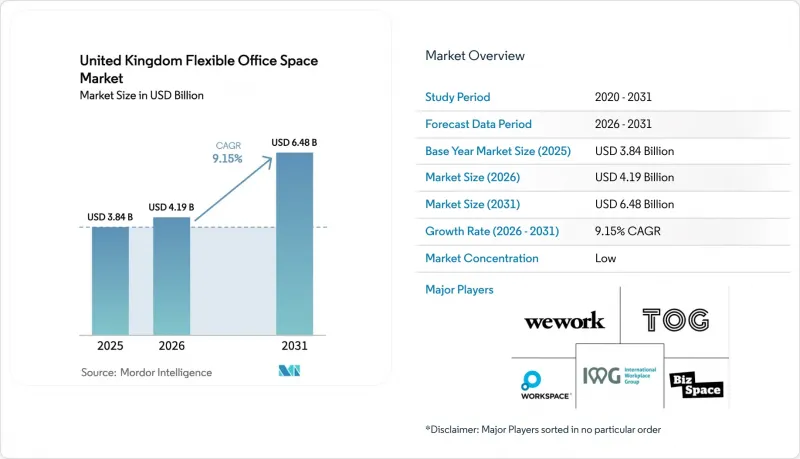
This report is Segmented by Type (Co-Working Space, Serviced Offices/Executive Suites and Others), by Sector (IT and ITES, BFSI, Business Consulting & Professional Service and Other Services), by End Use (Freelancers, Enterprises, Start Ups and Others), and by Country (England, Scotland, Wales and Northern Ireland). The Market Forecasts are Provided in Terms of Value (USD).
United Kingdom Flexible Office Space Market Trends and Insights
Strong Demand for Hybrid Work Solutions Across London and Regional Cities
The demand for hybrid work solutions continues to grow, driven by evolving workplace policies and employee preferences. What began as a temporary measure during the pandemic has now solidified into a permanent fixture. Following the April 2024 regulation allowing staff to request flexibility from day one, hybrid working has transitioned into a standard policy. In this evolving landscape, large employers find themselves navigating a divided market. While half of these employers still mandate full-time attendance, a notable 28% of workers have adopted a split-week approach. This shift has created a pressing demand for desks that can be adjusted on a daily basis. In response to this duality, corporations are strategically positioning satellite hubs in cities like Manchester and Birmingham. This move not only alleviates commuter stress but also serves as a countermeasure against the soaring rents in London. Operators are adeptly tapping into this demand, offering multisite access passes that seamlessly combine the allure of city-center prestige with the practicality of suburban convenience. Furthermore, a legal mandate now requires meaningful consultations before any rejection of flexible requests. This has significant implications: it integrates flexible office budgets into long-term profit and loss considerations, transforming what was once viewed as a discretionary expense into a pivotal strategic imperative.
High Adoption by Technology, Creative, and Professional Services Sectors
The increasing demand for flexible office spaces is reshaping how businesses operate across various sectors. Digital firms are increasingly opting for plug-and-play offices, enabling teams to swiftly initiate product sprints, onboard gig talent, and conduct client hackathons-all without the burden of capital expenditure. Major financial institutions, in a bid to attract top coding talent, are adopting a culture reminiscent of the tech industry. A testament to this shift is WeWork's expansive 286,000 square-foot hub in Canary Wharf, now a beacon of the banking, financial services, and insurance (BFSI) sector's embrace. For creative agencies and consultancies, flexible office spaces have evolved into pivotal tools for enhancing client experiences-serving as dynamic environments for ideation, prototyping, and showcasing results. This demand has prompted operators to incorporate specialized features like podcast studios, immersive demo rooms, and privacy booths that meet legal standards. Furthermore, the clustering of diverse industries in major urban centers not only boosts deal flow but also allows tenants to seamlessly transition from casual coffee discussions to formal contracts. This dynamic not only amplifies the advantages of networking but also ensures consistent occupancy for operators.
Oversupply Risk in Certain Central London Submarkets
The Central London office market is grappling with oversupply challenges, particularly in the City fringe. In 2024, the vacancy rate in this area increased to 9.2%, with older Grade B towers being the most affected as blue-chip companies transitioned to ESG-compliant properties. This oversupply has triggered price wars among operators, significantly eroding margins at a pace that license churn cannot counterbalance. Prominent lease-exit disputes, such as WeWork's Southbank litigation, highlight the risks of committing to 15-year headleases, especially as demand shifts towards the east or commuter towns. However, the anticipated reduction in new completions could help restore balance by 2027. Market participants who can endure the next two challenging years may have the opportunity to reprice their spaces at a premium once the oversupply diminishes.
Other drivers and restraints analyzed in the detailed report include:
- Investor Interest in Flexible Office Portfolios as a Resilient Asset Class
- Growing Demand for Sustainability-Certified and Wellness-Integrated Workspaces
- Rising Operational Costs for Flexible Office Operators Impacting Margins
For complete list of drivers and restraints, kindly check the Table Of Contents.
Segment Analysis
The co-working segment represented 50.85% of UK flexible office market share in 2025. Community programming, ranging from lunch-and-learns to investor pitch nights, keeps desk churn low and referral volume high. Operators blend hot-desk passes, dedicated desks, and private studios to smooth revenue across user tiers. Corporate demand surged after Fortune 500s shifted 15% of their UK headcount into flexible allowances, prompting providers to carve enterprise-grade, badge-controlled zones inside shared floors. Competitive differentiation now centers on proprietary app ecosystems that automate booking, billing, and access, which cuts staffing ratios to under one community manager per 300 members.
The Others segment (hybrid and virtual) will grow fastest at 10.35% CAGR through 2031 as distributed teams adopt "periodic presence" packages: bundles that include mailbox, quarterly off-site space, and pay-as-you-go meeting credits. Virtual addresses satisfy post-Brexit regulatory rules for overseas companies setting up in the UK while letting them test market entry with near-zero overhead. Larger providers leverage their footprint to upsell virtual clients into physical desks once headcount scales, extending lifetime value. Hybrid passes also supply real-time usage data, helping corporates right-size fixed leases and raising switching costs should they leave the platform-extending the lead of scale players in the UK flexible office market.
Complete Report Scope:
- By Type
- Co-Working Space
- Serviced offices / Executive suites
- Others (Hybrid, Virtual Office)
- By Sector
- Information Technology (IT and ITES)
- BFSI (Banking, Financial Services and Insurance)
- Business Consulting & Professional Service
- Other Services (Retail, Lifesciences, Energy, Legal Services)
- By End Use
- Freelancers
- Enterprises
- Start Ups and Others
- By Country
- England
- Scotland
- Wales
- Northern Ireland
List of Companies Covered in this Report:
- International Workplace Group (IWG / Regus / Spaces)
- WeWork
- The Office Group
- Workspace Group
- BizSpace (Sirius Real Estate)
- Bruntwood Works
- Landmark Space
- Huckletree
- Fora
- TOG & Fora (Joint entity)
- Knotel UK
- Industrious (LXD UK)
- x+why
- Plexal
- Mindspace
- Labs
- Uncommon
- Runway East
- Oval Real Estate (Division)
- Orega
Additional Benefits:
- The market estimate (ME) sheet in Excel format
- 3 months of analyst support
TABLE OF CONTENTS
1 Introduction
- 1.1 Study Assumptions & Market Definition
- 1.2 Scope of the Study
2 Research Methodology
3 Executive Summary
4 Market Landscape
- 4.1 Market Overview
- 4.2 Market Drivers
- 4.2.1 Strong demand for hybrid work solutions across London and regional cities
- 4.2.2 High adoption by technology, creative, and professional services sectors
- 4.2.3 Investor interest in flexible office portfolios as a resilient asset class
- 4.2.4 Growing demand for sustainability-certified and wellness-integrated workspaces
- 4.2.5 Expansion of global co-working brands alongside strong local operators
- 4.3 Market Restraints
- 4.3.1 Oversupply risk in certain central London submarkets
- 4.3.2 Uncertain macroeconomic conditions and Brexit-linked investment caution
- 4.3.3 Rising operational costs for flexible office operators impacting margins
- 4.4 Value / Supply-Chain Analysis
- 4.4.1 Overview
- 4.4.2 Real Estate Developers and Asset Owners - Key Quantitative and Qualitative Insights
- 4.4.3 Workspace Design and Technology Consultants - Key Quantitative and Qualitative Insights
- 4.4.4 Modular Furniture and Smart Office Solutions Providers - Key Quantitative and Qualitative Insights
- 4.5 Government Regulations and Initiatives in the Industry
- 4.6 Technological Innovations in the Flexible Office Real Estate Market
- 4.7 Insights into the Key Office Real Estate Industry Metrics (Supply, Rentals, Prices, Occupancy/Vacancy (%))
- 4.8 Impact of Remote Working on Space Demand
- 4.9 Porter's Five Forces
- 4.9.1 Bargaining Power of Suppliers
- 4.9.2 Bargaining Power of Buyers
- 4.9.3 Threat of New Entrants
- 4.9.4 Threat of Substitutes
- 4.9.5 Intensity of Competitive Rivalry
5 Market Size & Growth Forecasts (Value USD)
- 5.1 By Type
- 5.1.1 Co-Working Space
- 5.1.2 Serviced offices / Executive suites
- 5.1.3 Others (Hybrid, Virtual Office)
- 5.2 By Sector
- 5.2.1 Information Technology (IT and ITES)
- 5.2.2 BFSI (Banking, Financial Services and Insurance)
- 5.2.3 Business Consulting & Professional Service
- 5.2.4 Other Services (Retail, Lifesciences, Energy, Legal Services)
- 5.3 By End Use
- 5.3.1 Freelancers
- 5.3.2 Enterprises
- 5.3.3 Start Ups and Others
- 5.4 By Country
- 5.4.1 England
- 5.4.2 Scotland
- 5.4.3 Wales
- 5.4.4 Northern Ireland
6 Competitive Landscape
- 6.1 Market Concentration
- 6.2 Strategic Moves
- 6.3 Company Profiles {(includes Global level Overview, Market level overview, Core Segments, Financials as available, Strategic Information, Market Rank/Share for key companies, Products & Services, and Recent Developments)}
- 6.3.1 International Workplace Group (IWG / Regus / Spaces)
- 6.3.2 WeWork
- 6.3.3 The Office Group
- 6.3.4 Workspace Group
- 6.3.5 BizSpace (Sirius Real Estate)
- 6.3.6 Bruntwood Works
- 6.3.7 Landmark Space
- 6.3.8 Huckletree
- 6.3.9 Fora
- 6.3.10 TOG & Fora (Joint entity)
- 6.3.11 Knotel UK
- 6.3.12 Industrious (LXD UK)
- 6.3.13 x+why
- 6.3.14 Plexal
- 6.3.15 Mindspace
- 6.3.16 Labs
- 6.3.17 Uncommon
- 6.3.18 Runway East
- 6.3.19 Oval Real Estate (Division)
- 6.3.20 Orega
7 Market Opportunities & Future Outlook

