PUBLISHER: Mordor Intelligence | PRODUCT CODE: 2097239

PUBLISHER: Mordor Intelligence | PRODUCT CODE: 2097239
India Condominium and Apartment - Market Share Analysis, Industry Trends & Statistics, Growth Forecasts (2026 - 2031)
Sales transactions controlled 88.1% of the 2025 value, underscoring India's ownership bias and the tax benefits linked to mortgage interest deductions. Stable delivery records under RERA-compliant projects lifted consumer trust, enabling giants such as DLF to post USD 530 million in Q2 FY2025 sales from Privana South. Prestige and Lodha registered USD 667 million and USD 547 million, respectively, confirming depth in end-user demand. The rental arm of the India condominium and apartment market, though smaller, is gaining traction at an 8.12% CAGR.
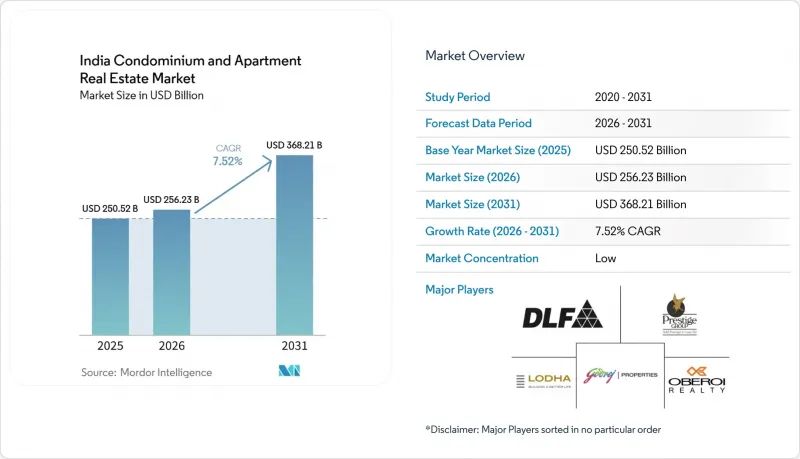
According to Mordor Intelligence, the India condominium and Apartment Market was valued at USD 250.52 billion in 2025 and is estimated to reach USD 256.23 billion in 2026. This report is Segmented by Business Model (Sales, Rental), by Price Band (Affordable, Mid-Market, Luxury), by Mode of Sale (Primary New-Build, Secondary Existing-Home Resale), and by City (Mumbai MMR, Delhi NCR, Pune, Bengaluru, Hyderabad, Chennai, Kolkata, Rest of India). The Market Forecasts are Provided in Terms of Value (USD).
India Condominium and Apartment Market Trends and Insights
Sustained GDP and Formal Job Creation Propelling Tier-1/2 Demand
Robust economic momentum sustains salaried employment in IT, finance, and manufacturing hubs, raising household purchasing power in key metros. Although the Reserve Bank trimmed policy rates in 2025, retail home-loan costs hover near 7.25-8.75%, steering entry-level buyers toward peripheral micro-markets. Premium launches benefit as high-income cohorts absorb rising ticket sizes, lifting the premium segment's share to 62% in January-September 2025. Demand strength translated into an 11-year high for sales across the top seven cities in H1 2024. The upshot is a stable end-user base supporting the India condominium and apartment market even as financing costs fluctuate.
Rapid Urbanization and Shrinking Household Size Favor Vertical Living
Nuclear families now form half of India's households, cutting average size to 4.44 members and amplifying appetite for compact, amenity-rich apartments. Mumbai registered 96,187 unit sales in 2024, the highest in 13 years, underscoring the vertical pivot where land scarcity is acute. Developers are responding with 1- and 2-bedroom configurations bundled with co-working areas, gyms, and rooftop gardens to replicate suburban comforts within city cores. Pune's 1-bedroom share fell as buyers upgraded to 2-bedroom units amid rising incomes. These shifts underpin a steady absorption base for the India condominium and apartment market.
Affordability Stress from Elevated Mortgage Rates
Retail borrowing costs remain near 7.25-8.75%, discouraging first-time buyers in prime sub-markets. Premium launches captured 62% of sales in early 2025, while the affordable tier fell to 18% of 2024 volumes, underscoring a bifurcated demand curve. Delhi NCR's 29% sales decline during January-September 2025 illustrates the squeeze when prices surge faster than incomes. Government subsidies under PMAY-Urban 2.0 aim to revive low-ticket demand, but delayed state-level implementation limits near-term relief. Consequently, affordability headwinds cap the upside for the India condominium and apartment market.
Other drivers and restraints analyzed in the detailed report include:
- Transit Corridors and Mixed-Use Townships Unlock Supply Pockets
- Regulatory Reforms and Stronger Governance
- Land Acquisition and Approval Bottlenecks
For complete list of drivers and restraints, kindly check the Table Of Contents.
Segment Analysis
Blackstone's build-to-rent joint ventures aim to capture mobile professionals in Bengaluru and Hyderabad, while co-living platforms validate the appetite for managed inventory.
A growing millennial workforce with average job tenures of 3-4 years values flexibility over ownership, feeding institutional interest in rental yields of 2.5-4% across major metros. Only 9% of property management today is tech-enabled, signaling a sizeable runway for PropTech adoption. As build-to-rent portfolios scale, rental receipts could form a steady annuity stream, diversifying revenue sources for large developers and enlarging the India condominium and apartment market.
Complete Report Scope:
- By Business Model
- Sales
- Rental
List of Companies Covered in this Report:
- DLF Ltd
- Prestige Estates Projects Ltd
- Godrej Properties Ltd
- Lodha (Macrotech Developers)
- Oberoi Realty Ltd
- Brigade Enterprises Ltd
- Sobha Ltd
- Puravankara Ltd
- Tata Housing Development Co
- Mahindra Lifespaces
- Indiabulls Real Estate Ltd
- NBCC India Ltd
- Phoenix Mills Ltd
- Sunteck Realty Ltd
- Kolte-Patil Developers
- L&T Realty
- Shriram Properties Ltd
- Emaar India
- Salarpuria Sattva Group
- Hiranandani Developers
- Ashiana Housing Ltd
Additional Benefits:
- The market estimate (ME) sheet in Excel format
- 3 months of analyst support
TABLE OF CONTENTS
1 Introduction
- 1.1 Study Assumptions & Market Definition
- 1.2 Scope of the Study
2 Research Methodology
3 Executive Summary
4 Market Insights and Dynamics
- 4.1 Market Overview
- 4.2 Market Drivers
- 4.2.1 Sustained GDP/income growth and formal job creation, boosting end-user demand in Tier-1/2 cities.
- 4.2.2 Rapid urbanization and shrinking household size are driving preference for strata apartments over plotted homes.
- 4.2.3 Transport/metro corridors and mixed-use townships unlocking new supply and price appreciation pockets.
- 4.2.4 Regulatory reforms (RERA, GST) and better governance are lifting buyer confidence and institutional participation.
- 4.2.5 Rising NRI and affluent domestic demand for amenitized, smart, and sustainable mid-to-premium condos.
- 4.3 Market Restraints
- 4.3.1 Affordability stress from high mortgage rates and elevated ticket sizes in prime submarkets.
- 4.3.2 Land acquisition complexity, approvals bottlenecks, and infra tie-ins elongating project timelines.
- 4.3.3 Construction cost inflation and contractor solvency issues pressuring delivery schedules and margins.
- 4.4 Residential Real Estate Buying Trends - Socio-economic & Demographic Insights
- 4.5 Rental Yield Analysis
- 4.6 Regulatory Outlook
- 4.7 Technological Outlook
- 4.8 Insights Into Affordable Housing Support Provided by Government and Public-private Partnerships
- 4.9 Insights into Existing and Upcoming Projects
- 4.10 Porter's Five Forces
- 4.10.1 Bargaining Power of Suppliers
- 4.10.2 Bargaining Power of Buyers
- 4.10.3 Threat of New Entrants
- 4.10.4 Threat of Substitutes
- 4.10.5 Intensity of Competitive Rivalry
5 India Condominium and Apartment Market Size & Growth Forecasts (Value USD billion)
- 5.1 By Business Model
- 5.1.1 Sales
- 5.1.2 Rental
6 India Condominium and Apartment Market (Sales Model) Size & Growth Forecasts (Value USD billion)
- 6.1 By Price Band
- 6.1.1 Affordable
- 6.1.2 Mid-Market
- 6.1.3 Luxury
- 6.2 By Mode of Sale
- 6.2.1 Primary (New-Build)
- 6.2.2 Secondary (Existing-Home Resale)
- 6.3 By City
- 6.3.1 Mumbai Metropolitan Region
- 6.3.2 Delhi NCR
- 6.3.3 Pune
- 6.3.4 Bengaluru
- 6.3.5 Hyderabad
- 6.3.6 Chennai
- 6.3.7 Kolkata
- 6.3.8 Rest of India
7 Competitive Landscape
- 7.1 Market Concentration
- 7.2 Strategic Moves
- 7.3 Market Share Analysis
- 7.4 Company Profiles (includes Global level Overview, Market level overview, Core Segments, Financials as available, Strategic Information, Products & Services, Recent Developments)
- 7.4.1 DLF Ltd
- 7.4.2 Prestige Estates Projects Ltd
- 7.4.3 Godrej Properties Ltd
- 7.4.4 Lodha (Macrotech Developers)
- 7.4.5 Oberoi Realty Ltd
- 7.4.6 Brigade Enterprises Ltd
- 7.4.7 Sobha Ltd
- 7.4.8 Puravankara Ltd
- 7.4.9 Tata Housing Development Co
- 7.4.10 Mahindra Lifespaces
- 7.4.11 Indiabulls Real Estate Ltd
- 7.4.12 NBCC India Ltd
- 7.4.13 Phoenix Mills Ltd
- 7.4.14 Sunteck Realty Ltd
- 7.4.15 Kolte-Patil Developers
- 7.4.16 L&T Realty
- 7.4.17 Shriram Properties Ltd
- 7.4.18 Emaar India
- 7.4.19 Salarpuria Sattva Group
- 7.4.20 Hiranandani Developers
- 7.4.21 Ashiana Housing Ltd
8 Market Opportunities & Future Outlook
- 8.1 White-Space & Unmet-Need Assessment

