PUBLISHER: Mordor Intelligence | PRODUCT CODE: 2117264

PUBLISHER: Mordor Intelligence | PRODUCT CODE: 2117264
United States Manufactured Homes - Market Share Analysis, Industry Trends & Statistics, Growth Forecasts (2026 - 2031)
According to Mordor Intelligence, the United States manufactured homes market size is expected to grow from USD 13.74 billion in 2025 to USD 14.6 billion in 2026 and is forecast to reach USD 19.8 billion by 2031 at 6.28% CAGR over 2026-2031.
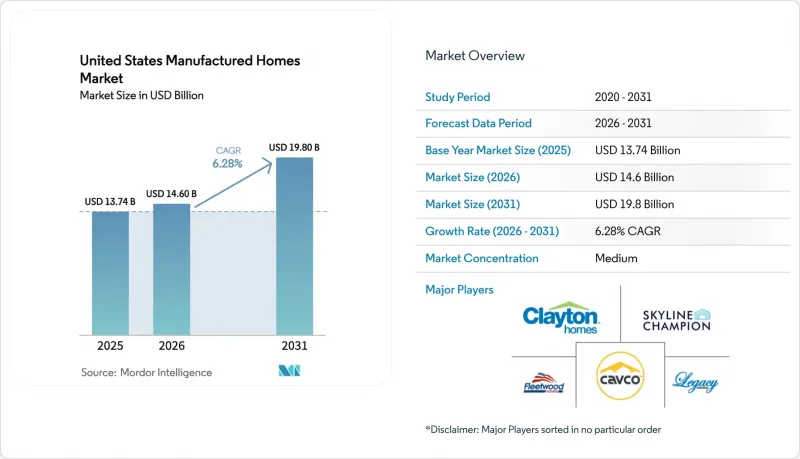
This report is Segmented by Structure Type (Single-Section Homes, Multi-Section Homes and Other Types), by Application (Single Family and Multi Family), by Material (Timber, Metal, Concrete and Others), and by States (Texas, California, Florida, New York, Illinois and Rest of US). The Market Forecasts are Provided in Terms of Value (USD).
United States Manufactured Homes Market Trends and Insights
Steady increase in annual unit shipments driven by growing demand for affordable housing alternatives
The US manufactured homes market is witnessing steady growth, driven by increasing demand for affordable housing alternatives. In April 2025, monthly shipments averaged 108,000 units, showcasing consistent activity even as traditional housing starts declined. A significant portion of buyers now comes from households priced out of conventional construction. In 2024, Legacy Housing sold 2,471 home sections, each starting at approximately USD 33,000. Retailers in Texas reported a 4.7% month-over-month increase in deliveries, highlighting the South's critical role in this market. Research from Freddie Mac indicates that 60% of consumers, including 68% of Millennials and 62% of Gen X, are open to considering manufactured homes. This sustained shipment momentum positions the sector as a key solution to the nation's affordability challenges.
Manufactured homes' share of total U.S. home sales expanding as pricing gaps widen versus site-built homes
Manufactured homes are gaining traction in the U.S. housing market as affordability challenges persist. Buyers of factory-built homes are saving between USD 50,000 and 100,000 compared to their site-built counterparts. This price gap is widening, driven by inflationary pressures on labor and materials faced by traditional builders. In Q2 2025, Champion Homes announced an average selling price of USD 92,400, marking a 4.5% annual uptick, yet still trailing behind site-built prices. Between 2017 and 2021, "Duty to Serve" programs spurred a 141% surge in loan acquisitions for real-property manufactured homes, indicating a growing liquidity in the secondary market. In 2023, the sector shipped 89,200 homes, accounting for roughly 4% of the nation's housing production. This share is on the rise, especially as CrossMod designs align with single-family zoning regulations. The increasing market share highlights the evolution of the U.S. manufactured homes market, transitioning from a counter-cyclical niche to a central player in the housing arena.
Limited mortgage access and higher financing costs due to non-traditional lending frameworks
Access to affordable financing remains a critical challenge for the U.S. manufactured homes market. Chattel loans for manufactured units often carry rates 150-200 basis points higher than conventional mortgages, diminishing monthly savings and dampening demand for upgrades. While FHA revised Title I caps in late 2024, the personal property classification still bars many borrowers from accessing 30-year fixed-rate products. Fannie Mae's annual target for MHRP acquisitions stands at a mere 7,400, overshadowed by the over 100,000 units shipped each year. Although USDA's January 2025 rule expands Section 502 eligibility, its delayed rollout to May 2025 hampers the relief effort. Without a broader appetite in the secondary market, financing challenges are likely to stifle the growth potential of the U.S. manufactured homes market.
Other drivers and restraints analyzed in the detailed report include:
- Rising median price per unit reflecting greater consumer acceptance and improved quality standards
- Increased adoption due to faster construction timelines and cost-effective land use in suburban regions
- Regulatory zoning barriers in multiple states limiting community expansion and placement approvals
For complete list of drivers and restraints, kindly check the Table Of Contents.
Segment Analysis
Multi-section homes secured 54.65% of 2025 revenue, underscoring consumer preference for larger footprints that rival site-built floor plans. The US manufactured homes market size for single-section units is expected to climb fastest at a 6.85% CAGR as first-time buyers and urban infill developers leverage compact designs. Clayton's CrossMod series blurs lines between modular and HUD-code, enabling placement in single-family zones that once excluded factory-built stock. Champion operates 48 plants, posting a 31.3% jump in U.S. homes sold during Q2 2025 as demand spanned both structure types. Price spreads between single and multi-section models are shrinking as energy-efficiency and smart-home features become standardised. HUD's 2025 rule allows multi-unit configurations inside a single chassis, opening rental and multi-generational use cases and deepening structural diversity.
Multi-section units retain a premium perception because they offer open kitchens, higher ceilings, and optional garages that match suburban buyer expectations. However, factory upgrades such as drywall interiors and full-size porches are now filtering into single-section lines, broadening appeal without eroding affordability. In disaster-prone states, multi-section steel-framed variants provide wind ratings that exceed local codes, a selling point post-hurricane. As production scale expands, manufacturers are shortening custom-order cycles, making multi-section units deliverable in as little as 60 days, versus 120 days five years ago. These efficiencies anchor the long-term share leadership of multi-section homes while keeping the US manufactured homes market open to value-oriented single-section growth.
Complete Report Scope:
- By Structure Type
- Single-Section Homes
- Multi-Section Homes
- Other Types
- By Application
- Single Family
- Multi Family
- By Material
- Timber
- Metal
- Concrete
- Others
- By States
- Texas
- California
- Florida
- New York
- Illinois
- Rest of US
List of Companies Covered in this Report:
- Clayton Homes, Inc.
- Skyline Champion Corporation
- Cavco Industries, Inc.
- Legacy Housing Corporation
- Fleetwood Homes (Cavco)
- Palm Harbor Homes
- Deer Valley Homebuilders
- Sunshine Homes
- Adventure Homes
- TRU Homes (Clayton)
- Commodore Homes
- Fairmont Homes
- Champion Homes Retail
- Hamilton Homebuilders
- Platinum Homes
- Live Oak Homes
- Redman Homes
- Pleasant Valley Homes
- Plant Prefab
- Z-Modular
- Morton Buildings
Additional Benefits:
- The market estimate (ME) sheet in Excel format
- 3 months of analyst support
TABLE OF CONTENTS
1 Introduction
- 1.1 Study Assumptions & Market Definition
- 1.2 Scope of the Study
2 Research Methodology
3 Executive Summary
4 Market Insights and Dynamics
- 4.1 Market Overview
- 4.2 Market Drivers
- 4.2.1 Steady increase in annual unit shipments driven by growing demand for affordable housing alternatives.
- 4.2.2 Manufactured homes' share of total U.S. home sales expanding as pricing gaps widen versus site-built homes.
- 4.2.3 Rising median price per unit reflecting greater consumer acceptance and improved quality standards.
- 4.2.4 Increased adoption due to faster construction timelines and cost-effective land use in suburban regions.
- 4.2.5 Supportive federal policy adjustments enhancing code compliance and energy efficiency standards.
- 4.2.6 Affordability challenges in urban housing pushing low-to-mid income buyers toward factory-built options.
- 4.3 Market Restraints
- 4.3.1 Limited mortgage access and higher financing costs due to non-traditional lending frameworks.
- 4.3.2 Regulatory zoning barriers in multiple states limiting community expansion and placement approvals.
- 4.3.3 Lingering consumer perception issues tied to outdated views of quality and depreciation.
- 4.3.4 Competitive pressure from downsized site-built homes and modular housing formats gaining momentum.
- 4.4 Value / Supply-Chain Analysis
- 4.5 Regulatory Landscape
- 4.6 Technological Outlook
- 4.7 Pricing & Cost-Structure Analysis
- 4.8 Housing Shortage & Demographic Outlook
- 4.9 Porter's Five Forces
- 4.9.1 Bargaining Power of Suppliers
- 4.9.2 Bargaining Power of Buyers
- 4.9.3 Threat of New Entrants
- 4.9.4 Threat of Substitutes
- 4.9.5 Intensity of Competitive Rivalry
5 Market Size & Growth Forecasts (Value & Units)
- 5.1 By Structure Type
- 5.1.1 Single-Section Homes
- 5.1.2 Multi-Section Homes
- 5.1.3 Other Types
- 5.2 By Application
- 5.2.1 Single Family
- 5.2.2 Multi Family
- 5.3 By Material
- 5.3.1 Timber
- 5.3.2 Metal
- 5.3.3 Concrete
- 5.3.4 Others
- 5.4 By States
- 5.4.1 Texas
- 5.4.2 California
- 5.4.3 Florida
- 5.4.4 New York
- 5.4.5 Illinois
- 5.4.6 Rest of US
6 Competitive Landscape
- 6.1 Market Concentration
- 6.2 Strategic Moves
- 6.3 Market Share Analysis
- 6.4 Company Profiles {(includes Global level Overview, Market level overview, Core Segments, Financials as available, Strategic Information, Market Rank/Share for key companies, Products & Services, and Recent Developments)}
- 6.4.1 Clayton Homes, Inc.
- 6.4.2 Skyline Champion Corporation
- 6.4.3 Cavco Industries, Inc.
- 6.4.4 Legacy Housing Corporation
- 6.4.5 Fleetwood Homes (Cavco)
- 6.4.6 Palm Harbor Homes
- 6.4.7 Deer Valley Homebuilders
- 6.4.8 Sunshine Homes
- 6.4.9 Adventure Homes
- 6.4.10 TRU Homes (Clayton)
- 6.4.11 Commodore Homes
- 6.4.12 Fairmont Homes
- 6.4.13 Champion Homes Retail
- 6.4.14 Hamilton Homebuilders
- 6.4.15 Platinum Homes
- 6.4.16 Live Oak Homes
- 6.4.17 Redman Homes
- 6.4.18 Pleasant Valley Homes
- 6.4.19 Plant Prefab
- 6.4.20 Z-Modular
- 6.4.21 Morton Buildings
7 Market Opportunities & Future Outlook
- 7.1 White-space & Unmet-Need Assessment

