PUBLISHER: Mordor Intelligence | PRODUCT CODE: 2125595

PUBLISHER: Mordor Intelligence | PRODUCT CODE: 2125595
UK Residential Construction - Market Share Analysis, Industry Trends & Statistics, Growth Forecasts (2026 - 2031)
According to Mordor Intelligence, the United Kingdom residential construction market size is expected to grow from USD 119.69 billion in 2025 to USD 123.43 billion in 2026 and is forecast to reach USD 143.86 billion by 2031 at 3.12% CAGR over 2026-2031.
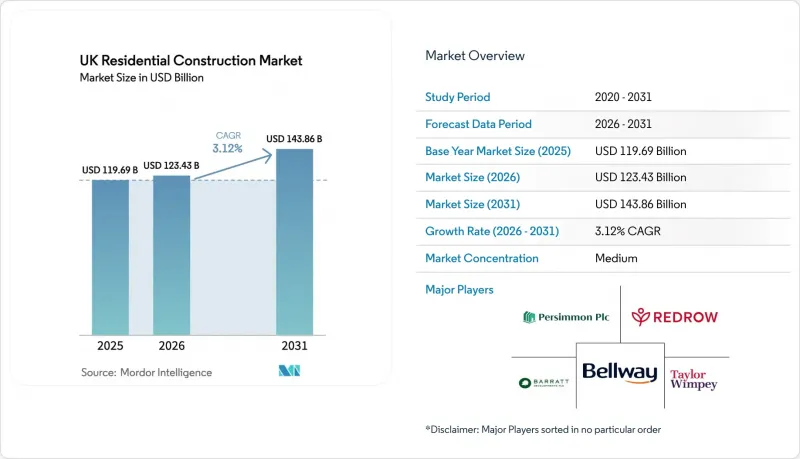
This report is Segmented by Type (Apartments & Condominiums, Landed Houses & Villas, and Other Types), by Construction Type (New Construction and Renovation), by Construction Method (Conventional On-Site, Modern Methods of Construction), by Investment Source (Public, Private), and by Geography (London, Birmingham, and More). The Market Forecasts are Provided in Terms of Value (USD).
UK Residential Construction Market Trends and Insights
Government Housing-Delivery Targets & Help-to-Buy Revival
Parliament has imposed mandatory annual planning targets of 371,000 homes, a 22% uplift over the prior guideline, forcing local authorities to align zoning decisions with national affordability metrics. A USD 3.75 billion support package announced in November 2024 doubles the ENABLE Build guarantee pool to USD 2.5 billion, specifically unlocking credit for small and medium-sized builders and specialist rental developers. Early assessments suggest the measures could catalyze more than 20,000 additional starts by 2027, though progress hinges on capacity within planning departments and the speed of digital permit processing. The revival of Help-to-Buy-style shared-equity instruments is also amplifying first-time buyer demand in regional cities, underpinning transaction pipelines for private developers. Collectively, these interventions underpin the forward book for the United Kingdom residential construction market.
Institutional Build-to-Rent Investment Wave
Completed build-to-rent stock now exceeds 100,000 units, representing roughly 2% of the private rental pool and attracting long-duration capital from pension funds seeking inflation-linked returns. Forward-funding deals are concentrating in London and Manchester corridors, where population density supports professional property management economics. Planned Renters' Rights legislation that raises minimum quality standards is expected to drive further consolidation toward institutional landlords able to absorb compliance costs. The strategic pivot from buy-to-let to purpose-built rental is broadening revenue resilience for contractors focused on multi-family delivery, thereby reinforcing multi-year volume commitments within the United Kingdom residential construction market.
Escalating Construction-Material Inflation
Timber, steel, and aggregates experienced cumulative price jumps above 70% between 2021-2023, widening tender spreads and prompting a wave of contractor insolvencies. Although headline indices moderated in early 2025, forward contracts still price in a 17% rise through 2028, compressing developer margins for marginal projects. Smaller builders, often operating on thin working-capital cushions, remain most exposed, leading to selective land-bank releases and deferment of optional schemes. This cost volatility undermines near-term volume targets for the United Kingdom residential construction market and incentivizes rapid adoption of price-stable modular components.
Other drivers and restraints analyzed in the detailed report include:
- Adoption of Modern Methods of Construction & Modular
- Net-Zero-2050 Mandate Spurring Low-Carbon Housing Solutions
- Grid-Connection Backlogs for All-Electric Schemes
For complete list of drivers and restraints, kindly check the Table Of Contents.
Segment Analysis
The apartment and condominium segment is forecast to post a 5.12% CAGR, outpacing villas and landed houses, even though detached formats held 64.32% of the United Kingdom residential construction market share in 2025. Institutional build-to-rent capital, regulatory incentives for higher-density zoning, and lifestyle shifts among younger cohorts all propel multi-family uptake in core employment nodes. Higher-rise products also align with municipal sustainability agendas as denser footprints lower per-capita emissions and infrastructure costs. Conversely, suburban villas preserve dominance in out-of-city sub-markets, leveraging remote work patterns and preferences for private outdoor space. Planning reforms that reduce parking minima and favor brownfield conversion continue to tilt incremental supply toward apartments, ensuring a structural rebalancing within the United Kingdom residential construction market.
Complying with post-Grenfell safety standards has raised per-square-foot costs, but developers increasingly mitigate expense through pre-manufactured facade panels and digital quality-control protocols. The segment benefits from transparent rental yield benchmarks, encouraging pension-fund entry and lifting forward-purchase pipelines to record levels. Villas remain the choice for high-net-worth buyers and for locations where land supply outweighs density imperatives, yet even these projects adopt semi-off-site components to control cost. Hybrid construction styles, therefore, sustain both volume segments, reinforcing diversified revenue streams across the United Kingdom residential construction market.
New-build activity retained 76.55% of the United Kingdom residential construction market size in 2025, yet renovations are set to deliver a 3.92% CAGR as fiscal and sustainability policies reward adaptive reuse. The USD 112.5 million Blackpool regeneration and the USD 25 million Selby Centre retrofit underscore public-funding leverage in transforming vacant commercial assets into mixed-income housing. Renovation projects enjoy expedited approvals and usually sidestep the biodiversity-net-gain metrics required for greenfield schemes, enabling faster realization of capital commitments. Furthermore, embodied-carbon considerations reveal up to 75% savings versus demolition plus rebuild, offering compliance advantages ahead of the 2028 carbon-budget tightening.
Nonetheless, structural unpredictability in historic assets can inflate contingency budgets, and the Future Homes Standard will oblige deep energy upgrades from 2025 onward. To offset risk, developers deploy ground-penetrating lidar surveys and digital twins that model load-path upgrades before procurement. Financial institutions now price renovation loan covenants on verified carbon metrics, tilting the cost of capital toward retrofit outcomes. This ecosystem shift should gradually raise renovation's contribution to volume, but will not dislodge new construction as the anchor of the United Kingdom residential construction market.
Complete Report Scope:
- By Type
- Apartment & Condominiums
- Villas and Landed Houses
- By Construction Type
- New Construction
- Renovation
- By Construction Method
- Conventional On-Site
- Modern Methods of Construction (Prefabricated, Modular, etc)
- By Investment Source
- Public
- Private
- By Geography
- London
- Birmingham
- Manchester
- Rest of UK
List of Companies Covered in this Report:
- Barratt Developments plc
- Persimmon plc
- Taylor Wimpey plc
- Bellway plc
- Redrow plc
- Berkeley Group Holdings plc
- Kier Group plc
- Morgan Sindall Group plc
- Mace Group
- Winvic Group Ltd
- Bouygues UK
- Lendlease (Europe) Ltd
- Balfour Beatty plc
- Willmott Dixon Holdings Ltd
- Skanska UK plc
- Laing O'Rourke plc
- Galliford Try plc
- Crest Nicholson Holdings plc
- Countryside Partnerships plc
- Cala Group Ltd
Additional Benefits:
- The market estimate (ME) sheet in Excel format
- 3 months of analyst support
TABLE OF CONTENTS
1 Introduction
- 1.1 Study Assumptions & Market Definition
- 1.2 Scope of the Study
2 Research Methodology
3 Executive Summary
4 Market Landscape
- 4.1 Market Overview
- 4.2 Market Drivers
- 4.2.1 Government housing-delivery targets & Help-to-Buy revival
- 4.2.2 Institutional build-to-rent investment wave
- 4.2.3 Adoption of modern methods of construction (MMC) & modular
- 4.2.4 Net-zero-2050 mandate spurring low-carbon housing solutions
- 4.2.5 Brownfield-site regeneration via Levelling-Up funding
- 4.2.6 Fintech-enabled fractional home-ownership demand
- 4.3 Market Restraints
- 4.3.1 Escalating construction-material inflation
- 4.3.2 Skilled-trade shortage & ageing workforce
- 4.3.3 Post-Brexit divergence of building-product standards
- 4.3.4 Grid-connection backlogs for all-electric schemes
- 4.4 Government Initiatives & Vision
- 4.5 Regulatory Outlook
- 4.6 Technological Outlook
- 4.7 Industry Attractiveness - Porters' Five Forces Analysis
- 4.7.1 Bargaining Power of Suppliers
- 4.7.2 Bargaining Power of Buyers
- 4.7.3 Threat of New Entrants
- 4.7.4 Threat of Substitutes
- 4.7.5 Intensity of Competitive Rivalry
- 4.8 Pricing (Construction Materials) and Construction Cost (Materials, Labour, Equipment) Analysis
- 4.9 Comparison of Key Industry Metrics of the United Kingdom with Other Countries
- 4.10 Key Upcoming/Ongoing Projects (with a focus on Mega Residential Projects)
5 Market Size & Growth Forecasts (Value, In USD Billion)
- 5.1 By Type
- 5.1.1 Apartment & Condominiums
- 5.1.2 Villas and Landed Houses
- 5.2 By Construction Type
- 5.2.1 New Construction
- 5.2.2 Renovation
- 5.3 By Construction Method
- 5.3.1 Conventional On-Site
- 5.3.2 Modern Methods of Construction (Prefabricated, Modular, etc)
- 5.4 By Investment Source
- 5.4.1 Public
- 5.4.2 Private
- 5.5 By Geography
- 5.5.1 London
- 5.5.2 Birmingham
- 5.5.3 Manchester
- 5.5.4 Rest of UK
6 Competitive Landscape
- 6.1 Market Concentration
- 6.2 Strategic Moves
- 6.3 Market Share Analysis
- 6.4 Company Profiles (includes Global level Overview, Market level overview, Core Segments, Financials as available, Strategic Information, Products & Services, and Recent Developments)
- 6.4.1 Barratt Developments plc
- 6.4.2 Persimmon plc
- 6.4.3 Taylor Wimpey plc
- 6.4.4 Bellway plc
- 6.4.5 Redrow plc
- 6.4.6 Berkeley Group Holdings plc
- 6.4.7 Kier Group plc
- 6.4.8 Morgan Sindall Group plc
- 6.4.9 Mace Group
- 6.4.10 Winvic Group Ltd
- 6.4.11 Bouygues UK
- 6.4.12 Lendlease (Europe) Ltd
- 6.4.13 Balfour Beatty plc
- 6.4.14 Willmott Dixon Holdings Ltd
- 6.4.15 Skanska UK plc
- 6.4.16 Laing O'Rourke plc
- 6.4.17 Galliford Try plc
- 6.4.18 Crest Nicholson Holdings plc
- 6.4.19 Countryside Partnerships plc
- 6.4.20 Cala Group Ltd
7 Market Opportunities & Future Outlook
- 7.1 White-space & unmet-need assessment

