PUBLISHER: Global Market Insights Inc. | PRODUCT CODE: 2101995

PUBLISHER: Global Market Insights Inc. | PRODUCT CODE: 2101995
Residential Metal Electrical Conduit Market Opportunity, Growth Drivers, Industry Trend Analysis, and Forecast 2026 - 2035
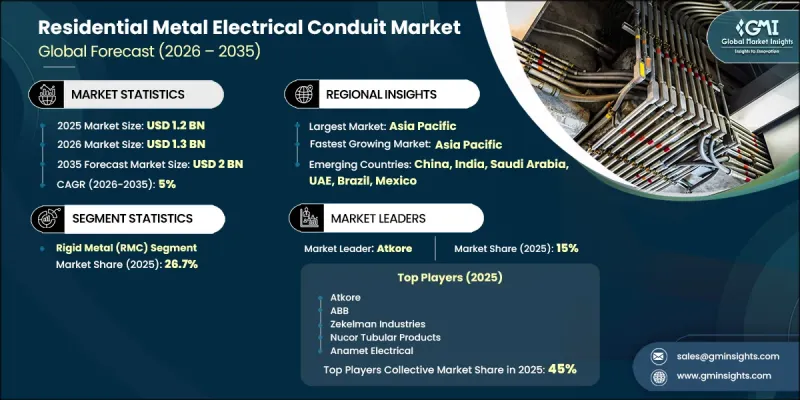
The Global Residential Metal Electrical Conduit Market was valued at USD 1.2 billion in 2025 and is estimated to grow at a CAGR of 5% to reach USD 2 billion by 2035.
Market expansion is supported by increasing residential construction activities, rising awareness regarding electrical protection, and growing demand for durable and fire-resistant conduit solutions. The adoption of metal electrical conduits is also being encouraged by strict safety requirements and building standards that emphasize secure electrical installations. The market is experiencing further growth as residential projects increasingly incorporate advanced electrical systems and smart home technologies that require reliable wiring infrastructure. Growing interest in energy-efficient buildings, sustainable construction practices, and environmentally responsible materials is also influencing product demand. Manufacturers are focusing on developing improved conduit designs and enhanced material solutions to meet changing construction requirements. The increasing preference for long-lasting, recyclable, and high-performance building components is creating additional opportunities for metal conduit adoption in residential applications. As housing development continues to expand and electrical safety standards become more stringent, the residential metal electrical conduit market is expected to maintain steady growth through 2035.
| Market Scope | |
|---|---|
| Start Year | 2025 |
| Forecast Year | 2026-2035 |
| Start Value | $1.2 Billion |
| Forecast Value | $2 Billion |
| CAGR | 5% |
The rigid metal conduit (RMC) segment accounted for 26.7% share in 2025 and is expected to reach USD 480 million by 2035. Demand for rigid metal configurations is increasing due to their superior mechanical strength, durability, and ability to provide enhanced protection for residential electrical wiring systems. These conduits are widely preferred in applications where electrical installations require strong resistance against physical impact, environmental stress, and fire-related risks. Their robust construction helps improve electrical safety, supports long-term reliability, and ensures dependable performance in demanding residential environments.
U.S. Residential Metal Electrical Conduit Market reached USD 172.6 million in 2025 and is projected to grow at a CAGR of 3.9% through 2035. Market development in the country is being driven by expanding residential construction projects, increasing installation of advanced electrical equipment, and rising demand for secure and reliable wiring systems. Stronger building regulations, greater emphasis on fire-resistant materials, and continued investment in residential infrastructure are contributing to the steady growth of metal conduit adoption across the U.S. housing sector.
Major companies operating in the global residential metal electrical conduit industry include Zekelman Industries, Atkore International, Wheatland Tube, Western Tube & Conduit, Nucor Tubular Products, ALEX, ARNET, Baolai Steel, Cat Van Loi, East Steel Pipe, ELECMAN, Eurotray, Hangzhou EVT Electrical, Hangzhou Topele Electrical, ITCC Group, Lonwow Industry, Southern Steel Pipe, Tianjin Rainbow Steel, TSI INOX CONDUIT, and ZHEJIANG AXWILL ELECTRICAL. Companies operating in the residential metal electrical conduit market are strengthening their competitive position through product innovation, manufacturing expansion, and improvements in material performance. Market participants are investing in advanced production technologies to develop durable, corrosion-resistant, and safety-focused conduit solutions that meet evolving construction requirements. Businesses are also expanding their distribution networks, forming strategic partnerships, and enhancing product portfolios to capture opportunities across residential construction projects. Companies are focusing on compliance with industry standards, sustainable manufacturing practices, and customized solutions to improve customer value. Increasing investments in research and development are helping manufacturers introduce improved conduit designs with better durability and installation efficiency.
Table of Contents
Chapter 1 Methodology & Scope
- 1.1 Research approach
- 1.2 Quality commitment
- 1.2.1 GMI AI policy & data integrity commitment
- 1.2.1.1 Source consistency protocol
- 1.2.1 GMI AI policy & data integrity commitment
- 1.3 Research Trail & Confidence Scoring
- 1.3.1 Research Trail Components
- 1.3.2 Scoring Components
- 1.4 Data Collection
- 1.4.1 Partial list of primary sources
- 1.5 Data mining sources
- 1.5.1 Paid sources
- 1.5.1.1 Sources, by region
- 1.5.1 Paid sources
- 1.6 Base estimates and calculations
- 1.6.1 Base year calculation for any one approach
- 1.7 Forecast model
- 1.8 Research transparency addendum
- 1.8.1 Source attribution framework
- 1.8.2 Quality assurance metrics
- 1.8.3 Our commitment to trust
- 1.8.3.1 Market definitions
Chapter 2 Executive Summary
- 2.1 Industry synopsis, 2022 - 2035
- 2.2 Business trends
- 2.3 Trade size trends
- 2.4 Configuration trends
- 2.5 Regional trends
Chapter 3 Industry Insights
- 3.1 Industry ecosystem analysis
- 3.2 Regulatory landscape
- 3.3 Industry impact forces
- 3.3.1 Growth drivers
- 3.3.2 Industry pitfalls & challenges
- 3.4 Growth potential analysis
- 3.5 Porter's analysis
- 3.5.1 Bargaining power of suppliers
- 3.5.2 Bargaining power of buyers
- 3.5.3 Threat of new entrants
- 3.5.4 Threat of substitutes
- 3.6 PESTEL analysis
- 3.7 Cost structure analysis of metal electrical conduits
- 3.8 Emerging opportunities & trends
- 3.9 Investment analysis & future outlook
Chapter 4 Competitive Landscape, 2026
- 4.1 Introduction
- 4.2 Company market share analysis, by region, 2025
- 4.2.1 North America
- 4.2.2 Europe
- 4.2.3 Asia Pacific
- 4.2.4 Middle East & Africa
- 4.2.5 Latin America
- 4.3 Competitive positioning matrix
- 4.4 Key Developments
- 4.4.1 Mergers & acquisitions
- 4.4.2 Partnerships & collaborations
- 4.4.3 New product launches
- 4.4.4 Expansion plans and funding
Chapter 5 Market Size and Forecast, By Trade Size, 2022 - 2035 (USD Million)
- 5.1 Key trends
- 5.2 1/2 to 1 inch
- 5.3 1 1/4 to 2 inches
- 5.4 2 1/2 to 3 inches
- 5.5 3 to 4 inches
- 5.6 5 to 6 inches
- 5.7 Others
Chapter 6 Market Size and Forecast, By Configuration, 2022 - 2035 (USD Million)
- 6.1 Key trends
- 6.2 Rigid Metal (RMC)
- 6.3 Galvanized Rigid (GRC)
- 6.4 Intermediate Metal (IMC)
- 6.5 Electrical Metal Tubing (EMT)
Chapter 7 Market Size and Forecast, By Region, 2022 - 2035 (USD Million)
- 7.1 Key trends
- 7.2 North America
- 7.2.1 U.S.
- 7.2.2 Canada
- 7.2.3 Mexico
- 7.3 Europe
- 7.3.1 France
- 7.3.2 Germany
- 7.3.3 Italy
- 7.3.4 UK
- 7.3.5 Russia
- 7.4 Asia Pacific
- 7.4.1 China
- 7.4.2 India
- 7.4.3 Japan
- 7.4.4 South Korea
- 7.4.5 Australia
- 7.5 Middle East & Africa
- 7.5.1 Saudi Arabia
- 7.5.2 UAE
- 7.5.3 Qatar
- 7.5.4 South Africa
- 7.6 Latin America
- 7.6.1 Brazil
- 7.6.2 Argentina
Chapter 8 Company Profiles
- 8.1 ALEX
- 8.2 ARNET
- 8.3 Atkore International
- 8.4 Baolai Steel
- 8.5 Cat Van Loi
- 8.6 East Steel Pipe
- 8.7 ELECMAN
- 8.8 Eurotray
- 8.9 Hangzhou EVT Electrical
- 8.10 Hangzhou Topele Electrical
- 8.11 ITCC Group
- 8.12 Lonwow Industry
- 8.13 Nucor Tubular Products
- 8.14 Southern Steel Pipe
- 8.15 Tianjin Rainbow Steel
- 8.16 TSI INOX CONDUIT
- 8.17 Western Tube & Conduit
- 8.18 Wheatland Tube
- 8.19 Zekelman Industries
- 8.20 ZHEJIANG AXWILL ELECTRICAL

