PUBLISHER: Mordor Intelligence | PRODUCT CODE: 2124802

PUBLISHER: Mordor Intelligence | PRODUCT CODE: 2124802
Germany Facility Management - Market Share Analysis, Industry Trends & Statistics, Growth Forecasts (2026 - 2031)
According to Mordor Intelligence, the Germany facility management market size was valued at USD 90.96 billion in 2025 and estimated to grow from USD 93.87 billion in 2026 to reach USD 109.86 billion by 2031, at a CAGR of 3.20% during the forecast period (2026-2031).
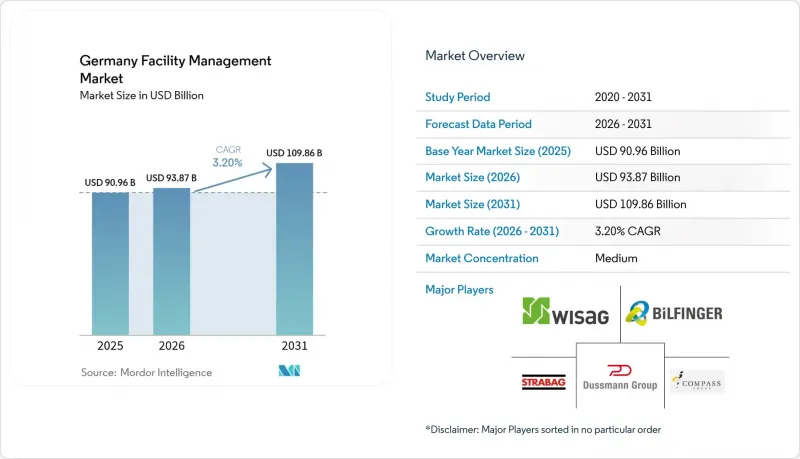
This report is Segmented by Service Type (Hard Services, and Soft Services), Offering Type (In-House, and Outsourced), End-User Industry (Commercial, Hospitality, Institutional and Public Infrastructure, Healthcare, Industrial and Process, and Other End-User Industries). The Market Forecasts are Provided in Terms of Value (USD).
Germany Facility Management Market Trends and Insights
Stringent Energy Efficiency Regulations
The Gebaudeenergiegesetz requires new heating systems installed from 2024 to derive at least 65% of heat from renewable sources, pushing operators to upgrade boilers, chillers, and distribution networks. HVAC units exceeding 12 kW must pass periodic energy inspections by certified experts, and owners face fines when deadlines lapse.Complementary rules under the Energy Efficiency Act oblige enterprises to deploy energy-management systems covering 90% of consumption and to publish reduction roadmaps. These mandates elevate demand for monitoring sensors, analytics dashboards, and performance contracting services that guarantee savings. Service providers able to bundle auditing, retro-commissioning, and financing options gain a competitive advantage in the Germany facility management market.
ESG Compliance Momentum
The Corporate Sustainable Reporting Directive will triple the number of German entities producing non-financial statements, reaching nearly 15,000 by 2026. Buildings contribute around 30% of national CO2 emissions, making facility operations a high-impact target. DGNB's "double materiality" lens obliges firms to disclose how their activities affect people and planet and how sustainability risks affect revenues. In response, providers now embed CO2 baselines, renewable sourcing plans, and waste-reduction KPIs into service-level agreements. High-profile appointments, such as ISS naming a Group Head of ESG, underline how credentials drive bid evaluation and project awards. This alignment is nudging the Germany facility management market toward outcome-based pricing tied to verified emissions cuts.
High Initial Implementation Costs
Energy-positive retrofits, advanced sensors, and on-site renewables often require capital outlays that stretch budgets during a downturn. The property sector saw deal volumes fall 52% to EUR 31.7 billion (USD 36.94 billion) in 2023, tightening credit for large upgrades. Owners worry that GEG-mandated boiler replacements might raise rents, provoking tenant resistance and delaying project approvals. Construction spending is projected to contract by 3.5% in 2025, so phased roll-outs, leasing models, and public grants become essential financing levers. Without these supports, some operators may defer or scale back technology investments, muting growth potential for the Germany facility management market in the near term.
Other drivers and restraints analyzed in the detailed report include:
- Digital Transformation and Smart Buildings
- Workforce Automation Momentum
- Cybersecurity and Data Privacy Concerns
For complete list of drivers and restraints, kindly check the Table Of Contents.
Segment Analysis
Hard Services contributed 56.62% of 2025 revenue because regulatory compliance tasks such as HVAC retro-commissioning and electrical safety inspections demand deep engineering know-how. Mechanical, electrical, and plumbing teams schedule thermographic surveys, balance hydronic circuits, and tune building-automation logic to align with GEG thresholds. Asset-management consultancies overlay life-cycle planning on an aging real-estate stock where 60% of properties exceed 30 years. As the Germany facility management market size for Hard Services tightens around legally enforceable performance targets, suppliers invest in sensor-equipped toolkits and cloud analytics that speed issue detection and track warranty claims.
Soft Services, forecast at a 5.29% CAGR, mirror employers' focus on occupant well-being. Heightened cleaning standards integrate UV-C disinfection robots for after-hours sweeps, while hospitality-grade front-of-house teams curate hybrid-work experiences through flex-desk management apps. Security guards increasingly deploy AI-enabled video analytics that distinguish safety breaches from routine events. Sodexo's robotic kitchen use case shows how automation raises throughput in healthcare catering without compromising nutrition. The growing appetite for tech-infused Soft Services suggests that their Germany facility management market share will rise steadily through 2031, even though value creation remains tethered to wellness metrics more than mandated compliance thresholds.
Complete Report Scope:
- By Service Type
- Hard Services
- Asset Management
- MEP and HVAC Services
- Fire Systems and Safety
- Other Hard FM Services
- Soft Services
- Office Support and Security
- Cleaning Services
- Catering Services
- Other Soft FM Services
- Hard Services
- By Offering Type
- In-house
- Outsourced
- Single FM
- Bundled FM
- Integrated FM
- By End-user Industry
- Commercial (IT and Telecom, Retail and Warehousing)
- Hospitality (Hotels, Eateries, Restaurants)
- Institutional and Public Infrastructure (Govt, Education, Transport)
- Retail and Warehousing
- Healthcare (Public and Private Facilities)
- Industrial and Process (Manufacturing, Energy, Mining)
- Other End-user Industries (Multi-housing, Entertainment, Sports and Leisure)
List of Companies Covered in this Report:
- Strabag SE
- Bilfinger SE
- Dussmann Group
- Compass Group PLC
- Wisag Facility Service Holding GmbH
- Vinci SA
- Aramark
- ISS Facilities Services Inc.
- Sodexo
- Apleona GmbH
- Weidemann Gruppe GmbH
- Coor Group
- Ray Facility Management
- Gegenbauer Services GmbH
- SPIE Deutschland & Zentraleuropa
- Kluh Service Management GmbH
- Piepenbrock Dienstleistungen GmbH & Co. KG
- Sasse Group
- Hectas Facility Services
- Johnson Controls (Germany)
- Caverion Deutschland GmbH
- Engie Deutschland GmbH
- Siemens Smart Infrastructure
- CBRE GWS Germany
- Serco Limited (Germany)
- Mitie Deutschland
Additional Benefits:
- The market estimate (ME) sheet in Excel format
- 3 months of analyst support
TABLE OF CONTENTS
1 INTRODUCTION
- 1.1 Study Assumptions and Market Definition
- 1.2 Scope of the Study
2 RESEARCH METHODOLOGY
3 EXECUTIVE SUMMARY
4 MARKET LANDSCAPE
- 4.1 Market Overview
- 4.1.1 Current Occupancy Rates in Key Commercial Real Estate Segments
- 4.1.2 Profitability Benchmarks of Major FM Providers
- 4.1.3 Workforce Indicators - Labour Participation and Skill Availability
- 4.1.4 Facility Management Market Share (%) by Service Type
- 4.1.5 Facility Management Market Share (%) by Hard FM Services
- 4.1.6 Facility Management Market Share (%) by Soft FM Services
- 4.1.7 Urbanisation and Population Growth in Top Metros (Berlin, Munich, Hamburg, Cologne, Frankfurt)
- 4.1.8 Sector Investment Priorities in Germany's National Infrastructure Pipeline
- 4.1.9 Regulatory Drivers Specific to Labour and Safety Standards
- 4.2 Drivers
- 4.2.1 Stringent Energy Efficiency Regulations
- 4.2.2 ESG Compliance Momentum
- 4.2.3 Digital Transformation and Smart Buildings
- 4.2.4 Workforce Automation Momentum
- 4.3 Restraints
- 4.3.1 High Initial Implementation Costs
- 4.3.2 Cybersecurity and Data Privacy Concerns
- 4.4 Value Chain Analysis
- 4.5 PESTEL Analysis
- 4.6 Regulatory and Legislative Framework for Market Entrants
- 4.7 Impact of Macroeconomic Indicators on Facility Management Demand
- 4.8 Porter's Five Forces Analysis
- 4.8.1 Bargaining Power of Suppliers
- 4.8.2 Bargaining Power of Buyers
- 4.8.3 Threat of New Entrants
- 4.8.4 Threat of Substitute Services
- 4.8.5 Intensity of Competitive Rivalry
- 4.9 Investment and Funding Analysis
5 MARKET SIZE AND GROWTH FORECASTS (VALUE)
- 5.1 By Service Type
- 5.1.1 Hard Services
- 5.1.1.1 Asset Management
- 5.1.1.2 MEP and HVAC Services
- 5.1.1.3 Fire Systems and Safety
- 5.1.1.4 Other Hard FM Services
- 5.1.2 Soft Services
- 5.1.2.1 Office Support and Security
- 5.1.2.2 Cleaning Services
- 5.1.2.3 Catering Services
- 5.1.2.4 Other Soft FM Services
- 5.1.1 Hard Services
- 5.2 By Offering Type
- 5.2.1 In-house
- 5.2.2 Outsourced
- 5.2.2.1 Single FM
- 5.2.2.2 Bundled FM
- 5.2.2.3 Integrated FM
- 5.3 By End-user Industry
- 5.3.1 Commercial (IT and Telecom, Retail and Warehousing)
- 5.3.2 Hospitality (Hotels, Eateries, Restaurants)
- 5.3.3 Institutional and Public Infrastructure (Govt, Education, Transport)
- 5.3.3.1 Retail and Warehousing
- 5.3.4 Healthcare (Public and Private Facilities)
- 5.3.5 Industrial and Process (Manufacturing, Energy, Mining)
- 5.3.6 Other End-user Industries (Multi-housing, Entertainment, Sports and Leisure)
6 COMPETITIVE LANDSCAPE
- 6.1 Market Concentration
- 6.2 Strategic Moves
- 6.3 Market Share Analysis
- 6.4 Company Profiles (includes Global level Overview, Market level overview, Core Segments, Financials as available, Strategic Information, Market Rank/Share for key companies, Products and Services, and Recent Developments)
- 6.4.1 Strabag SE
- 6.4.2 Bilfinger SE
- 6.4.3 Dussmann Group
- 6.4.4 Compass Group PLC
- 6.4.5 Wisag Facility Service Holding GmbH
- 6.4.6 Vinci SA
- 6.4.7 Aramark
- 6.4.8 ISS Facilities Services Inc.
- 6.4.9 Sodexo
- 6.4.10 Apleona GmbH
- 6.4.11 Weidemann Gruppe GmbH
- 6.4.12 Coor Group
- 6.4.13 Ray Facility Management
- 6.4.14 Gegenbauer Services GmbH
- 6.4.15 SPIE Deutschland & Zentraleuropa
- 6.4.16 Kluh Service Management GmbH
- 6.4.17 Piepenbrock Dienstleistungen GmbH & Co. KG
- 6.4.18 Sasse Group
- 6.4.19 Hectas Facility Services
- 6.4.20 Johnson Controls (Germany)
- 6.4.21 Caverion Deutschland GmbH
- 6.4.22 Engie Deutschland GmbH
- 6.4.23 Siemens Smart Infrastructure
- 6.4.24 CBRE GWS Germany
- 6.4.25 Serco Limited (Germany)
- 6.4.26 Mitie Deutschland
7 MARKET OPPORTUNITIES AND FUTURE OUTLOOK
- 7.1 White-space and Unmet-Need Assessment
- 7.2 Technology-led Integrated FM (IoT, BMS, AI-based Predictive Maintenance)
- 7.3 ESG-Compliant FM Solutions Demand
- 7.4 Future Service-Model Shifts (Outcome-Based Contracts)
- 7.5 Data-Driven Energy Optimisation and Carbon Reporting Services

