PUBLISHER: Mordor Intelligence | PRODUCT CODE: 2099081

PUBLISHER: Mordor Intelligence | PRODUCT CODE: 2099081
South America CRM Marketing Services Market - Market Share Analysis, Industry Trends & Statistics, Growth Forecasts (2026 - 2031)
According to Mordor Intelligence, the South America CRM marketing services market size was valued at USD 1.28 billion in 2025 and is estimated to grow from USD 1.41 billion in 2026 to reach USD 2.44 billion by 2031, at a CAGR of 11.59% during the forecast period (2026-2031).
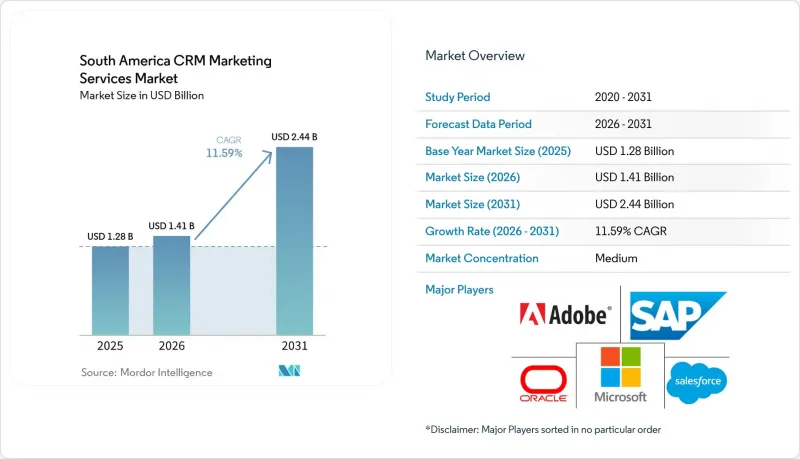
This report is Segmented by Service Type (CRM Strategy and Consulting, and More), Enterprise Size (Large Enterprises and Small and Medium Enterprises), Service Application (Customer Acquisition, and More), End-User Industry (Banking, Financial Services, and Insurance (BFSI), Healthcare and Life Sciences, and More ), and Geography. The Market Forecasts are Provided in Terms of Value (USD).
South America CRM Marketing Services Market Trends and Insights
Rapid Shift to Cloud-Delivered CRM and Marketing Automation
The South America CRM marketing services market is increasingly organized around cloud delivery because most new enterprise programs now assume SaaS deployment from the start. This is increasing demand for implementation, migration, integration, and post-deployment support under a single contract rather than in separate workstreams. Brazil is also showing that cloud adoption has moved into a more mature phase, as Salesforce described the country in 2026 as one of its leading markets for moving Agentforce from pilot programs into production environments. The same pattern is visible in large program design, where CASSI rolled out Salesforce Health Cloud, Marketing Cloud, Data Cloud, Sales Cloud, Service Cloud, Einstein Bot, Loyalty Management, and Advertising Studio as part of one broader healthcare transformation effort. As cloud architecture becomes standard, providers with stronger connectors, migration capability, and local delivery depth are better placed to capture larger and longer mandates.
Rising Demand for AI-Driven Personalization and Lead Scoring
The South America CRM marketing services market is also being pushed by the shift from basic automation toward AI-supported sales and service execution. Banco do Brasil clearly showed this direction when it presented a Salesforce-based CRM and hyperpersonalization strategy aimed at improving sales by 30%, with a 2026 phase planned to have AI agents handle routine client interactions. That kind of program shifts service demand away from one-time implementation and toward data preparation, model tuning, workflow redesign, and ongoing optimization. Salesforce's acquisition moves have reinforced this direction by deepening its data and AI stack through Informatica and by adding an autonomous customer support capability through Fin. As AI features become part of frontline execution, CRM service providers with stronger data-handling and AI operations capabilities are gaining a more defensible position.
Integration Complexity Across Legacy ERP, POS, and Commerce Stacks
The South America CRM marketing services market still faces a major delivery constraint because many clients operate with uneven legacy environments across ERP, commerce, payments, and point-of-sale systems. This slows down projects, increases implementation effort, and often pushes consulting costs above initial budget assumptions. The issue is especially important in large enterprise environments where multiple clouds, business units, and regulated data flows must work together within a single design. Grupo Aval's migration work with Siebel CRM Cloud Manager and Oracle Autonomous Database reflects the kind of architecture depth that makes integration a central part of the service opportunity and a central source of execution risk. In the South America CRM marketing services market, providers that reduce integration friction can protect margins better and improve client confidence during renewal cycles.
Other drivers and restraints analyzed in the detailed report include:
- Expansion of E-Commerce and Digital Commerce Orchestration
- Multichannel Customer Engagement Across Mobile and Social Touchpoints
- Budget Sensitivity and Longer Payback Cycles Among Mid-Market Buyers
For complete list of drivers and restraints, kindly check the Table Of Contents.
Segment Analysis
CRM implementation and integration held the largest share among service types at 27.1% in 2025, keeping this part of the South America CRM marketing services market at the center of new contract flow. The segment still benefits from first-generation deployments in some enterprises and from complex replacement cycles in others. Many clients are not yet in a stable optimization phase, so implementation work continues to absorb a large part of spending across BFSI, retail, and healthcare. This also means the South America CRM marketing services industry still rewards providers that can handle architecture design, workflow mapping, data migration, and user rollout in one engagement. The segment remains important because every subsequent service layer still depends on the quality of implementation at the start.
Implementation scope is also becoming broader. CASSI's multi-module Salesforce rollout is a strong example because one program covered Health Cloud, Marketing Cloud, Data Cloud, Sales Cloud, Service Cloud, Einstein Bot, Loyalty Management, and Advertising Studio. CRM migration and modernization are forecast to grow at a 12.7% CAGR through 2031, and the South America CRM marketing services market is benefiting from the need to replace older architectures that are less suited to AI and event-driven workflows. That growth is also helping adjacent categories such as strategy consulting, managed services, and training because modernization rarely ends with technical migration alone. As a result, implementation still leads on current revenue while modernization is setting the pace for future expansion.
Large enterprises accounted for 58.1% of total market revenue in 2025, making them the primary revenue driver for the South America CRM marketing services market. Their contracts are larger because they usually cover several business functions, more users, deeper integration, and longer support terms. Petrobras illustrated this scale in 2026 when it initiated procurement for Salesforce development and maintenance services with a reference budget of more than BRL 155 million, or approximately USD 30 million. Programs at this level tend to combine solution architecture, agile delivery, AI teams, and ongoing support, keeping service intensity high throughout the contract cycle. Large enterprises, therefore, continue to set the commercial benchmark for delivery capability and account depth.
SMEs are forecast to expand at a 12.8% CAGR through 2031, which is changing the growth pattern of the South America CRM marketing services market, even if not the immediate revenue base. Subscription pricing and modular deployment have reduced entry barriers, which makes CRM programs more realistic for smaller buyers than in earlier cycles. Even so, SME growth does not necessarily mean easier delivery because smaller firms often need more onboarding support and clearer operating discipline after go-live. This creates a recurring opening for lower-cost consulting, workflow setup, training, and performance support rather than only for software resale. The South America CRM marketing services market is therefore being shaped by two different buyer groups, one defined by contract size and the other by faster expansion.
Complete Report Scope:
- By Service Type
- CRM Strategy and Consulting
- CRM Implementation and Integration
- CRM Migration and Modernization
- CRM Managed Services
- CRM Training and Support
- By Enterprise Size
- Large Enterprises
- Small and Medium Enterprises
- By Service Application
- Customer Acquisition
- Customer Retention and Loyalty
- Campaign Management Services
- Marketing Automation Services
- Customer Analytics and Insights
- Omnichannel Customer Engagement
- Personalization Services
- By End-user Industry
- Banking, Financial Services, and Insurance (BFSI)
- Healthcare and Life Sciences
- Information Technology and Telecom
- Retail and E-commerce
- Industrial Manufacturing
- Government and Public Administration
- Other End-user Industries
- By Geography
- Brazil
- Argentina
- Colombia
- Chile
- Peru
- Rest of South America
List of Companies Covered in this Report:
- Salesforce, Inc.
- Adobe Inc.
- Microsoft Corporation
- Oracle Corporation
- SAP SE
- HubSpot, Inc.
- Zoho Corporation Pvt. Ltd.
- Pipedrive OU
- Freshworks Inc.
- Zendesk, Inc.
- ActiveCampaign, LLC
- Intuit Inc.
- Braze, Inc.
- Klaviyo, Inc.
- Iterable, Inc.
- Acoustic, L.P.
- SAS Institute Inc.
- Salesforce Benelux B.V.
- SugarCRM Inc.
- Keap Inc.
Additional Benefits:
- The market estimate (ME) sheet in Excel format
- 3 months of analyst support
TABLE OF CONTENTS
1 INTRODUCTION
- 1.1 Study Assumptions and Market Definition
- 1.2 Scope of the Study
2 RESEARCH METHODOLOGY
3 EXECUTIVE SUMMARY
4 MARKET LANDSCAPE
- 4.1 Market Overview
- 4.2 Market Drivers
- 4.2.1 Rapid Shift to Cloud-Delivered CRM and Marketing Automation
- 4.2.2 Expansion of E-Commerce and Digital Commerce Orchestration
- 4.2.3 Rising Demand for AI-Driven Personalization and Lead Scoring
- 4.2.4 Multichannel Customer Engagement Across Mobile and Social Touchpoints
- 4.2.5 Data Localization and Privacy Compliance Readiness as a Buying Trigger
- 4.2.6 SME Subscription Adoption and Modular Pricing Preference
- 4.3 Market Restraints
- 4.3.1 Integration Complexity Across Legacy ERP, POS, and Commerce Stacks
- 4.3.2 Budget Sensitivity and Longer Payback Cycles Among Mid-Market Buyers
- 4.3.3 Data Quality Gaps That Weaken Automation and Attribution Outcomes
- 4.3.4 Talent Shortage in Martech Operations and CRM Administration
- 4.4 Industry Value-Chain Analysis
- 4.5 Regulatory Landscape
- 4.6 Technological Outlook
- 4.7 Porter's Five Forces Analysis
- 4.7.1 Bargaining Power of Buyers
- 4.7.2 Bargaining Power of Suppliers
- 4.7.3 Threat of New Entrants
- 4.7.4 Threat of Substitutes
- 4.7.5 Intensity of Competitive Rivalry
5 MARKET SIZE AND GROWTH FORECASTS (VALUE)
- 5.1 By Service Type
- 5.1.1 CRM Strategy and Consulting
- 5.1.2 CRM Implementation and Integration
- 5.1.3 CRM Migration and Modernization
- 5.1.4 CRM Managed Services
- 5.1.5 CRM Training and Support
- 5.2 By Enterprise Size
- 5.2.1 Large Enterprises
- 5.2.2 Small and Medium Enterprises
- 5.3 By Service Application
- 5.3.1 Customer Acquisition
- 5.3.2 Customer Retention and Loyalty
- 5.3.3 Campaign Management Services
- 5.3.4 Marketing Automation Services
- 5.3.5 Customer Analytics and Insights
- 5.3.6 Omnichannel Customer Engagement
- 5.3.7 Personalization Services
- 5.4 By End-user Industry
- 5.4.1 Banking, Financial Services, and Insurance (BFSI)
- 5.4.2 Healthcare and Life Sciences
- 5.4.3 Information Technology and Telecom
- 5.4.4 Retail and E-commerce
- 5.4.5 Industrial Manufacturing
- 5.4.6 Government and Public Administration
- 5.4.7 Other End-user Industries
- 5.5 By Geography
- 5.5.1 Brazil
- 5.5.2 Argentina
- 5.5.3 Colombia
- 5.5.4 Chile
- 5.5.5 Peru
- 5.5.6 Rest of South America
6 COMPETITIVE LANDSCAPE
- 6.1 Market Concentration
- 6.2 Strategic Moves
- 6.3 Market Share Analysis
- 6.4 Company Profiles (includes Global Level Overview, Market Level Overview, Core Segments, Financials as available, Strategic Information, Market Rank/Share, Products and Services, Recent Developments)
- 6.4.1 Salesforce, Inc.
- 6.4.2 Adobe Inc.
- 6.4.3 Microsoft Corporation
- 6.4.4 Oracle Corporation
- 6.4.5 SAP SE
- 6.4.6 HubSpot, Inc.
- 6.4.7 Zoho Corporation Pvt. Ltd.
- 6.4.8 Pipedrive OU
- 6.4.9 Freshworks Inc.
- 6.4.10 Zendesk, Inc.
- 6.4.11 ActiveCampaign, LLC
- 6.4.12 Intuit Inc.
- 6.4.13 Braze, Inc.
- 6.4.14 Klaviyo, Inc.
- 6.4.15 Iterable, Inc.
- 6.4.16 Acoustic, L.P.
- 6.4.17 SAS Institute Inc.
- 6.4.18 Salesforce Benelux B.V.
- 6.4.19 SugarCRM Inc.
- 6.4.20 Keap Inc.
7 MARKET OPPORTUNITIES AND FUTURE OUTLOOK
- 7.1 White-Space and Unmet-Need Assessment

