PUBLISHER: Mordor Intelligence | PRODUCT CODE: 2099226

PUBLISHER: Mordor Intelligence | PRODUCT CODE: 2099226
Singapore CRM Marketing Services Market - Market Share Analysis, Industry Trends & Statistics, Growth Forecasts (2026 - 2031)
According to Mordor Intelligence, the Singapore CRM marketing services market size was valued at USD 199.48 million in 2025 and estimated to grow from USD 225.77 million in 2026 to reach USD 457.66 million by 2031, at a CAGR of 15.18% during the forecast period 2026-2031.
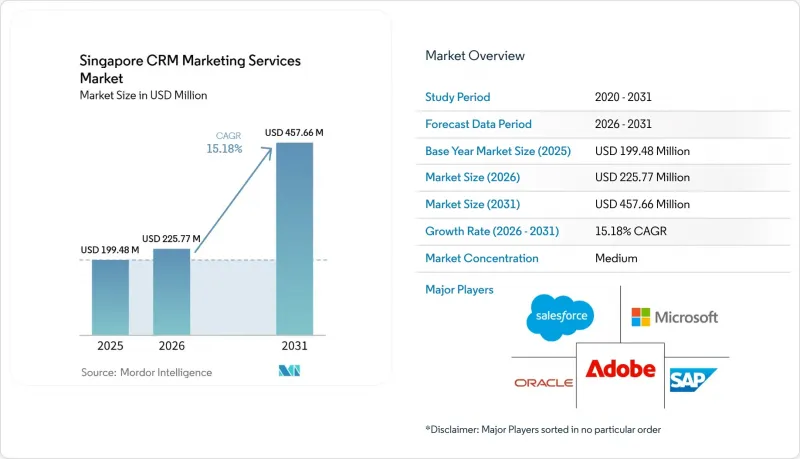
This report is Segmented by Service Type (CRM Implementation and Integration, CRM Migration and Modernization, and More), Enterprise Size (Large Enterprises, and Small and Medium Enterprises), Service Application (Customer Acquisition, Personalization Services, and More), and End-User Industry (Healthcare and Life Sciences, and More). The Market Forecasts are Provided in Terms of Value (USD).
Singapore CRM Marketing Services Market Trends and Insights
Rising SME Demand for Affordable Marketing Automation
Rising SME demand remains one of the clearest growth pillars for the Singapore CRM marketing services market. Smaller firms are under pressure to professionalize lead management, customer follow-up, and retention activity without building large in-house teams. The compliance burden around customer data also means that even basic CRM deployments now require better process design than many small firms can manage in-house. This raises demand for outside providers that can package implementation, training, and ongoing support into affordable monthly service models. It also means first-time buyers often enter through a modest deployment and then expand toward recurring managed contracts once daily usage begins. The result is a wider and more durable client pipeline for the Singapore CRM marketing services market.
AI-Led Personalization Across Small Budgets
Personalization demand is rising faster than in-house execution capacity, which is driving growth in the Singapore CRM marketing services market. Salesforce reported in June 2026 that 86% of Singapore marketers had begun optimizing for AI-generated responses, while 87% still ran generic campaigns. The same Salesforce findings showed that 100% of Singapore marketers faced barriers to personalization, with siloed data and poor data quality cited most often. That gap pushes firms toward service partners that can unify data, build campaign logic, and operate AI-led workflows at manageable cost. DBS reported SGD 1 billion (USD 771 million) in AI-derived economic value in 2025, which strengthens the commercial case for personalized engagement in customer-facing functions. As a result, personalization services are moving from an optional upgrade to a central buying criterion across the Singapore CRM marketing services market.
High Total Cost of Ownership for Advanced Integrations
High ownership costs remain a significant restraint on the Singapore CRM marketing services market. The issue is not limited to software fees, because first-year spending often includes implementation work, data migration, workflow redesign, training, and later-stage optimization. This burden is heavier for smaller organizations that need advanced capability but cannot spread cost across a large user base. Freshworks reported in March 2026 that mid-market firms in Singapore lose 23% of their AI budgets to integration complexity before realizing returns. That loss delays full deployment, narrows vendor choice, and increases caution around multi-module purchases. At the same time, the cost challenge also shifts more clients toward managed service partners, reducing internal execution strain in the Singapore CRM marketing services market.
Other drivers and restraints analyzed in the detailed report include:
- Retail, E-commerce, and Tourism Recovery Driving Customer Retention Spend
- Singapore as a Regional SaaS Hub for ASEAN Rollouts
- Data Privacy and Consent Management Complexity
For complete list of drivers and restraints, kindly check the Table Of Contents.
Segment Analysis
CRM Implementation and Integration accounted for 58.18% of revenue in 2025, keeping this category at the center of the Singapore CRM marketing services market. Much of the current revenue base still comes from organizations replacing disconnected contact systems and older marketing tools with unified CRM environments. That foundation work remains necessary because many firms are still aligning customer data, workflow rules, and channel execution inside a single operating model. Large projects also tend to generate follow-on demand for testing, user enablement, and post-launch adjustments, which keeps implementation spending active beyond the initial rollout. In this stage of the Singapore CRM marketing services market, implementation is still the point where most service relationships begin.
CRM Managed Services is projected to grow at a 17.36% CAGR from 2026-2031, indicating where the next layer of spending is headed. Once the core platform is live, clients still need ongoing support for campaign operations, performance tuning, AI model calibration, and workflow maintenance. Salesforce's March 2025 work with Singapore Airlines showed how an enterprise deployment can extend into a longer support and optimization relationship, as Agentforce, Einstein in Service Cloud, and Data Cloud are embedded into customer case management. Migration and Modernization is also gaining importance as older on-premise systems become less compatible with cloud-native AI tooling. Training and Support remains smaller in revenue terms, but it stays structurally important because adoption quality often determines whether a client expands service scope or stalls after launch.
Large Enterprises accounted for 71.47% of revenue in 2025, making them the primary spending anchor in the Singapore CRM marketing services market. These organizations usually buy broader platform suites, connect more internal systems, and sign longer service contracts than smaller customers. Their deployments also set the performance benchmark for the wider market because they are often the first to test AI-led service and marketing workflows at scale. OCBC announced in July 2026 that it planned to spend more than SGD 1 billion (USD 771 million) annually on AI, digital, and data initiatives under its Next Frontier Strategy, alongside the launch of its AI avatar-powered WoW wealth management application. This level of enterprise investment keeps large accounts central to revenue concentration in the Singapore CRM marketing services market.
SMEs are projected to grow at a 17.71% CAGR from 2026 to 2031, making them the fastest-growing demand pool. Their adoption pattern differs because buyers usually prefer modular deployments, shorter setup cycles, and stronger vendor support after launch. In March 2026, Freshworks found that 92% of Singapore mid-market IT leaders planned to increase AI investment over the next 12-24 months, yet only 20% had integrated AI across core operations. That gap creates room for phased CRM rollouts, managed migration work, and packaged support services that reduce in-house execution pressure. It also means SME growth will likely continue to expand the customer base of the Singapore CRM marketing services market, even if average contract values remain below those of large enterprises.
Complete Report Scope:
- By Service Type
- CRM Strategy and Consulting
- CRM Implementation and Integration
- CRM Migration and Modernization
- CRM Managed Services
- CRM Training and Support
- By Enterprise Size
- Large Enterprises
- Small and Medium Enterprises
- By Service Application
- Customer Acquisition
- Customer Retention and Loyalty
- Campaign Management Services
- Marketing Automation Services
- Customer Analytics and Insights
- Omnichannel Customer Engagement
- Personalization Services
- By End-user Industry
- Banking, Financial Services, and Insurance (BFSI)
- Healthcare and Life Sciences
- Information Technology and Telecom
- Retail and E-commerce
- Industrial Manufacturing
- Government and Public Administration
- Other End-user Industries
List of Companies Covered in this Report:
- Salesforce, Inc.
- Microsoft Corporation
- Oracle Corporation
- SAP SE
- HubSpot, Inc.
- Zoho Corporation Pvt. Ltd.
- Freshworks Inc.
- Adobe Inc.
- Pipedrive OU
- SugarCRM Inc.
- Zendesk, Inc.
- Creatio, Inc.
- monday.com Ltd.
- ActiveCampaign, LLC
- Intercom, Inc.
- Insightly, Inc.
- Keap, Inc.
- Copper CRM, Inc.
- Brevo
- Efficy N.V.
Additional Benefits:
- The market estimate (ME) sheet in Excel format
- 3 months of analyst support
TABLE OF CONTENTS
1 INTRODUCTION
- 1.1 Study Assumptions and Market Definition
- 1.2 Scope of the Study
2 RESEARCH METHODOLOGY
3 EXECUTIVE SUMMARY
4 MARKET LANDSCAPE
- 4.1 Market Overview
- 4.2 Market Drivers
- 4.2.1 Rising SME Demand for Affordable Marketing Automation
- 4.2.2 AI-Led Personalization Across Small Budgets
- 4.2.3 Retail, E-Commerce, and Tourism Recovery Driving Customer Retention Spend
- 4.2.4 Singapore as a Regional SaaS Hub for ASEAN Rollouts
- 4.2.5 Privacy-By-Design CRM Favoring Compliant Vendors
- 4.2.6 WhatsApp and Omnichannel Engagement Integration
- 4.3 Market Restraints
- 4.3.1 High Total Cost of Ownership for Advanced Integrations
- 4.3.2 Data Privacy and Consent Management Complexity
- 4.3.3 Limited In-House CRM Talent among Micro Enterprises
- 4.3.4 Integration Friction with Legacy ERP and POS Stacks
- 4.4 Industry Value Chain Analysis
- 4.5 Impact of Macroeconomic Factors on the Market
- 4.6 Regulatory Landscape
- 4.7 Technological Outlook
- 4.8 Porter's Five Forces Analysis
- 4.8.1 Bargaining Power of Suppliers
- 4.8.2 Bargaining Power of Buyers
- 4.8.3 Threat of New Entrants
- 4.8.4 Threat of Substitutes
- 4.8.5 Intensity of Competitive Rivalry
5 MARKET SIZE AND GROWTH FORECASTS (VALUE)
- 5.1 By Service Type
- 5.1.1 CRM Strategy and Consulting
- 5.1.2 CRM Implementation and Integration
- 5.1.3 CRM Migration and Modernization
- 5.1.4 CRM Managed Services
- 5.1.5 CRM Training and Support
- 5.2 By Enterprise Size
- 5.2.1 Large Enterprises
- 5.2.2 Small and Medium Enterprises
- 5.3 By Service Application
- 5.3.1 Customer Acquisition
- 5.3.2 Customer Retention and Loyalty
- 5.3.3 Campaign Management Services
- 5.3.4 Marketing Automation Services
- 5.3.5 Customer Analytics and Insights
- 5.3.6 Omnichannel Customer Engagement
- 5.3.7 Personalization Services
- 5.4 By End-user Industry
- 5.4.1 Banking, Financial Services, and Insurance (BFSI)
- 5.4.2 Healthcare and Life Sciences
- 5.4.3 Information Technology and Telecom
- 5.4.4 Retail and E-commerce
- 5.4.5 Industrial Manufacturing
- 5.4.6 Government and Public Administration
- 5.4.7 Other End-user Industries
6 COMPETITIVE LANDSCAPE
- 6.1 Market Concentration
- 6.2 Strategic Moves
- 6.3 Market Share Analysis
- 6.4 Company Profiles (includes Global Level Overview, Market Level Overview, Core Segments, Financials as available, Strategic Information, Market Rank/Share, Products and Services, Recent Developments)
- 6.4.1 Salesforce, Inc.
- 6.4.2 Microsoft Corporation
- 6.4.3 Oracle Corporation
- 6.4.4 SAP SE
- 6.4.5 HubSpot, Inc.
- 6.4.6 Zoho Corporation Pvt. Ltd.
- 6.4.7 Freshworks Inc.
- 6.4.8 Adobe Inc.
- 6.4.9 Pipedrive OU
- 6.4.10 SugarCRM Inc.
- 6.4.11 Zendesk, Inc.
- 6.4.12 Creatio, Inc.
- 6.4.13 monday.com Ltd.
- 6.4.14 ActiveCampaign, LLC
- 6.4.15 Intercom, Inc.
- 6.4.16 Insightly, Inc.
- 6.4.17 Keap, Inc.
- 6.4.18 Copper CRM, Inc.
- 6.4.19 Brevo
- 6.4.20 Efficy N.V.
7 MARKET OPPORTUNITIES AND FUTURE OUTLOOK
- 7.1 White-space and Unmet-Need Assessment

