PUBLISHER: Mordor Intelligence | PRODUCT CODE: 2099228

PUBLISHER: Mordor Intelligence | PRODUCT CODE: 2099228
Indonesia CRM Marketing Services Market - Market Share Analysis, Industry Trends & Statistics, Growth Forecasts (2026 - 2031)
According to Mordor Intelligence, the Indonesia CRM marketing services market size is expected to increase from USD 164.54 million in 2025 to USD 191.80 million in 2026 and reach USD 423.75 million by 2031, growing at a CAGR of 17.18% over 2026-2031.
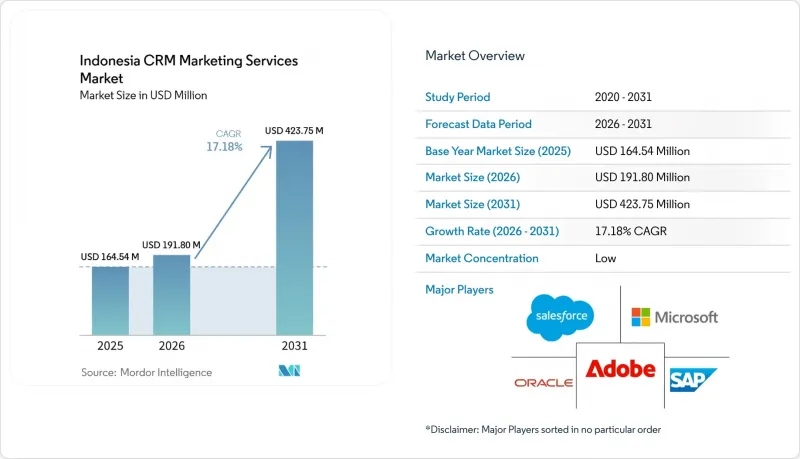
This report is Segmented by Service Type (CRM Implementation and Integration, CRM Migration and Modernization, and More), Enterprise Size (Large Enterprises, and Small and Medium Enterprises), Service Application (Customer Acquisition, Personalization Services, and More), and End-User Industry (Healthcare and Life Sciences, and More). The Market Forecasts are Provided in Terms of Value (USD).
Indonesia CRM Marketing Services Market Trends and Insights
Rising Omnichannel Customer Engagement Budgets
Customer engagement budgets are moving toward CRM-centered orchestration across email, messaging, service, and commerce channels. This is increasing the amount of design, integration, and support work bundled into each deployment in the Indonesia CRM marketing services market. Vendors are no longer being asked only to connect software. They are also being asked to shape consent flows, data capture, audience logic, and message sequencing inside the same operating environment. Salesforce's July 2025 expansion of Hyperforce services in Indonesia, including Agentforce, Data Cloud, and Marketing Cloud Next, showed that buyers in regulated sectors now expect local data residency and full-stack activation in the same program. That requirement favors service providers that can combine architecture, workflow setup, and campaign operations under a single delivery model. The result is a larger contract scope and a clearer path from implementation into recurring managed services within the Indonesia CRM marketing services market.
Rapid Expansion of E-Commerce and Retail CRM Use Cases
Retail and digital commerce are expanding the addressable market for CRM services nationwide. The U.S. International Trade Administration stated that Indonesia's e-commerce value is projected to reach USD 86.81 billion by 2028, while social commerce is expected to reach USD 22 billion in gross merchandise value by 2028. Those transaction flows create a stronger need for customer identification, lifecycle tracking, and re-engagement across marketplaces, social channels, and owned channels. In the Indonesia CRM marketing services market, this lifts demand for acquisition workflows first and then for retention and personalization programs as customer databases deepen. It also shifts value toward providers that can connect commerce data with campaign execution rather than only set up contact records. That is one reason Retail and E-commerce is becoming a major growth engine across the Indonesia CRM marketing services market.
Data Privacy Compliance and Consent Management Complexity
Compliance now shapes project design across the Indonesia CRM marketing services market, especially in sectors that handle sensitive customer records. Buyers are asking vendors to demonstrate that campaign data, analytics workflows, and customer records can be managed within architectures that support local residency and tighter governance. Salesforce linked its July 2025 Indonesia expansion directly to data residency and compliance needs in government, financial services, and telecom. This increases the planning burden on service providers because consent capture, data movement, and channel activation must work together from the start. It also slows some buying decisions, as clients prefer to wait for greater certainty before locking in long-lived data-processing structures. The result is not a collapse in demand, but a longer path from evaluation to signed project scope in the Indonesia CRM marketing services market.
Other drivers and restraints analyzed in the detailed report include:
- Cloud-First Adoption Among Small and Medium Enterprises
- Marketing Automation Demand Tied to Performance Marketing
- Integration Friction with Legacy ERP, POS, and WhatsApp Workflows
For complete list of drivers and restraints, kindly check the Table Of Contents.
Segment Analysis
CRM Implementation and Integration accounted for 57.88% of the Indonesia CRM marketing services market in 2025, making it the largest service type by a clear margin. That share reflects the basic structure of the market, where buyers still need substantial hands-on work to configure platforms, connect data sources, and align customer workflows. The service scope is broader than simple system setup because many programs must tie together sales, marketing, service, and commerce functions across separate channels. In the Indonesia CRM marketing services industry, implementation work remains central to revenue even as the software itself becomes easier to access. It also explains why the market continues to favor providers that can deliver architecture, integration, and activation together instead of as separate workstreams.
The dominance of this segment is reinforced by the way customer communication operates in Indonesia. CRM programs often have to connect marketplace activity, internal systems, and messaging channels before businesses can run a consistent engagement strategy. Salesforce's July 2025 local data residency expansion in Indonesia made advanced marketing and data tools easier to deploy for regulated clients, which supports more complex implementation programs rather than reducing the need for services. At the same time, CRM Managed Services is projected to grow at a 19.05% CAGR through 2031 as earlier deployments move into ongoing optimization, reporting, and performance support. This points to a gradual rebalancing inside the Indonesia CRM marketing services market, where one-time projects still anchor revenue but recurring support becomes more important with each completed rollout. Strategy and consulting, migration and modernization, and training and support remain smaller pools, but they gain relevance as clients consolidate older deployments and seek stronger internal adoption.
Large Enterprises accounted for 68.71% of the Indonesia CRM marketing services market share in 2025, indicating that revenue remains strongly concentrated in larger accounts. These clients can fund multi-phase rollouts, support longer implementation calendars, and carry the cost of integrating CRM with broader enterprise systems. They are also the most likely buyers of local data residency, advanced analytics, and high-touch managed services. In the Indonesia CRM marketing services market, this keeps large organizations at the center of value creation even as the customer base broadens. The pattern is especially visible in banking, telecom, retail, and public-sector environments, where scale and compliance requirements push projects beyond basic contact management.
Small and Medium Enterprises are projected to grow at a 19.49% CAGR through 2031, making them the fastest-expanding enterprise segment. Their growth is supported by lighter cloud deployment models, shorter implementation cycles, and prebuilt workflows that reduce some of the complexity seen in enterprise programs. Mekari Qontak stated that its platform was designed for full operationalization within 3-4 weeks, indicating that the service model is changing for smaller buyers who need faster results and lower setup friction. This matters because a scalable SME model can expand the reach of the Indonesia CRM marketing services market without requiring the same level of labor intensity as large-account projects. Over time, that mix shift can reduce the market's dependence on a narrow group of large buyers while still leaving enterprise contracts as the main revenue base.
Complete Report Scope:
- By Service Type
- CRM Strategy and Consulting
- CRM Implementation and Integration
- CRM Migration and Modernization
- CRM Managed Services
- CRM Training and Support
- By Enterprise Size
- Large Enterprises
- Small and Medium Enterprises
- By Service Application
- Customer Acquisition
- Customer Retention and Loyalty
- Campaign Management Services
- Marketing Automation Services
- Customer Analytics and Insights
- Omnichannel Customer Engagement
- Personalization Services
- By End-user Industry
- Banking, Financial Services, and Insurance (BFSI)
- Healthcare and Life Sciences
- Information Technology and Telecom
- Retail and E-commerce
- Industrial Manufacturing
- Government and Public Administration
- Other End-user Industries
List of Companies Covered in this Report:
- Salesforce, Inc.
- HubSpot, Inc.
- Microsoft Corporation
- Oracle Corporation
- SAP SE
- Zoho Corporation Pvt. Ltd.
- Adobe Inc.
- Freshworks Inc.
- Pipedrive OU
- SugarCRM Inc.
- ActiveCampaign, LLC
- Klaviyo, Inc.
- Brevo SAS
- monday.com Ltd.
- EngageBay Inc.
- Bitrix, Inc.
- Insightly, Inc.
- Nimble Inc.
- Keap, LLC
- Creatio Inc.
Additional Benefits:
- The market estimate (ME) sheet in Excel format
- 3 months of analyst support
TABLE OF CONTENTS
1 INTRODUCTION
- 1.1 Study Assumptions and Market Definition
- 1.2 Scope of the Study
2 RESEARCH METHODOLOGY
3 EXECUTIVE SUMMARY
4 MARKET LANDSCAPE
- 4.1 Market Overview
- 4.2 Market Drivers
- 4.2.1 Rising Omnichannel Customer Engagement Budgets
- 4.2.2 Rapid Expansion of E-Commerce and Retail CRM Use Cases
- 4.2.3 Cloud-First Adoption Among Small and Medium Enterprises
- 4.2.4 Marketing Automation Demand Tied to Performance Marketing
- 4.2.5 AI-Based Lead Scoring and Personalization Workflows
- 4.2.6 Under-Served Tier-2 and Tier-3 City Demand
- 4.3 Market Restraints
- 4.3.1 Data Privacy Compliance and Consent Management Complexity
- 4.3.2 Integration Friction with Legacy ERP, POS, and WhatsApp Workflows
- 4.3.3 Shortage of CRM Implementation and RevOps Talent Outside Java
- 4.3.4 Budget Sensitivity Among Micro and Small Enterprises
- 4.4 Industry Value Chain Analysis
- 4.5 Regulatory Landscape
- 4.6 Technological Outlook
- 4.7 Impact of Macroeconomic Factors on the Market
- 4.8 Porter's Five Forces Analysis
- 4.8.1 Bargaining Power of Suppliers
- 4.8.2 Bargaining Power of Buyers
- 4.8.3 Threat of New Entrants
- 4.8.4 Threat of Substitutes
- 4.8.5 Intensity of Competitive Rivalry
5 MARKET SIZE AND GROWTH FORECASTS (VALUE)
- 5.1 By Service Type
- 5.1.1 CRM Strategy and Consulting
- 5.1.2 CRM Implementation and Integration
- 5.1.3 CRM Migration and Modernization
- 5.1.4 CRM Managed Services
- 5.1.5 CRM Training and Support
- 5.2 By Enterprise Size
- 5.2.1 Large Enterprises
- 5.2.2 Small and Medium Enterprises
- 5.3 By Service Application
- 5.3.1 Customer Acquisition
- 5.3.2 Customer Retention and Loyalty
- 5.3.3 Campaign Management Services
- 5.3.4 Marketing Automation Services
- 5.3.5 Customer Analytics and Insights
- 5.3.6 Omnichannel Customer Engagement
- 5.3.7 Personalization Services
- 5.4 By End-user Industry
- 5.4.1 Banking, Financial Services, and Insurance (BFSI)
- 5.4.2 Healthcare and Life Sciences
- 5.4.3 Information Technology and Telecom
- 5.4.4 Retail and E-commerce
- 5.4.5 Industrial Manufacturing
- 5.4.6 Government and Public Administration
- 5.4.7 Other End-user Industries
6 COMPETITIVE LANDSCAPE
- 6.1 Market Concentration
- 6.2 Strategic Moves
- 6.3 Market Share Analysis
- 6.4 Company Profiles (includes Global Level Overview, Market Level Overview, Core Segments, Financials as available, Strategic Information, Market Rank/Share, Products and Services, Recent Developments)
- 6.4.1 Salesforce, Inc.
- 6.4.2 HubSpot, Inc.
- 6.4.3 Microsoft Corporation
- 6.4.4 Oracle Corporation
- 6.4.5 SAP SE
- 6.4.6 Zoho Corporation Pvt. Ltd.
- 6.4.7 Adobe Inc.
- 6.4.8 Freshworks Inc.
- 6.4.9 Pipedrive OU
- 6.4.10 SugarCRM Inc.
- 6.4.11 ActiveCampaign, LLC
- 6.4.12 Klaviyo, Inc.
- 6.4.13 Brevo SAS
- 6.4.14 monday.com Ltd.
- 6.4.15 EngageBay Inc.
- 6.4.16 Bitrix, Inc.
- 6.4.17 Insightly, Inc.
- 6.4.18 Nimble Inc.
- 6.4.19 Keap, LLC
- 6.4.20 Creatio Inc.
7 MARKET OPPORTUNITIES AND FUTURE OUTLOOK
- 7.1 White-space and Unmet-Need Assessment

