PUBLISHER: Mordor Intelligence | PRODUCT CODE: 2099221

PUBLISHER: Mordor Intelligence | PRODUCT CODE: 2099221
Germany CRM Marketing Services Market - Market Share Analysis, Industry Trends & Statistics, Growth Forecasts (2026 - 2031)
According to Mordor Intelligence, the Germany CRM marketing services market size is expected to increase from USD 1.98 billion in 2025 to USD 2.14 billion in 2026 and reach USD 3.17 billion by 2031, growing at a CAGR of 8.18% over 2026-2031.
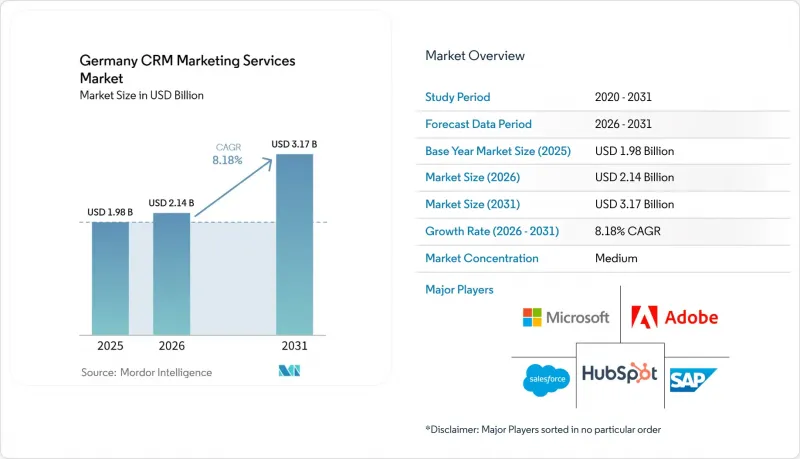
This report is Segmented by Service Type (CRM Strategy and Consulting, CRM Implementation, and More), Enterprise Size (Large Enterprises, and Small and Medium Enterprises), Service Application (Customer Acquisition, Customer Retention, and More), and End-User Industry (Banking, Financial Services, and Insurance (BFSI), and More). The Market Forecasts are Provided in Terms of Value (USD).
Germany CRM Marketing Services Market Trends and Insights
Under-Monetized Mid-Market CRM Modernization Demand in Mittelstand Firms
The unmet demand in the Germany CRM marketing services market is deepest in Mittelstand firms, where CRM use is already widespread but full value capture remains limited. Bitkom's 2026 survey said 72% of German companies use CRM marketing tools, but only 8% fully use their CRM system's capabilities, which leaves a large service gap after initial deployment. That gap keeps advisory, implementation, and managed services commercially relevant even after a company has installed a platform. Leadership transition inside family-owned firms is also moving customer management away from founder-led relationships and toward formal CRM processes. SAP's May 2026 move to extend SAP Commerce Cloud to Mittelstand and growing companies lowers the adoption threshold and widens the serviceable client pool.
Rising Demand for Data-Driven Personalization Across Customer Journeys
The Germany CRM marketing services market is also being supported by rising demand for more consistent personalization across acquisition, service, and loyalty programs. SAP Emarsys reported that true customer loyalty declined by 5 percentage points, while nearly 1 in 3 German customers is lost because of inconsistent customer experiences. Salesforce reported that 84% of German marketers still ran generic campaigns even though 75% had adopted AI, which points to configuration and data integration gaps rather than missing software. Bitkom also found that 76% of German enterprises expect marketing automation to become more important by 2027, while 35% cited the lack of an AI strategy as the main internal barrier. These conditions favor providers that can connect customer data, prove campaign attribution, and turn platform features into repeatable operating processes.
High Integration Complexity With Legacy ERP and CRM Environments
Legacy ERP and CRM environments remain a major brake on the Germany CRM marketing services market because many large German firms still run heavily customized systems built over long periods. Integrating CRM marketing workflows with SAP S/4HANA, DATEV connections, and local invoicing rules expands data mapping and middleware work in almost every large deployment. The same complexity increases the risk that implementation goals slip when data models, governance rules, and process ownership are not aligned early. In practice, providers often need longer diagnostic and migration phases before they can move into campaign execution or analytics optimization. When AI features are added, works council consultation can lengthen already complex projects and pressure delivery margins further.
Other drivers and restraints analyzed in the detailed report include:
- Stronger Enterprise Focus on CRM-To-Marketing Stack Integration
- Compliance-Led Shift Toward First-Party Data Activation
- Persistent Privacy and Consent Management Overhead
For complete list of drivers and restraints, kindly check the Table Of Contents.
Segment Analysis
CRM implementation and integration held 36.19% of the Germany CRM marketing services market share in 2025, which made it the revenue anchor for service providers operating in SAP-heavy client environments. That position reflects the recurring need to connect CRM workflows with ERP, commerce, analytics, tax, and invoicing systems before campaigns can scale. SAP's shift toward SAP Engagement Cloud and its Q1 2026 feature releases kept implementation work active because clients needed partner support to reconfigure customer data, orchestration rules, and reporting structures. In the Germany CRM marketing services industry, implementation work still carries strategic weight because it often determines whether later analytics and managed services can perform as promised.
CRM managed services are projected to expand at 11.93% CAGR through 2031, making it the fastest-growing service type in the Germany CRM marketing services market. Mittelstand firms increasingly prefer ongoing support because many lack dedicated CRM operations teams and want predictable delivery after go-live. Training and support remain relevant where providers embed German-language enablement into long-term contracts, which helps improve user adoption and reduces service friction. Basic implementation is becoming more standardized in the SME tier, while differentiation is shifting toward analytics, compliance support, and continuous optimization.
Large enterprises accounted for 68.49% of the Germany CRM marketing services market share in 2025, reflecting the weight of DAX 40 groups, large industrial companies, and major financial institutions. These clients usually run multi-platform environments across marketing, sales, service, and commerce, so service providers capture larger contract values and longer engagement timelines. Enterprise accounts also demand deeper specialization in SAP, Salesforce, governance, and sector-specific compliance, which favors providers with broad delivery benches. In the Germany CRM marketing services industry, large accounts remain the base load for revenue because their harmonization and modernization needs do not end after one deployment cycle.
Small and medium enterprises are projected to grow at 11.86% CAGR from 2026 to 2031, which makes them the fastest-expanding client tier in the Germany CRM marketing services market. Cloud-native platforms, shorter implementation cycles, and standardized service packages have made CRM adoption easier at Mittelstand price points. HubSpot's German-language support model and Frankfurt data residency proposition show why SME demand is moving toward faster deployments with ongoing managed support rather than large custom builds. This shift creates room for regional specialists that can deliver fixed-fee, compliant, and easy-to-manage service models for clients that are too large for self-service and too small for major consultancies.
Complete Report Scope:
- By Service Type
- CRM Strategy and Consulting
- CRM Implementation and Integration
- CRM Migration and Modernization
- CRM Managed Services
- CRM Training and Support
- By Enterprise Size
- Large Enterprises
- Small and Medium Enterprises
- By Service Application
- Customer Acquisition
- Customer Retention and Loyalty
- Campaign Management Services
- Marketing Automation Services
- Customer Analytics and Insights
- Omnichannel Customer Engagement
- Personalization Services
- By End-user Industry
- Banking, Financial Services, and Insurance (BFSI)
- Healthcare and Life Sciences
- Information Technology and Telecom
- Retail and E-commerce
- Industrial Manufacturing
- Government and Public Administration
- Other End-user Industries
List of Companies Covered in this Report:
- Salesforce, Inc.
- SAP SE
- Adobe Inc.
- HubSpot, Inc.
- Microsoft Corporation
- Oracle Corporation
- SAS Institute Inc.
- Zoho Corporation Pvt. Ltd.
- Pipedrive OU
- Mailchimp, LLC
- CAS Software AG
- weclapp GmbH
- CentralStationCRM GmbH
- TecArt GmbH
- Combit Software GmbH
- Accenture plc
- Deloitte Touche Tohmatsu Limited
- Publicis Groupe S.A.
- Merkle, Inc.
- WPP plc
Additional Benefits:
- The market estimate (ME) sheet in Excel format
- 3 months of analyst support
TABLE OF CONTENTS
1 INTRODUCTION
- 1.1 Study Assumptions and Market Definition
- 1.2 Scope of the Study
2 RESEARCH METHODOLOGY
3 EXECUTIVE SUMMARY
4 MARKET LANDSCAPE
- 4.1 Market Overview
- 4.2 Market Drivers
- 4.2.1 Rising Demand for Data-Driven Personalization Across Customer Journeys
- 4.2.2 Stronger Enterprise Focus on CRM-To-Marketing Stack Integration
- 4.2.3 Growth of Cloud-Native Marketing Service Delivery Models
- 4.2.4 Faster Adoption of AI-Assisted Campaign Orchestration
- 4.2.5 Under-Monetized Mid-Market CRM Modernization Demand in Mittelstand Firms
- 4.2.6 Compliance-Led Shift Toward First-Party Data Activation
- 4.3 Market Restraints
- 4.3.1 High Integration Complexity With Legacy ERP and CRM Environments
- 4.3.2 Persistent Privacy and Consent Management Overhead
- 4.3.3 Budget Scrutiny on Discretionary Marketing Transformation Spend
- 4.3.4 Shortage of Specialized CRM Marketing Talent and Implementation Capacity
- 4.4 Industry Value-Chain Analysis
- 4.5 Impact of Macroeconomic Factors on the Market
- 4.6 Regulatory Landscape
- 4.7 Technological Outlook
- 4.8 Porter's Five Forces Analysis
- 4.8.1 Threat of New Entrants
- 4.8.2 Bargaining Power of Suppliers
- 4.8.3 Bargaining Power of Buyers
- 4.8.4 Threat of Substitutes
- 4.8.5 Industry Rivalry
5 MARKET SIZE AND GROWTH FORECASTS (VALUE)
- 5.1 By Service Type
- 5.1.1 CRM Strategy and Consulting
- 5.1.2 CRM Implementation and Integration
- 5.1.3 CRM Migration and Modernization
- 5.1.4 CRM Managed Services
- 5.1.5 CRM Training and Support
- 5.2 By Enterprise Size
- 5.2.1 Large Enterprises
- 5.2.2 Small and Medium Enterprises
- 5.3 By Service Application
- 5.3.1 Customer Acquisition
- 5.3.2 Customer Retention and Loyalty
- 5.3.3 Campaign Management Services
- 5.3.4 Marketing Automation Services
- 5.3.5 Customer Analytics and Insights
- 5.3.6 Omnichannel Customer Engagement
- 5.3.7 Personalization Services
- 5.4 By End-user Industry
- 5.4.1 Banking, Financial Services, and Insurance (BFSI)
- 5.4.2 Healthcare and Life Sciences
- 5.4.3 Information Technology and Telecom
- 5.4.4 Retail and E-commerce
- 5.4.5 Industrial Manufacturing
- 5.4.6 Government and Public Administration
- 5.4.7 Other End-user Industries
6 COMPETITIVE LANDSCAPE
- 6.1 Market Concentration
- 6.2 Strategic Moves
- 6.3 Market Share Analysis
- 6.4 Company Profiles (includes Global Level Overview, Market Level Overview, Core Segments, Financials as available, Strategic Information, Market Rank/Share, Products and Services, Recent Developments)
- 6.4.1 Salesforce, Inc.
- 6.4.2 SAP SE
- 6.4.3 Adobe Inc.
- 6.4.4 HubSpot, Inc.
- 6.4.5 Microsoft Corporation
- 6.4.6 Oracle Corporation
- 6.4.7 SAS Institute Inc.
- 6.4.8 Zoho Corporation Pvt. Ltd.
- 6.4.9 Pipedrive OU
- 6.4.10 Mailchimp, LLC
- 6.4.11 CAS Software AG
- 6.4.12 weclapp GmbH
- 6.4.13 CentralStationCRM GmbH
- 6.4.14 TecArt GmbH
- 6.4.15 Combit Software GmbH
- 6.4.16 Accenture plc
- 6.4.17 Deloitte Touche Tohmatsu Limited
- 6.4.18 Publicis Groupe S.A.
- 6.4.19 Merkle, Inc.
- 6.4.20 WPP plc
7 MARKET OPPORTUNITIES AND FUTURE OUTLOOK
- 7.1 White-Space and Unmet-Need Assessment

