PUBLISHER: Mordor Intelligence | PRODUCT CODE: 2099225

PUBLISHER: Mordor Intelligence | PRODUCT CODE: 2099225
Malaysia CRM Marketing Services Market - Market Share Analysis, Industry Trends & Statistics, Growth Forecasts (2026 - 2031)
According to Mordor Intelligence, the Malaysia CRM marketing services market size is projected to expand from USD 129.10 million in 2025 and USD 150.57 million in 2026 to USD 329.26 million by 2031, registering a CAGR of 16.94% between 2026 to 2031.
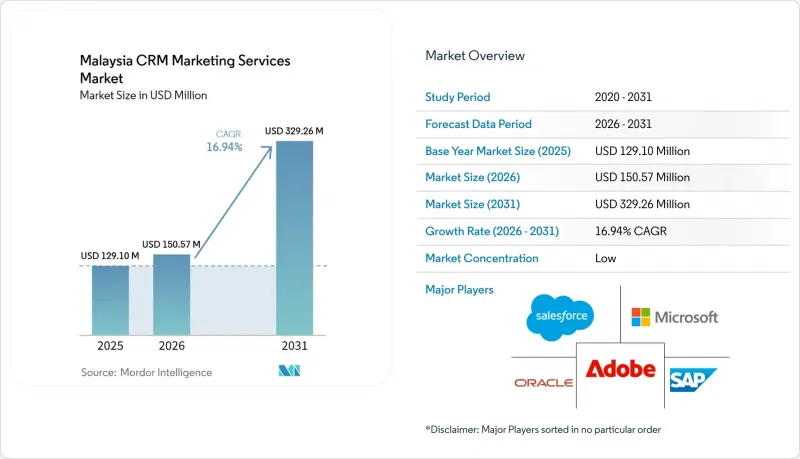
This report is Segmented by Service Type (CRM Implementation and Integration, CRM Migration and Modernization, and More), Enterprise Size (Large Enterprises, and Small and Medium Enterprises), Service Application (Customer Acquisition, Personalization Services, and More), and End-User Industry (Healthcare and Life Sciences, and More). The Market Forecasts are Provided in Terms of Value (USD).
Malaysia CRM Marketing Services Market Trends and Insights
Rising First-Party Data Prioritization After Cookie Restrictions
A decisive move toward first-party data is shaping the Malaysia CRM marketing services market as third-party tracking becomes less dependable. Malaysia's Personal Data Protection Amendment Act 2024 was implemented in stages from January to June 2025 and introduced data portability rights, mandatory breach notification, and a risk-based approach to cross-border transfers. That shift made consent design, customer data pipelines, and compliant segmentation tools more central to CRM projects in the Malaysia CRM marketing services market. Companies that once relied on external audience pools now need internal customer records to support targeting, measurement, and retention without weak consent practices. Star Media Group's selection of Antsomi CDP 365 in March 2025 showed how enterprises were already moving to unify first-party data across publishing, radio, and events operations. The result is a market where compliance raises delivery complexity, but it also turns data governance into a recurring revenue stream for service providers.
WhatsApp-First And Mobile-First Customer Engagement Models
The Malaysia CRM marketing services market is also being redirected by messaging-led customer engagement. The Malaysian Communications and Multimedia Commission reported in 2025 that more than 97% of internet users in the country accessed the internet via mobile devices, further reinforcing the case for mobile-first CRM design. In practice, that behavior makes WhatsApp and related chat tools more important than standard email sequences for many local campaigns in the Malaysia CRM marketing services market. Service providers now need to build workflows for chat triggers, template approvals, multilingual messaging, and real-time customer responses. This has given local firms an advantage, as buyers increasingly want Bahasa Malaysia, English, and Mandarin support built into campaign execution, training, and follow-up processes. It also changes the value of CRM services, because implementation quality now depends on how well the platform supports conversational outreach rather than only how well it stores contacts.
PDPA Compliance Burden and Consent Management Complexity
PDPA enforcement has strengthened the long-term case for CRM investment, but it has also slowed parts of the Malaysia CRM marketing services market. Penalties for breaches of core data protection principles increased, and imprisonment terms rose from 2 to 3 years, making weak compliance a material legal risk. From June 2025, organizations were also required to appoint at least 1 Data Protection Officer and maintain more formal records for cross-border transfers and breach handling. That raised the service scope of many projects in the Malaysia CRM marketing services market, because buyers now expect consent configuration, governance support, audit readiness, and transfer documentation within the delivery model. SMEs are more exposed to the drag, since many do not have internal legal, privacy, or data governance teams to share this work. Providers, therefore, face margin pressure when compliance support expands faster than the original pricing structure allows.
Other drivers and restraints analyzed in the detailed report include:
- SME Digitalization Grants and Subsidized SaaS Adoption
- AI-Assisted Campaign Orchestration and Lead Scoring
- Fragmented MarTech and CRM Stack Integration
For complete list of drivers and restraints, kindly check the Table Of Contents.
Segment Analysis
CRM implementation and integration led with 57.19% of the Malaysia CRM marketing services market share in 2025, which showed that core deployment work still anchored demand. That position reflected the fact that many organizations were either launching CRM programs for the first time or consolidating older systems into more unified environments. The Malaysia CRM marketing services market still carries an early-to-mid maturity profile when compared with more saturated parts of Asia Pacific, so first-wave deployment demand remains strong. Migration and modernization work also expanded as companies moved away from legacy or limited SaaS versions and toward cloud-ready setups that support faster analytics and stronger governance. Strategy and consulting remained relevant because many buyers needed help connecting CRM spending to acquisition, retention, service quality, and internal reporting needs.
Managed services are projected to grow at a 18.87% CAGR through 2031, making it the fastest-expanding service type in the Malaysia CRM marketing services market. This shift reflects the gap between what enterprises want from CRM optimization and what many internal teams can sustain after go-live. Buyers increasingly prefer subscription-style support that covers platform administration, campaign execution, reporting, and ongoing performance monitoring. That model also fits the talent shortage inside the Malaysia CRM marketing services industry, because clients can access specialized skills without building full in-house teams. For providers, the move from project work to recurring support improves revenue visibility and deepens client retention across the Malaysia CRM marketing services market.
Large enterprises held 67.98% share of the Malaysia CRM marketing services market size in 2025, which confirmed that major banks, telecom operators, retail groups, and diversified corporations still account for most contract value. Their projects are larger because they often involve multiple divisions, tighter governance, more integrations, and higher compliance exposure. This part of the Malaysia CRM marketing services market also favors vendors that can manage long implementation cycles and enterprise-level service architecture. Maybank's August 2025 strategic partnership with Microsoft showed the scale at which top-tier financial institutions are committing to cloud, AI, and customer experience capabilities. Enterprise demand, therefore, remains tied not only to software selection but also to transformation programs that span analytics, productivity, service responsiveness, and personalized customer engagement.
SMEs are projected to grow at a 19.34% CAGR through 2031, which makes them the fastest-growing enterprise cohort in the Malaysia CRM marketing services market. The strongest enabler remains the grant-backed adoption model, as co-funding lowered entry costs for smaller firms that had previously delayed CRM spending. Local platforms also gained favor when they offered WhatsApp integration, local tax alignment, practical onboarding, and multilingual support at a lower total cost. This part of the Malaysia CRM marketing services industry is becoming more structured as buyers seek bundles that combine software access, setup, training, and campaign execution. The result is a more active SME layer that complements enterprise demand rather than replacing it.
Complete Report Scope:
- By Service Type
- CRM Strategy and Consulting
- CRM Implementation and Integration
- CRM Migration and Modernization
- CRM Managed Services
- CRM Training and Support
- By Enterprise Size
- Large Enterprises
- Small and Medium Enterprises
- By Service Application
- Customer Acquisition
- Customer Retention and Loyalty
- Campaign Management Services
- Marketing Automation Services
- Customer Analytics and Insights
- Omnichannel Customer Engagement
- Personalization Services
- By End-user Industry
- Banking, Financial Services, and Insurance (BFSI)
- Healthcare and Life Sciences
- Information Technology and Telecom
- Retail and E-commerce
- Industrial Manufacturing
- Government and Public Administration
- Other End-user Industries
List of Companies Covered in this Report:
- Salesforce, Inc.
- Microsoft Corporation
- Oracle Corporation
- SAP SE
- HubSpot, Inc.
- Zoho Corporation Private Limited
- Freshworks Inc.
- Adobe Inc.
- ActiveCampaign, LLC
- Zendesk, Inc.
- Pipedrive OU
- monday.com Ltd.
- Klaviyo, Inc.
- Braze, Inc.
- Mailchimp, Intuit Inc.
- KloudConnect Sdn. Bhd.
- MYSense Sdn. Bhd.
- Marketing By Ali Sdn. Bhd.
- ML IT Partners Sdn Bhd
- KKBC Pte. Ltd.
Additional Benefits:
- The market estimate (ME) sheet in Excel format
- 3 months of analyst support
TABLE OF CONTENTS
1 INTRODUCTION
- 1.1 Study Assumptions and Market Definition
- 1.2 Scope of the Study
2 RESEARCH METHODOLOGY
3 EXECUTIVE SUMMARY
4 MARKET LANDSCAPE
- 4.1 Market Overview
- 4.2 Market Drivers
- 4.2.1 Rising First-Party Data Prioritization After Cookie Restrictions
- 4.2.2 WhatsApp-First and Mobile-First Customer Engagement Models
- 4.2.3 SME Digitalization Grants and Subsidized SaaS Adoption
- 4.2.4 AI-Assisted Campaign Orchestration and Lead Scoring
- 4.2.5 Omnichannel Retention Demand Across Retail, BFSI, and Services
- 4.2.6 Cross-Platform Integration With E-Commerce, ERP, and E-Invoicing Stacks
- 4.3 Market Restraints
- 4.3.1 PDPA Compliance Burden and Consent Management Complexity
- 4.3.2 Fragmented MarTech and CRM Stack Integration
- 4.3.3 Shortage of CRM Implementation and Automation Talent
- 4.3.4 Budget Sensitivity and Slow ROI Recognition Among SMEs
- 4.4 Industry Value Chain Analysis
- 4.5 Impact of Macroeconomic Factors on the Market
- 4.6 Regulatory Landscape
- 4.7 Technological Outlook
- 4.8 Porter's Five Forces Analysis
- 4.8.1 Bargaining Power of Suppliers
- 4.8.2 Bargaining Power of Buyers
- 4.8.3 Threat of New Entrants
- 4.8.4 Threat of Substitutes
- 4.8.5 Intensity of Competitive Rivalry
5 MARKET SIZE AND GROWTH FORECASTS (VALUE)
- 5.1 By Service Type
- 5.1.1 CRM Strategy and Consulting
- 5.1.2 CRM Implementation and Integration
- 5.1.3 CRM Migration and Modernization
- 5.1.4 CRM Managed Services
- 5.1.5 CRM Training and Support
- 5.2 By Enterprise Size
- 5.2.1 Large Enterprises
- 5.2.2 Small and Medium Enterprises
- 5.3 By Service Application
- 5.3.1 Customer Acquisition
- 5.3.2 Customer Retention and Loyalty
- 5.3.3 Campaign Management Services
- 5.3.4 Marketing Automation Services
- 5.3.5 Customer Analytics and Insights
- 5.3.6 Omnichannel Customer Engagement
- 5.3.7 Personalization Services
- 5.4 By End-user Industry
- 5.4.1 Banking, Financial Services, and Insurance (BFSI)
- 5.4.2 Healthcare and Life Sciences
- 5.4.3 Information Technology and Telecom
- 5.4.4 Retail and E-commerce
- 5.4.5 Industrial Manufacturing
- 5.4.6 Government and Public Administration
- 5.4.7 Other End-user Industries
6 COMPETITIVE LANDSCAPE
- 6.1 Market Concentration
- 6.2 Strategic Moves
- 6.3 Market Share Analysis
- 6.4 Company Profiles (includes Global Level Overview, Market Level Overview, Core Segments, Financials as available, Strategic Information, Market Rank/Share, Products and Services, Recent Developments)
- 6.4.1 Salesforce, Inc.
- 6.4.2 Microsoft Corporation
- 6.4.3 Oracle Corporation
- 6.4.4 SAP SE
- 6.4.5 HubSpot, Inc.
- 6.4.6 Zoho Corporation Private Limited
- 6.4.7 Freshworks Inc.
- 6.4.8 Adobe Inc.
- 6.4.9 ActiveCampaign, LLC
- 6.4.10 Zendesk, Inc.
- 6.4.11 Pipedrive OU
- 6.4.12 monday.com Ltd.
- 6.4.13 Klaviyo, Inc.
- 6.4.14 Braze, Inc.
- 6.4.15 Mailchimp, Intuit Inc.
- 6.4.16 KloudConnect Sdn. Bhd.
- 6.4.17 MYSense Sdn. Bhd.
- 6.4.18 Marketing By Ali Sdn. Bhd.
- 6.4.19 ML IT Partners Sdn Bhd
- 6.4.20 KKBC Pte. Ltd.
7 MARKET OPPORTUNITIES AND FUTURE OUTLOOK
- 7.1 White-Space and Unmet-Need Assessment

