PUBLISHER: Mordor Intelligence | PRODUCT CODE: 2099223

PUBLISHER: Mordor Intelligence | PRODUCT CODE: 2099223
France CRM Marketing Services Market - Market Share Analysis, Industry Trends & Statistics, Growth Forecasts (2026 - 2031)
According to Mordor Intelligence, the France CRM marketing services market size is expected to increase from USD 1.26 billion in 2025 to USD 1.38 billion in 2026 and reach USD 2.18 billion by 2031, growing at a CAGR of 9.58% over 2026-2031.
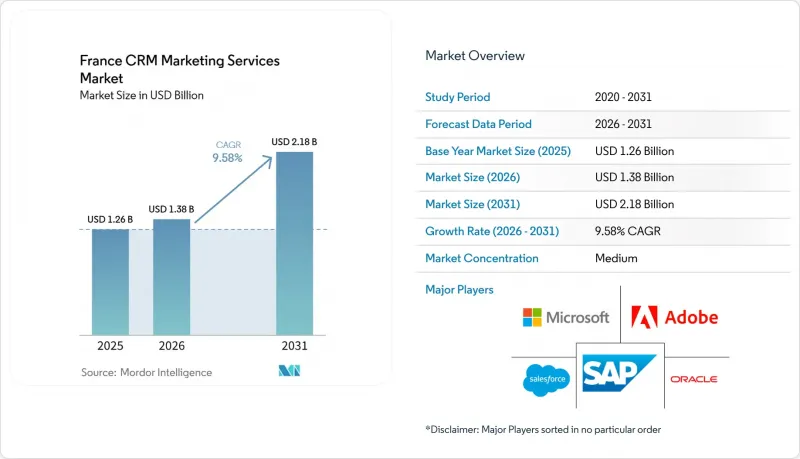
This report is Segmented by Service Type (CRM Strategy and Consulting, CRM Implementation, and More), Enterprise Size (Large Enterprises, and Small and Medium Enterprises), Service Application (Customer Acquisition, Customer Retention, and More), and End-User Industry (Banking, Financial Services, and Insurance (BFSI), and More). The Market Forecasts are Provided in Terms of Value (USD).
France CRM Marketing Services Market Trends and Insights
Rising SME Adoption of Structured Customer Data Workflows
Small and medium enterprises are moving from informal customer tracking toward structured CRM processes, and that shift is broadening the client base for the France CRM marketing services market. France Num's 2025 Barometer found that 75% of French TPE and PME already use client and sales data to steer activity, which shows that data-led decision making has moved well beyond large enterprises. The same market direction is visible in near-term buying plans, with 43% of French organizations saying they plan to deploy or change their CRM platform in the near term. A 2025 peer-reviewed study found that CRM performance in SMEs improves when technology is matched with structured customer knowledge workflows, which supports demand for advisory, implementation, and adoption support rather than software alone. This pattern is one reason SMEs are becoming the fastest-growing enterprise tier in the France CRM marketing services market, especially as quick-start programs and modular cloud platforms lower entry barriers.
Generative AI Assisted Campaign Orchestration
Generative AI is changing campaign management from a manual process into a more continuous operating model, and that is creating fresh service demand across the France CRM marketing services market. Salesforce reported in 2025 that 75% of marketers had adopted AI, yet 84% still admitted they run generic campaigns, which points to a gap between tool adoption and execution quality. The same report found that marketers with unified customer data were 60% more likely to use AI agents to scale engagement, which makes data integration and CRM configuration work more important. SAP and Google Cloud expanded their partnership in April 2026 to deploy Joule Agents within SAP CX, allowing marketers to set business goals and let AI coordinate personalization, launch activity, and conversational engagement across channels. As AI moves inside the CRM layer, service work is shifting toward tuning, governance, integration, and ongoing oversight rather than one-time deployment.
Budget Pressure in Large Accounts and Slower Replacement Cycles
Large enterprises remain important buyers in the France CRM marketing services market, but they are reviewing CRM renewal budgets more carefully than before. Multi-year contracts now face stronger scrutiny because platform costs, AI spending priorities, and license escalation clauses can all compete for the same budget pool. This often slows seat expansion, delays module additions, and stretches replacement cycles for older CRM estates. The effect is strongest in large accounts where implementation and upgrade work tends to be highest in value. Smaller service providers are more exposed when these decisions are postponed because they often depend more heavily on discretionary project revenue than diversified global integrators.
Other drivers and restraints analyzed in the detailed report include:
- Shift to First-Party Data and Consent-Based Marketing
- Rising Demand for Unified Sales, Service, and Marketing Operations
- Fragmented Legacy Systems Increasing Integration Complexity
For complete list of drivers and restraints, kindly check the Table Of Contents.
Segment Analysis
CRM implementation and integration held 36.11% of France CRM marketing services market share in 2025, while CRM managed services are projected to grow at a 12.46% CAGR through 2031. Implementation and integration remained the largest service type because major buyers still need vendor selection, system design, migration planning, and workflow alignment when they consolidate older CRM environments. This pattern is especially visible in financial services and telecom programs where data controls, permissions, and reporting requirements make delivery more complex. Strategy and consulting continue to act as the entry point for first-time buyers and for firms that are reassessing platform fit before committing to larger rollouts. Migration and modernization are also gaining weight as enterprises that deployed Salesforce or Microsoft Dynamics years ago now need cleaner data structures, updated integrations, and AI-ready configurations.
Training and support remain the smallest service type by revenue, but they still matter in enterprise deployments, where change management and user adoption influence project outcomes. The service mix is also shifting because newer CRM environments require more continuous operational oversight than earlier generations of platform deployments. Microsoft's June 2026 view of agentic CRM shows why this matters, since AI now captures and updates customer data in the flow of work rather than after the fact. SAP's April 2026 expansion with Google Cloud points in the same direction because AI agents are being embedded directly into customer engagement processes. As a result, the France CRM marketing services market is moving toward a more recurring revenue profile in which managed services, governance, optimization, and AI supervision carry more weight over time.
Large enterprises accounted for 67.51% of the France CRM marketing services market size in 2025, while Small and Medium Enterprises are projected to expand at a 13.29% CAGR through 2031. Large organizations still dominate revenue because they manage broader user bases, more complex integration estates, and tighter regulatory obligations than smaller firms. These buyers also tend to run multi-phase programs that include architecture work, rollout support, change management, and longer post-launch service commitments. Even so, the faster growth path is shifting toward SMEs as cloud pricing, modular packages, and simpler deployment models improve accessibility. That change is widening the addressable base of the France CRM marketing services market beyond traditional large-account demand.
The momentum behind SMEs is supported by clear signals from the French business environment. France Num reported that 75% of TPE and PME already use client and sales data to guide business activity, which shows that the habit of structured customer management is already taking hold. Another 43% of organizations said they plan to deploy or change their CRM platform in the near term, which supports a healthy near-term service pipeline. The 2025 peer-reviewed study on SMEs also showed that strong CRM outcomes depend on customer knowledge workflows, not just software capability, which supports demand for process design and adoption services. This gives smaller specialist firms room to compete through fixed-scope rollout programs, faster implementation cycles, and operating models tailored to mid-market clients.
Complete Report Scope:
- By Service Type
- CRM Strategy and Consulting
- CRM Implementation and Integration
- CRM Migration and Modernization
- CRM Managed Services
- CRM Training and Support
- By Enterprise Size
- Large Enterprises
- Small and Medium Enterprises
- By Service Application
- Customer Acquisition
- Customer Retention and Loyalty
- Campaign Management Services
- Marketing Automation Services
- Customer Analytics and Insights
- Omnichannel Customer Engagement
- Personalization Services
- By End-user Industry
- Banking, Financial Services, and Insurance (BFSI)
- Healthcare and Life Sciences
- Information Technology and Telecom
- Retail and E-commerce
- Industrial Manufacturing
- Government and Public Administration
- Other End-user Industries
List of Companies Covered in this Report:
- Salesforce, Inc.
- Microsoft Corporation
- SAP SE
- Oracle Corporation
- Adobe Inc.
- HubSpot, Inc.
- Capgemini SE
- Accenture plc
- Publicis Groupe S.A.
- Capita Plc
- Brevo
- Divalto
- Synolia
- Markentive
- ALMAVIA CX
- ChapsVision
- Commanders Act
- Klee Group
- Ouidou
- Devoteam
- Isatech
- SQLI
Additional Benefits:
- The market estimate (ME) sheet in Excel format
- 3 months of analyst support
TABLE OF CONTENTS
1 INTRODUCTION
- 1.1 Study Assumptions and Market Definition
- 1.2 Scope of the Study
2 RESEARCH METHODOLOGY
3 EXECUTIVE SUMMARY
4 MARKET LANDSCAPE
- 4.1 Market Overview
- 4.2 Impact of Macroeconomic Factors on the Market
- 4.3 Market Drivers
- 4.3.1 Rising SME Adoption of Structured Customer Data Workflows
- 4.3.2 Generative AI Assisted Campaign Orchestration
- 4.3.3 Shift to First-Party Data and Consent-Based Marketing
- 4.3.4 Rising Demand for Unified Sales, Service, and Marketing Operations
- 4.3.5 Composable Customer Data Platform Adoption in Regulated Enterprises
- 4.3.6 Verticalized CRM Services for Industry-Specific Workflows
- 4.4 Market Restraints
- 4.4.1 Budget Pressure in Large Accounts and Slower Replacement Cycles
- 4.4.2 Fragmented Legacy Systems Increasing Integration Complexity
- 4.4.3 Data Privacy, Consent, and AI Governance Constraints
- 4.4.4 Talent Shortage in CRM Architecture, MarTech, and Data Operations
- 4.5 Industry Value-Chain Analysis
- 4.6 Regulatory Landscape
- 4.7 Technological Outlook
- 4.8 Porter's Five Forces Analysis
- 4.8.1 Threat of New Entrants
- 4.8.2 Bargaining Power of Buyers
- 4.8.3 Bargaining Power of Suppliers
- 4.8.4 Threat of Substitutes
- 4.8.5 Intensity of Competitive Rivalry
5 MARKET SIZE AND GROWTH FORECASTS (VALUE)
- 5.1 By Service Type
- 5.1.1 CRM Strategy and Consulting
- 5.1.2 CRM Implementation and Integration
- 5.1.3 CRM Migration and Modernization
- 5.1.4 CRM Managed Services
- 5.1.5 CRM Training and Support
- 5.2 By Enterprise Size
- 5.2.1 Large Enterprises
- 5.2.2 Small and Medium Enterprises
- 5.3 By Service Application
- 5.3.1 Customer Acquisition
- 5.3.2 Customer Retention and Loyalty
- 5.3.3 Campaign Management Services
- 5.3.4 Marketing Automation Services
- 5.3.5 Customer Analytics and Insights
- 5.3.6 Omnichannel Customer Engagement
- 5.3.7 Personalization Services
- 5.4 By End-user Industry
- 5.4.1 Banking, Financial Services, and Insurance (BFSI)
- 5.4.2 Healthcare and Life Sciences
- 5.4.3 Information Technology and Telecom
- 5.4.4 Retail and E-commerce
- 5.4.5 Industrial Manufacturing
- 5.4.6 Government and Public Administration
- 5.4.7 Other End-user Industries
6 COMPETITIVE LANDSCAPE
- 6.1 Market Concentration
- 6.2 Strategic Moves
- 6.3 Market Share Analysis
- 6.4 Company Profiles (includes Global Level Overview, Market Level Overview, Core Segments, Financials as available, Strategic Information, Market Rank/Share, Products and Services, Recent Developments)
- 6.4.1 Salesforce, Inc.
- 6.4.2 Microsoft Corporation
- 6.4.3 SAP SE
- 6.4.4 Oracle Corporation
- 6.4.5 Adobe Inc.
- 6.4.6 HubSpot, Inc.
- 6.4.7 Capgemini SE
- 6.4.8 Accenture plc
- 6.4.9 Publicis Groupe S.A.
- 6.4.10 Capita Plc
- 6.4.11 Brevo
- 6.4.12 Divalto
- 6.4.13 Synolia
- 6.4.14 Markentive
- 6.4.15 ALMAVIA CX
- 6.4.16 ChapsVision
- 6.4.17 Commanders Act
- 6.4.18 Klee Group
- 6.4.19 Ouidou
- 6.4.20 Devoteam
- 6.4.21 Isatech
- 6.4.22 SQLI
7 MARKET OPPORTUNITIES AND FUTURE OUTLOOK
- 7.1 White-space and Unmet-Need Assessment

