PUBLISHER: Mordor Intelligence | PRODUCT CODE: 2099102

PUBLISHER: Mordor Intelligence | PRODUCT CODE: 2099102
Asia-Pacific CRM Marketing Services Market - Market Share Analysis, Industry Trends & Statistics, Growth Forecasts (2026 - 2031)
According to Mordor Intelligence, the Asia-Pacific CRM marketing services market size was valued at USD 7.14 billion in 2025 and USD 8.05 billion in 2026, and is forecast to reach USD 14.72 billion by 2031, at a CAGR of 12.83% from 2026 to 2031.
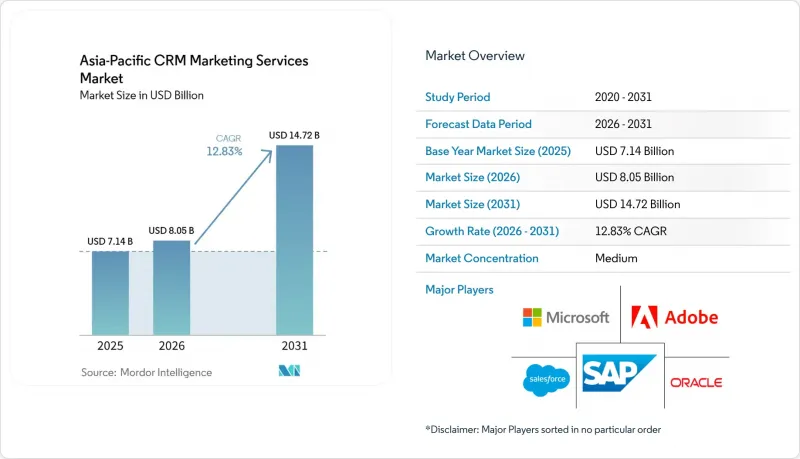
This report is Segmented by Service Type (CRM Strategy and Consulting, CRM Implementation, and More), Enterprise Size (Large Enterprises, and Small and Medium Enterprises), Service Application (Customer Acquisition, Customer Retention, and More), End-User Industry (Banking, Financial Services, and Insurance, and More), and Country. The Market Forecasts are Provided in Terms of Value (USD).
Asia-Pacific CRM Marketing Services Market Trends and Insights
Rising Need for AI-Driven Customer Journey Orchestration
AI is becoming a standard operating layer for the Asia-Pacific CRM marketing services market, not a niche feature reserved for early adopters. Enterprises across the region are trying to manage large volumes of customer interactions across sales, service, and marketing channels without depending on disconnected tools. That shift is increasing demand for service providers that can unify campaign execution, personalization, analytics, and support workflows inside one operating model. It is also pushing more spending toward longer-duration managed contracts instead of one-time implementation work. Salesforce reinforced this direction in March 2025 when it committed USD 1 billion in Singapore over 5 years to support Agentforce adoption, Hyperforce expansion, and AI development with Singapore Airlines, showing how platform vendors are tying AI capability to regional CRM service growth. As more enterprises expect AI-assisted case handling and next-best-action workflows, the Asia-Pacific CRM marketing services market is shifting toward providers that can manage both platform setup and ongoing orchestration at scale.
Expansion of First-Party Data Strategies Across Privacy-Sensitive Markets
The Asia-Pacific CRM marketing services market is also benefiting from the move toward first-party data strategies across countries with tighter privacy expectations. Enterprises can no longer rely on a single regional activation model when consent rules, data transfer requirements, and local storage expectations differ from one jurisdiction to another. This is making CRM architecture more country-aware, especially in China, India, Singapore, Indonesia, and other regulated markets. Service providers that can connect consent management, data residency design, and CRM activation are gaining a stronger role in buying decisions. Salesforce's April 2025 expansion of Hyperforce data residency in Singapore reflected this need, especially for organizations in regulated sectors that require local handling of customer data. As privacy rules become part of core CRM planning, the Asia-Pacific CRM marketing services market is moving toward service models where compliance design and customer engagement execution sit much closer together.
Fragmented Consent Management Across Asia-Pacific Jurisdictions
Consent management remains a real barrier for the Asia-Pacific CRM marketing services market because regional deployments still face different national requirements for customer data handling. Programs that appear compliant at a regional level may still need redesign when they enter China, India, Indonesia, Vietnam, or other markets with specific processing and transfer rules. This raises delivery costs for service providers because architecture, workflows, and governance often need to be tailored country by country. It also slows execution, especially when real-time personalization depends on data movement across borders or between business units. Multi-country CRM programs, therefore, carry a higher compliance burden than their surface design suggests, and that burden affects pricing, staffing, and project timing. Until more organizations standardize local consent frameworks within their CRM programs, the Asia-Pacific CRM marketing services market will continue to face friction in cross-border activation and regional operating efficiency.
Other drivers and restraints analyzed in the detailed report include:
- Growth of Commerce Media and Retail CRM Activation Budgets
- Shift From Campaign Execution to Revenue Operations Alignment
- Difficulty Proving Incremental ROI in Multi-Touch CRM Programs
For complete list of drivers and restraints, kindly check the Table Of Contents.
Segment Analysis
Implementation and integration held 36.12% of revenue in 2025, making it the largest service category in the Asia-Pacific CRM marketing services market. That share reflects the scale of ongoing deployment work across enterprises that are replacing older on-premises tools and aligning CRM with ERP, commerce, and data platforms. The work is often complex because large organizations operate across several countries, each with different data needs, workflow rules, and customer channels. Migration and modernization work continues to support this pipeline, especially where older CRM estates still shape system architecture and data structures. Strategy and consulting remain important because many deployments begin with roadmap, platform, and operating model decisions before implementation starts.
The service mix is now shifting as managed services become the fastest-growing sub-segment, with a projected 15.91% CAGR through 2031 in the Asia-Pacific CRM marketing services market. Companies are increasingly outsourcing platform administration, campaign execution, analytics support, and data hygiene because internal teams often cannot cover all of these functions consistently. This is changing the commercial model of the CRM services industry, as providers move from project-heavy delivery into longer recurring contracts. Outcome-linked delivery is also becoming more relevant because clients want providers to support measurable improvements, not only technical stability. In practical terms, implementation still anchors current revenue, but managed services are setting the longer-term direction of the Asia-Pacific CRM marketing services market.
Large enterprises accounted for 66.81% of revenue in 2025, which shows how much of the Asia-Pacific CRM marketing services market still depends on large, multi-country contracts. These programs usually involve customized integrations, dedicated governance structures, broader compliance review, and longer timelines than SME deployments. Large organizations also tend to buy premium support and ongoing optimization work after the first implementation is complete. This makes them central to near-term revenue even when procurement cycles are slower. The high share also reflects the fact that many large enterprises are still modernizing older CRM setups rather than starting from scratch.
SMEs are projected to grow at 14.68% CAGR through 2031, making them the fastest-moving opportunity set in the Asia-Pacific CRM marketing services market. Lower-cost cloud models, grant support, and simplified deployment pathways are helping smaller businesses adopt CRM services earlier than before. Government-linked support has reinforced this trend, including Salesforce's January 2026 startup program in Malaysia and the Philippines, which was designed to strengthen the regional innovation ecosystem and support wider technology deployment. As SME demand expands, the Asia-Pacific CRM services industry is seeing stronger interest in templated implementations, lighter onboarding models, and scalable managed service packages. Large enterprises still dominate revenue today, but SMEs are widening the addressable base of the Asia-Pacific CRM marketing services market with faster adoption across cloud-first operating environments.
Complete Report Scope:
- By Service Type
- CRM Strategy and Consulting
- CRM Implementation and Integration
- CRM Migration and Modernization
- CRM Managed Services
- CRM Training and Support
- By Enterprise Size
- Large Enterprises
- Small and Medium Enterprises
- By Service Application
- Customer Acquisition
- Customer Retention and Loyalty
- Campaign Management Services
- Marketing Automation Services
- Customer Analytics and Insights
- Omnichannel Customer Engagement
- Personalization Services
- By End-user Industry
- Banking, Financial Services, and Insurance (BFSI)
- Healthcare and Life Sciences
- Information Technology and Telecom
- Retail and E-commerce
- Industrial Manufacturing
- Government and Public Administration
- Other End-user Industries
- By Country
- China
- Japan
- India
- South Korea
- Australia
- Indonesia
- Malaysia
- Thailand
- Rest of Asia-Pacific
List of Companies Covered in this Report:
- Salesforce, Inc.
- Adobe Inc.
- Microsoft Corporation
- Oracle Corporation
- SAP SE
- HubSpot, Inc.
- Zoho Corporation Pvt. Ltd.
- Freshworks Inc.
- Braze, Inc.
- Iterable, Inc.
- Insider
- CleverTap
- MoEngage
- Klaviyo, Inc.
- SAS Institute Inc.
- Teradata Corporation
- Emarsys eMarketing Systems AG
- Acxiom LLC
- Maropost Inc.
- Customer.io, Inc.
Additional Benefits:
- The market estimate (ME) sheet in Excel format
- 3 months of analyst support
TABLE OF CONTENTS
1 INTRODUCTION
- 1.1 Study Assumptions and Market Definition
- 1.2 Scope of the Study
2 RESEARCH METHODOLOGY
3 EXECUTIVE SUMMARY
4 MARKET LANDSCAPE
- 4.1 Market Overview
- 4.2 Market Drivers
- 4.2.1 Rising Need for AI-Driven Customer Journey Orchestration
- 4.2.2 Expansion of First-Party Data Strategies Across Privacy-Sensitive Markets
- 4.2.3 Growth of Commerce Media and Retail CRM Activation Budgets
- 4.2.4 Shift From Campaign Execution to Revenue Operations Alignment
- 4.2.5 Adoption of Real-Time Personalization Across Super-Apps and Mobile-First Ecosystems
- 4.2.6 Underutilized Customer Data in Legacy MarTech Stacks Creating Outsourcing Demand
- 4.3 Market Restraints
- 4.3.1 Fragmented Consent Management Across Asia-Pacific Jurisdictions
- 4.3.2 Difficulty Proving Incremental ROI in Multi-Touch CRM Programs
- 4.3.3 Skills Shortage in Marketing Automation, Data Engineering, and CRM Ops
- 4.3.4 Integration Complexity Across CRM, CDP, and Commerce Platforms
- 4.4 Industry Value-Chain Analysis
- 4.5 Impact of Macroeconomic Factors on the Market
- 4.6 Regulatory Landscape
- 4.7 Technological Outlook
- 4.8 Porter's Five Forces Analysis
- 4.8.1 Bargaining Power of Suppliers
- 4.8.2 Bargaining Power of Buyers
- 4.8.3 Threat of New Entrants
- 4.8.4 Threat of Substitutes
- 4.8.5 Intensity of Competitive Rivalry
5 MARKET SIZE AND GROWTH FORECASTS (VALUE)
- 5.1 By Service Type
- 5.1.1 CRM Strategy and Consulting
- 5.1.2 CRM Implementation and Integration
- 5.1.3 CRM Migration and Modernization
- 5.1.4 CRM Managed Services
- 5.1.5 CRM Training and Support
- 5.2 By Enterprise Size
- 5.2.1 Large Enterprises
- 5.2.2 Small and Medium Enterprises
- 5.3 By Service Application
- 5.3.1 Customer Acquisition
- 5.3.2 Customer Retention and Loyalty
- 5.3.3 Campaign Management Services
- 5.3.4 Marketing Automation Services
- 5.3.5 Customer Analytics and Insights
- 5.3.6 Omnichannel Customer Engagement
- 5.3.7 Personalization Services
- 5.4 By End-user Industry
- 5.4.1 Banking, Financial Services, and Insurance (BFSI)
- 5.4.2 Healthcare and Life Sciences
- 5.4.3 Information Technology and Telecom
- 5.4.4 Retail and E-commerce
- 5.4.5 Industrial Manufacturing
- 5.4.6 Government and Public Administration
- 5.4.7 Other End-user Industries
- 5.5 By Country
- 5.5.1 China
- 5.5.2 Japan
- 5.5.3 India
- 5.5.4 South Korea
- 5.5.5 Australia
- 5.5.6 Indonesia
- 5.5.7 Malaysia
- 5.5.8 Thailand
- 5.5.9 Rest of Asia-Pacific
6 COMPETITIVE LANDSCAPE
- 6.1 Market Concentration
- 6.2 Strategic Moves
- 6.3 Market Share Analysis
- 6.4 Company Profiles (includes Global Level Overview, Market Level Overview, Core Segments, Financials as available, Strategic Information, Market Rank/Share, Products and Services, Recent Developments)
- 6.4.1 Salesforce, Inc.
- 6.4.2 Adobe Inc.
- 6.4.3 Microsoft Corporation
- 6.4.4 Oracle Corporation
- 6.4.5 SAP SE
- 6.4.6 HubSpot, Inc.
- 6.4.7 Zoho Corporation Pvt. Ltd.
- 6.4.8 Freshworks Inc.
- 6.4.9 Braze, Inc.
- 6.4.10 Iterable, Inc.
- 6.4.11 Insider
- 6.4.12 CleverTap
- 6.4.13 MoEngage
- 6.4.14 Klaviyo, Inc.
- 6.4.15 SAS Institute Inc.
- 6.4.16 Teradata Corporation
- 6.4.17 Emarsys eMarketing Systems AG
- 6.4.18 Acxiom LLC
- 6.4.19 Maropost Inc.
- 6.4.20 Customer.io, Inc.
7 MARKET OPPORTUNITIES AND FUTURE OUTLOOK
- 7.1 White-Space and Unmet-Need Assessment

