PUBLISHER: Mordor Intelligence | PRODUCT CODE: 2099116

PUBLISHER: Mordor Intelligence | PRODUCT CODE: 2099116
Middle East and Africa CRM Marketing Services Market - Market Share Analysis, Industry Trends & Statistics, Growth Forecasts (2026 - 2031)
According to Mordor Intelligence, the Middle East and Africa CRM marketing services market size is projected to expand from USD 1.30 billion in 2025 and USD 1.49 billion in 2026 to USD 2.92 billion by 2031, registering a CAGR of 14.40% between 2026 and 2031.
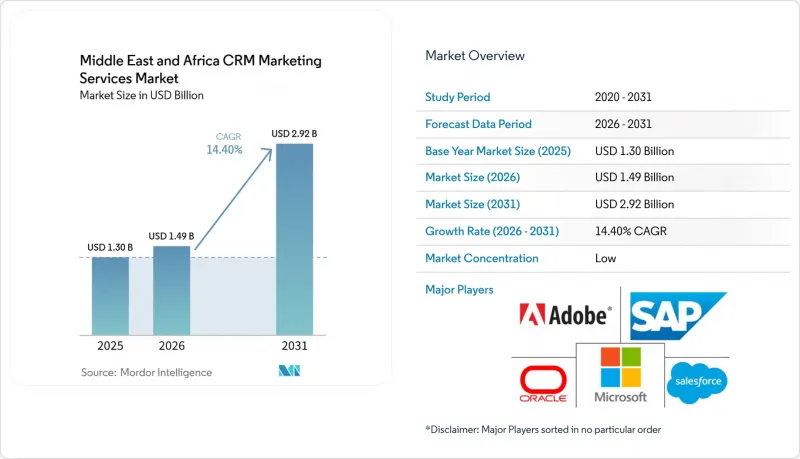
This report is Segmented by Service Type (CRM Strategy and Consulting, CRM Implementation and Integration, and More), Enterprise Size (Large Enterprises, and Small and Medium Enterprises), Service Application (Customer Acquisition, and More), End-User Industry (BFSI, Healthcare and Life Sciences, and More), and Geography. The Market Forecasts are Provided in Terms of Value (USD).
Middle East and Africa CRM Marketing Services Market Trends and Insights
Rapid Digitization of Customer Engagement Workflows
National digitization mandates are moving CRM services from optional technology upgrades to core operating requirements across the region. The MENA digital advertising market reached USD 8.185 billion in 2025, up 17.8% year on year, and that scale is pushing enterprises to capture and act on customer data across more channels than before. Public programs in the Gulf are also shaping procurement behavior, because firms that want to serve regulated sectors increasingly need stronger digital customer engagement infrastructure. Adobe reported in January 2026 that 24% of Middle East business leaders ranked digital transformation as their top five-year strategic priority, ahead of AI and automation as stand-alone goals. This gives the Middle East and Africa CRM marketing services market a steadier demand base, because spending is tied to operating change rather than short-term technology sentiment.
Rising Demand for Arabic-First Personalization and Localization
Buyers across the Gulf are placing more weight on Arabic-native workflows than they did in earlier CRM purchasing cycles. Basic translation is no longer enough when service teams need right-to-left interfaces, localized campaign logic, and better sentiment handling for Gulf dialects. This is raising the value of service partners that can configure language models, templates, and data structures to align with local customer behavior rather than global defaults. The same shift is also influencing vendor selection, because regionally adapted deployments can move faster and create less friction during user adoption. For the Middle East and Africa CRM marketing services market, this demand is widening the gap between general implementation capacity and higher-value localization capability.
High Data Residency and Sovereignty Complexity Across Countries
Data residency rules now shape CRM architecture decisions across much of the region, especially in regulated sectors. Organizations operating across several countries often need separate hosting, governance, and access structures for each jurisdiction rather than one regional design. That adds cost at the start of a project and also slows implementation because legal, security, and data teams need to approve more conditions before go-live. It also reduces the appeal of one-size-fits-all delivery models from vendors that rely on remote regional hubs. For the Middle East and Africa CRM marketing services market, this means compliance capability is becoming as important as technical delivery in larger cross-border programs.
Other drivers and restraints analyzed in the detailed report include:
- Expansion of Cloud-First Marketing and CRM Stacks
- Omnichannel Commerce Growth Across Retail And Telecom
- Integration Friction with Legacy ERP and Call Center Systems
For complete list of drivers and restraints, kindly check the Table Of Contents.
Segment Analysis
CRM Implementation and Integration held the largest service-type share at 26.92% in 2025, which kept it at the center of spending across the region. This part of the portfolio absorbs the largest budgets because enterprises often need to connect CRM with ERP, billing, data warehouse, and service applications before business teams can use the platform fully. Large programs in BFSI and telecom also raise contract values because delivery usually spans design, workflow setup, data mapping, user training, and post-launch stabilization. Strategy and consulting remain important because clients want help with vendor choice, rollout sequencing, and governance before they commit to large builds. Managed Services then extends the client relationship after launch, since many enterprises prefer external support for optimization, administration, and release management.
CRM Migration and Modernization is projected to advance at a 15.51% CAGR through 2031, making it the fastest-growing service type in the portfolio. That growth reflects a new phase in which organizations that installed earlier CRM environments are revisiting them to support AI functions, align with sovereign data requirements, and better integrate with modern cloud applications. Training and support remain the smallest service type by revenue, but it is becoming more important because many buyers lack enough certified administrators to run new environments on their own. The service mix, therefore, forms a cycle in which consulting feeds implementation, implementation creates managed service work, and managed service relationships later uncover migration needs. This cycle provides the Middle East and Africa CRM marketing services market with a deeper revenue base than a project-only model, and CRM Implementation and Integration accounted for 26.92% of the Middle East and Africa CRM marketing services market in 2025.
Large Enterprises accounted for 57.84% of total demand in 2025, which reflected the scale and complexity of their deployments across multiple business units and countries. These clients usually buy several workstreams at once, including architecture design, integration, migration, governance, and managed support. They also tend to operate in heavily regulated sectors where documentation, security, and workflow control matter as much as front-end functionality. As a result, enterprise deals remain the primary source of revenue stability for the Middle East and Africa CRM marketing services market. Large buyers also influence partner ecosystems, since vendors often build local delivery teams and certified networks around the requirements of these accounts first.
SMEs are projected to expand at a 15.62% CAGR through 2031, which makes them the fastest-growing enterprise segment. Their growth is tied to subscription-based CRM platforms that reduce infrastructure barriers and allow phased adoption rather than one large capital project. SAP noted in January 2026 that cloud ERP and CRM are widening access to enterprise-grade systems for African businesses without heavy upfront spending, and that logic also supports SME adoption across the wider region. Government-backed SME enablement programs in the Gulf are also helping demand by pushing more firms toward digitized customer operations and formal software procurement. As a result, the Middle East and Africa CRM marketing services industry is no longer driven only by very large accounts, because smaller firms are entering the pipeline with needs for onboarding, localization, integration, and support.
Complete Report Scope:
- By Service Type
- CRM Strategy and Consulting
- CRM Implementation and Integration
- CRM Migration and Modernization
- CRM Managed Services
- CRM Training and Support
- By Enterprise Size
- Large Enterprises
- Small and Medium Enterprises
- By Service Application
- Customer Acquisition
- Customer Retention and Loyalty
- Campaign Management Services
- Marketing Automation Services
- Customer Analytics and Insights
- Omnichannel Customer Engagement
- Personalization Services
- By End-user Industry
- Banking, Financial Services, and Insurance (BFSI)
- Healthcare and Life Sciences
- Information Technology and Telecom
- Retail and E-commerce
- Industrial Manufacturing
- Government and Public Administration
- Other End-user Industries
- By Geography
- Middle East
- Saudi Arabia
- United Arab Emirates
- Rest of Middle East
- Africa
- South Africa
- Nigeria
- Rest of Africa
- Middle East
List of Companies Covered in this Report:
- Salesforce, Inc.
- Microsoft Corporation
- Oracle Corporation
- SAP SE
- Adobe Inc.
- HubSpot, Inc.
- Zoho Corporation Private Limited
- Freshworks Inc.
- Zendesk, Inc.
- Pipedrive OU
- Creatio Ltd.
- SugarCRM Inc.
- Pegasystems Inc.
- Vtiger Systems Private Limited
- Bitrix24 Ltd.
- Apptivo Inc.
- Insightly, Inc.
- Accenture plc
- ActiveCampaign, LLC
- Veeva Systems Inc.
Additional Benefits:
- The market estimate (ME) sheet in Excel format
- 3 months of analyst support
TABLE OF CONTENTS
1 INTRODUCTION
- 1.1 Study Assumptions and Market Definition
- 1.2 Scope of the Study
2 RESEARCH METHODOLOGY
3 EXECUTIVE SUMMARY
4 MARKET LANDSCAPE
- 4.1 Market Overview
- 4.2 Market Drivers
- 4.2.1 Rapid Digitization of Customer Engagement Workflows
- 4.2.2 Rising Demand for Arabic First Personalization and Localization
- 4.2.3 SME Shift toward Subscription Based Customer Engagement Tools
- 4.2.4 Expansion of Cloud First Marketing And CRM Stacks
- 4.2.5 Omnichannel Commerce Growth Across Retail and Telecom
- 4.2.6 Sovereign Data Hosting and Compliance Led Platform Replacement
- 4.3 Market Restraints
- 4.3.1 High Data Residency and Sovereignty Complexity Across Countries
- 4.3.2 Integration Friction with Legacy ERP and Call Center Systems
- 4.3.3 Shortage Of Skilled CRM Administrators and Marketing Ops Talent
- 4.3.4 Budget Sensitivity Among Small Businesses and Mid Market Buyers
- 4.4 Industry Value-Chain Analysis
- 4.5 Regulatory Landscape
- 4.6 Technological Outlook
- 4.7 Porter's Five Forces Analysis
- 4.7.1 Bargaining Power of Buyers
- 4.7.2 Bargaining Power of Suppliers
- 4.7.3 Threat of New Entrants
- 4.7.4 Threat of Substitutes
- 4.7.5 Intensity of Competitive Rivalry
5 MARKET SIZE AND GROWTH FORECASTS (VALUE)
- 5.1 By Service Type
- 5.1.1 CRM Strategy and Consulting
- 5.1.2 CRM Implementation and Integration
- 5.1.3 CRM Migration and Modernization
- 5.1.4 CRM Managed Services
- 5.1.5 CRM Training and Support
- 5.2 By Enterprise Size
- 5.2.1 Large Enterprises
- 5.2.2 Small and Medium Enterprises
- 5.3 By Service Application
- 5.3.1 Customer Acquisition
- 5.3.2 Customer Retention and Loyalty
- 5.3.3 Campaign Management Services
- 5.3.4 Marketing Automation Services
- 5.3.5 Customer Analytics and Insights
- 5.3.6 Omnichannel Customer Engagement
- 5.3.7 Personalization Services
- 5.4 By End-user Industry
- 5.4.1 Banking, Financial Services, and Insurance (BFSI)
- 5.4.2 Healthcare and Life Sciences
- 5.4.3 Information Technology and Telecom
- 5.4.4 Retail and E-commerce
- 5.4.5 Industrial Manufacturing
- 5.4.6 Government and Public Administration
- 5.4.7 Other End-user Industries
- 5.5 By Geography
- 5.5.1 Middle East
- 5.5.1.1 Saudi Arabia
- 5.5.1.2 United Arab Emirates
- 5.5.1.3 Rest of Middle East
- 5.5.2 Africa
- 5.5.2.1 South Africa
- 5.5.2.2 Nigeria
- 5.5.2.3 Rest of Africa
- 5.5.1 Middle East
6 COMPETITIVE LANDSCAPE
- 6.1 Market Concentration
- 6.2 Strategic Moves
- 6.3 Market Share Analysis
- 6.4 Company Profiles (includes Global Level Overview, Market Level Overview, Core Segments, Financials as available, Strategic Information, Market Rank/Share, Products and Services, Recent Developments)
- 6.4.1 Salesforce, Inc.
- 6.4.2 Microsoft Corporation
- 6.4.3 Oracle Corporation
- 6.4.4 SAP SE
- 6.4.5 Adobe Inc.
- 6.4.6 HubSpot, Inc.
- 6.4.7 Zoho Corporation Private Limited
- 6.4.8 Freshworks Inc.
- 6.4.9 Zendesk, Inc.
- 6.4.10 Pipedrive OU
- 6.4.11 Creatio Ltd.
- 6.4.12 SugarCRM Inc.
- 6.4.13 Pegasystems Inc.
- 6.4.14 Vtiger Systems Private Limited
- 6.4.15 Bitrix24 Ltd.
- 6.4.16 Apptivo Inc.
- 6.4.17 Insightly, Inc.
- 6.4.18 Accenture plc
- 6.4.19 ActiveCampaign, LLC
- 6.4.20 Veeva Systems Inc.
7 MARKET OPPORTUNITIES AND FUTURE OUTLOOK
- 7.1 White-Space and Unmet-Need Assessment

