PUBLISHER: Mordor Intelligence | PRODUCT CODE: 2099834

PUBLISHER: Mordor Intelligence | PRODUCT CODE: 2099834
India Specialty Oil Logistics - Market Share Analysis, Industry Trends & Statistics, Growth Forecasts (2026 - 2031)
According to Mordor Intelligence, the India specialty oil logistics market size is expected to increase from USD 158.14 million in 2025 to USD 162.01 million in 2026 and reach USD 194.79 million by 2031, growing at a CAGR of 3.75% over 2026-2031.
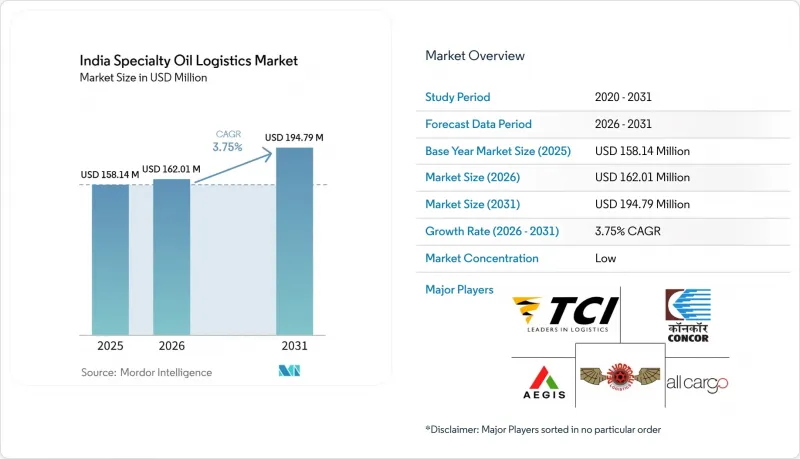
The India specialty oil logistics market is being supported by steady underlying demand, since India's lubricant and specialty fluid consumption reached 4.83 million tons in 2025, up 9.40% year over year, while base oil imports exceeded 3.00 million tons, up 11.00% from the prior year. This report is Segmented by Service Type (Transportation, Warehousing, and More), by Product Category (Transformer and Insulating Oils, White Oils and Process Oils, and More), by Handling/Shipment Format (Bulk Liquid, Ibcs, and More), and by End-Use Industry (Automotive & Transportation, Steel and Metal Machining, and More). The Market Forecasts are Provided in Value (USD) and Volume.
India Specialty Oil Logistics Market Trends and Insights
Industrial Lubricant and Specialty Fluid Demand Underpins Volume Growth
India's lubricant consumption reached 4.83 million tons in 2025, up 9.40% year over year, and that volume increase directly widened the freight and storage base available to service providers in the India specialty oil logistics market. More finished lubricant and specialty fluid output means more shipments to OEMs, industrial plants, workshops, and retail channels. The product mix is also shifting, as industrial and specialty fluids are gaining weight even as automotive lubricants face pressure from the adoption of electric vehicles. That shift matters because metalworking fluids, transformer oils, and food and pharma grade oils need tighter handling standards, cleaner equipment, and stronger documentation. Castrol India's FY2025 revenue reached a record INR 5,722 crores (USD 636.84 million), and its distribution network covered 150,000 outlets, underscoring how broader channel reach drives recurring logistics demand across India's specialty oil logistics market.
Base-Oil Import Dependence Generates Sustained Port-to-Inland Corridor Demand
The India specialty oil logistics market continues to depend on import-led movement because domestic production does not fully cover demand for key base oils, especially naphthenic grades used in transformer and insulating oils. Base oil imports crossed 3.00 million tons in 2025, which kept liquid bulk reception, tank storage, and inland dispatch active across the main import corridors. South Korea supplied 1,322,161 tons, while Malaysia's shipments rose sharply, which reinforced the importance of west coast ports in the India specialty oil logistics market. This import pattern creates two practical inland systems, one centered on Kandla for road tanker dispatch to northern and western blending hubs, and another centered on JNPT and Nhava Sheva with stronger multimodal potential. Even if new domestic lube capacity comes online, the India specialty oil logistics market will still see fresh short-haul movement between new complexes, downstream distributors, and industrial customers.
Imported Base-Oil and Freight Volatility Creates Margin Pressure Throughout the Chain
The India specialty oil logistics market remains exposed to imported feedstock and freight volatility because so much of the value chain depends on seaborne base oil arrivals. When import costs and freight rates rise together, landed costs move up quickly and the pressure spreads to storage, road movement, and delivery scheduling. This matters because many domestic haulage contracts are fixed for a period and cannot be repriced quickly. In 2026, Gulf conflict rerouting contributed to congestion at Jawaharlal Nehru Port and forced the Ministry of Ports, Shipping, and Waterways to hold an emergency session with liquid bulk importers. The result is tighter margin management and less planning certainty across the India specialty oil logistics market during import-heavy periods.
Other drivers and restraints analyzed in the detailed report include:
- Compliant Storage and Handling Needs Rising for High-Value Specialty Fluids
- Used-Oil EPR Formalizes Reverse Logistics Networks
- Fragmented Tanker Ecosystem Caps Network Standardization
For complete list of drivers and restraints, kindly check the Table Of Contents.
Segment Analysis
Transportation held 70.72% of the India specialty oil logistics market share in 2025, which shows how strongly the sector still depends on physical movement between ports, plants, terminals, and end users. The India specialty oil logistics market has historically been shaped by bulk movement economics, so transportation remains the base layer of most customer contracts. Road tankers, line-haul planning, and port-to-plant transfer still absorb the largest part of logistics spend. That pattern is unlikely to disappear, because base oil imports, inland blending, and downstream delivery continue to define the operating rhythm of the market.
Value-added services, however, are growing faster than the core transport layer and are forecast to expand at a 5.24% CAGR through 2031. This reflects a change in customer preference inside the India specialty oil logistics market, where simple freight execution is no longer enough for many accounts. Pharmaceutical, personal care, and specialty industrial users increasingly request inventory management, repacking, relabeling, quality segregation, and order-specific kitting within a single workflow. Warehousing and distribution remain the middle layer that connects import receipt with final dispatch, and operators are scaling those assets to improve service depth. Aegis Logistics' terminal expansion at JNPA shows that liquid storage is being built ahead of future demand, not just to support current throughput. As a result, the India specialty oil logistics market is gradually shifting from an asset-only model toward a more integrated service model with better customer retention and higher revenue per ton.
Transformer and insulating oils accounted for 40.57% of the India specialty oil logistics market size in 2025, making them the largest product category by a wide margin. This leadership is closely tied to the pace of grid investment and transformer deployment across India. The Economic Times reported that India's power transmission sector is set to receive INR 9.00 trillion in capex through 2032, giving this product segment a strong demand base. Power Line Magazine also noted that India must add 776,330 MVA of transformer capacity by FY2027, which supports continued movement of insulating oils between import points, blending locations, transformer manufacturers, and project sites.
White oils and process oils are the fastest-growing product segment, with a 5.01% CAGR projected for 2026-2031. In the India specialty oil industry, this growth is being supported by rising pharmaceutical and personal care manufacturing, where product purity and handling discipline matter more than in standard bulk fluid chains. APAR Industries supplies pharmaceutical- and food-grade white oils under its POWEROIL PEARL brand and exports to more than 125 countries, underscoring the need for inbound sourcing and tightly managed outbound dispatch. Metalworking and process fluids also remain important in machining clusters across Maharashtra, Tamil Nadu, and the broader automotive belt. According to research, the automotive metal forming sector is advancing in a fast pace, which supports stable movement of industrial oils and fluids. Taken together, these patterns show that the India specialty oil logistics market is led by grid-linked oils today, while higher-value white oil and process oil flows are becoming more important to future growth.
Complete Report Scope:
- By Service Type
- Transportation
- Road
- Full-Truck-Load (FTL)
- Less than-Truck-Load (LTL)
- Rail
- Multimodal Transport
- Road
- Warehousing and Distribution
- Value-added Services (Inventory management, Repacking, Relabeling, and Kitting etc.)
- Transportation
- By Product Category
- Transformer and insulating oils
- White oils and process oils
- Metalworking and process fluids
- Other Product Categories
- By Handling / Shipment Format
- Bulk liquid
- Intermediate Bulk Containers (IBCs)
- Drums
- Small Retail and Commercial (Bottles and Jerry Cans, Stand-up Pouches, Pails, Kegs, etc.)
- By End-use Industry
- Automotive and Transportation
- Heavy Equipment, Mining and Construction
- Steel and Metal Machining
- Energy/Power Generation
- Rubber and Tire Manufacturing
- Personal Care and Pharmaceuticals
- Food and Beverage Processing
- Aerospace and Defense
- Other End-user Industries
List of Companies Covered in this Report:
- 20Cube Logistics Pte. Ltd.
- Aegis Logistics Ltd.
- Allcargo Logistics Limited
- CJ Darcl Logistics Limited
- DHL Group
- DSV A/S
- Express Roadways Private Limited
- K D Supply Chain Solutions Pvt. Ltd.
- Kuehne+Nagel
- Mahindra Logistics, Ltd.
- MTI Logistics
- Nippon Express Holdings
- Om Logistics Limited
- Safexpress Private Limited
- Siddhartha Logistics Co. Pvt. Ltd.
- Toll Holdings Limited
- Transport Corporation of India Limited
- V Power Logistics
- Varuna Group
- VRL Logistics Limited
Additional Benefits:
- The market estimate (ME) sheet in Excel format
- 3 months of analyst support
TABLE OF CONTENTS
1 Introduction
- 1.1 Study Assumptions and Market Definition
- 1.2 Scope of the Study
2 Research Methodology
3 Executive Summary
4 Market Landscape
- 4.1 Market Overview
- 4.2 Market Drivers
- 4.2.1 Industrial Lubricant and Specialty Fluid Demand Expansion
- 4.2.2 Base-Oil Import Dependence Sustaining Port-to-Inland Bulk Movements
- 4.2.3 Compliant Storage and Handling Needs Rising for High-Value Specialty Fluids
- 4.2.4 Used-Oil EPR Formalizing Reverse Logistics Networks
- 4.2.5 DFC-Led Multimodal Corridors Improving Inland Liquid Movement Economics
- 4.2.6 Expansion of OEM-Approved and Premium Branded Lubricant Distribution Networks
- 4.3 Market Restraints
- 4.3.1 Imported Base-Oil and Freight Volatility Pressuring Logistics Costs
- 4.3.2 Fragmented Tanker Ecosystem Limiting Network Standardization
- 4.3.3 Hazardous-Waste Compliance Burden Slowing Informal Channel Conversion
- 4.3.4 Port and Terminal Congestion During Import Surges
- 4.4 Value / Supply-Chain Analysis
- 4.5 Regulatory Landscape
- 4.6 Technological Outlook
- 4.7 Porter's Five Forces Analysis
- 4.7.1 Threat of new entrants
- 4.7.2 Bargaining power of suppliers
- 4.7.3 Bargaining power of buyers
- 4.7.4 Threat of substitutes
- 4.7.5 Competitive rivalry
- 4.8 Impact of Geopolitical Events on the Market
5 Market Size and Growth Forecasts (Value and Volume)
- 5.1 By Service Type
- 5.1.1 Transportation
- 5.1.1.1 Road
- 5.1.1.1.1 Full-Truck-Load (FTL)
- 5.1.1.1.2 Less than-Truck-Load (LTL)
- 5.1.1.2 Rail
- 5.1.1.3 Multimodal Transport
- 5.1.1.1 Road
- 5.1.2 Warehousing and Distribution
- 5.1.3 Value-added Services (Inventory management, Repacking, Relabeling, and Kitting etc.)
- 5.1.1 Transportation
- 5.2 By Product Category
- 5.2.1 Transformer and insulating oils
- 5.2.2 White oils and process oils
- 5.2.3 Metalworking and process fluids
- 5.2.4 Other Product Categories
- 5.3 By Handling / Shipment Format
- 5.3.1 Bulk liquid
- 5.3.2 Intermediate Bulk Containers (IBCs)
- 5.3.3 Drums
- 5.3.4 Small Retail and Commercial (Bottles and Jerry Cans, Stand-up Pouches, Pails, Kegs, etc.)
- 5.4 By End-use Industry
- 5.4.1 Automotive and Transportation
- 5.4.2 Heavy Equipment, Mining and Construction
- 5.4.3 Steel and Metal Machining
- 5.4.4 Energy/Power Generation
- 5.4.5 Rubber and Tire Manufacturing
- 5.4.6 Personal Care and Pharmaceuticals
- 5.4.7 Food and Beverage Processing
- 5.4.8 Aerospace and Defense
- 5.4.9 Other End-user Industries
6 Competitive Landscape
- 6.1 Market Concentration
- 6.2 Strategic Moves
- 6.3 Market Share Analysis
- 6.4 Company Profiles (Includes Global Level Overview, Market Level Overview, Core Segments, Financials as Available, Strategic Information, Market Rank/Share for Key Companies, Products and Services, and Recent Developments)
- 6.4.1 20Cube Logistics Pte. Ltd.
- 6.4.2 Aegis Logistics Ltd.
- 6.4.3 Allcargo Logistics Limited
- 6.4.4 CJ Darcl Logistics Limited
- 6.4.5 DHL Group
- 6.4.6 DSV A/S
- 6.4.7 Express Roadways Private Limited
- 6.4.8 K D Supply Chain Solutions Pvt. Ltd.
- 6.4.9 Kuehne+Nagel
- 6.4.10 Mahindra Logistics, Ltd.
- 6.4.11 MTI Logistics
- 6.4.12 Nippon Express Holdings
- 6.4.13 Om Logistics Limited
- 6.4.14 Safexpress Private Limited
- 6.4.15 Siddhartha Logistics Co. Pvt. Ltd.
- 6.4.16 Toll Holdings Limited
- 6.4.17 Transport Corporation of India Limited
- 6.4.18 V Power Logistics
- 6.4.19 Varuna Group
- 6.4.20 VRL Logistics Limited
7 Market Opportunities and Future Outlook
- 7.1 White-space and unmet-need assessment

