PUBLISHER: Mordor Intelligence | PRODUCT CODE: 2124622

PUBLISHER: Mordor Intelligence | PRODUCT CODE: 2124622
GCC Chemical Logistics - Market Share Analysis, Industry Trends & Statistics, Growth Forecasts (2026 - 2031)
According to Mordor Intelligence, the GCC chemical logistics market size is expected to grow from USD 9.10 billion in 2025 to USD 9.51 billion in 2026 and is forecast to reach USD 11.86 billion by 2031 at 4.52% CAGR over 2026-2031.
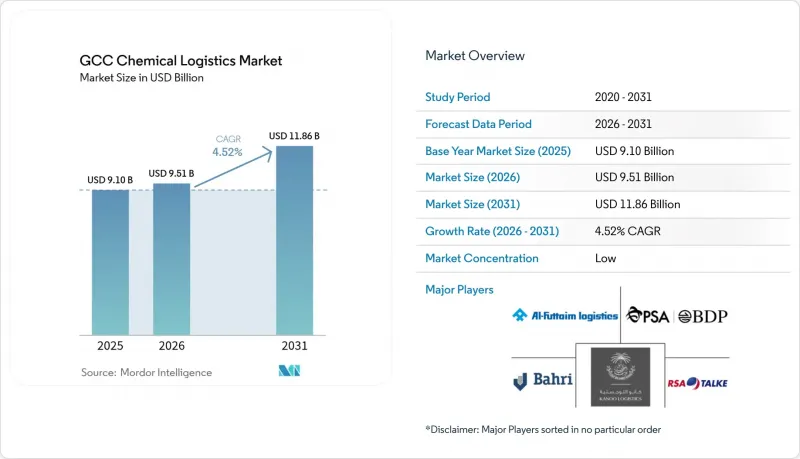
This report is Segmented by Service (Transportation, Warehousing, Distribution & Inventory Management, and More), End-User Industry (Pharmaceutical, Oil & Gas, and More), Hazard Class (Hazardous Chemicals and Non-Hazardous Chemicals), Temperature Control (Temperature-Controlled and More), Country (Saudi Arabia, Qatar, and More). The Market Forecasts are Provided in Terms of Value (USD).
GCC Chemical Logistics Market Trends and Insights
Surge in Petrochemical Production Capacity Expansions
Major projects such as Saudi Aramco's USD 7.7 billion Fadhili Gas Plant expansion will raise feedstock output and create new flows for ethane, naphtha, and mixed-feed cracker derivatives. Growing output diversity obliges logistics providers to manage multiple hazard classes and temperature bands within the same network. Integrated complexes located at Jubail, Yanbu, and Ras Laffan require synchronized inbound feedstock and outbound product scheduling, prompting investment in specialized tank fleets, vapor-recovery terminals, and port handling systems. The resulting jump in throughput volumes underpins steady growth in the GCC chemical logistics market as producers seek assured capacity and regulatory compliance.
Massive Multimodal Infrastructure Investments
Saudi Arabia's Logisti 2 platform and DP World's USD 2.5 billion regional program are improving modal shifts across road, rail, and sea. New community systems cut clearance times, while inland logistics parks bring storage closer to chemical clusters. Etihad Rail is enhancing inter-emirate connectivity, and the Gulf Railway concept promises cross-border block-train services for bulk liquids. Infrastructure upgrades expand corridor choices, lower handling costs, and support the scalability required by the GCC chemical logistics market.
High CAPEX for ADR-Compliant Fleets & Warehouses
Explosion-proof wiring, vapor-control systems, and specialized fire suppression raise fleet and facility costs well above general cargo benchmarks. Continuous recertification and crew training obligations add to operating expenditure and deter smaller entrants. Capital hurdles slow network expansion and temper competitive intensity in the GCC chemical logistics market.
Other drivers and restraints analyzed in the detailed report include:
- Tightening HSE Regulations Fueling 3PL Outsourcing
- Booming Pharma & Specialty-Chemical Imports Needing GDP-Compliant Transport
- Geopolitical Chokepoints Increasing Transit-Time Risk
For complete list of drivers and restraints, kindly check the Table Of Contents.
Segment Analysis
Transportation retained a 61.40% share of the GCC chemical logistics market in 2025, supported by extensive highway links from petrochemical clusters to export terminals. Road tankers remain the workhorse for regional moves, yet investments in Etihad Rail and proposed Gulf Railway corridors will gradually divert heavy bulk flows onto rail. Sea transport governs export revenue, and chemical tanker availability is a critical capacity lever. Airfreight caters to specialty and pharma cargo where transit time is critical.
Warehousing, distribution, and inventory management is the fastest-growing service at a 4.05% CAGR through 2031, buoyed by demand for digital-twin warehouses and pick-to-light systems that lift productivity. Continuous value-added services such as labeling and repackaging are also rising, reinforcing integrated solutions in the GCC chemical logistics market.
Oil & gas contributed 35.60% to the GCC chemical logistics market size in 2025, reflecting feedstock flows within vertically integrated complexes. Reliance on long-term contracts cushions volatility and provides stable base volumes for fleet deployment.
Pharmaceutical cargo, though smaller, is expanding at a 4.70% CAGR, propelled by regional health spending and mandatory GDP compliance. Specialty chemicals serve downstream conversion industries, and cosmetics retain a niche share yet benefit from rising disposable incomes. Diversification trends sustain demand diversity and underpin resilience in the GCC chemical logistics market.
Complete Report Scope:
- By Service
- Transportation
- Road
- Rail
- Air
- Sea
- Warehousing, Distribution & Inventory Management
- Other Services
- Transportation
- By End-User Industry
- Pharmaceutical
- Cosmetic
- Oil & Gas
- Specialty Chemicals
- Other End-Users
- By Hazard Class
- Hazardous Chemicals
- Non-hazardous Chemicals
- By Temperature Control
- Temperature-Controlled (Refrigerated/Heated)
- Non-Temperature-Controlled
- By Country
- Saudi Arabia
- United Arab Emirates
- Qatar
- Kuwait
- Bahrain
- Oman
List of Companies Covered in this Report:
- Al-Futtaim Logistics
- RSA-TALKE
- BDP International (PSA BDP)
- Bahri Logistics
- Kanoo Logistics
- Bertschi AG
- Gulf Warehousing Company (GWC)
- Al Saidi Logistics
- AAA Freight Services
- JSL Global
- Den Hartogh Logistics
- Hellmann Worldwide Logistics
- International Chemical Logistics (ICL)
- CEVA Logistics
- Kuehne + Nagel
- RSA Global
- Chemical Petroleum Transport LLC
- DSV
- Noatum Logistics
- Al-Zabin & Al-Dakheel Allah Transports Co.
Additional Benefits:
- The market estimate (ME) sheet in Excel format
- 3 months of analyst support
TABLE OF CONTENTS
1 Introduction
- 1.1 Study Assumptions & Market Definition
- 1.2 Scope of the Study
2 Research Methodology
3 Executive Summary
4 Market Landscape
- 4.1 Market Overview
- 4.2 Market Drivers
- 4.2.1 Surge in petrochemical production capacity expansions
- 4.2.2 Massive multimodal-infrastructure investments (ports, rail & land-bridge)
- 4.2.3 Tightening HSE regulations fuelling 3PL outsourcing
- 4.2.4 Booming pharma & specialty-chemical imports needing GDP-compliant transport
- 4.2.5 SEZ-linked "near-terminal" chemical clusters driving onsite logistics demand
- 4.2.6 Adoption of forward-hubbing & digital-twin control towers to bypass route shocks
- 4.3 Market Restraints
- 4.3.1 High CAPEX for ADR-compliant fleets & warehouses
- 4.3.2 Geopolitical choke-points increasing transit-time risk
- 4.3.3 Shortage of ADR/IMO-certified labour
- 4.3.4 Energy-transition volatility in bulk chemical flows
- 4.4 Value / Supply-Chain Analysis
- 4.5 Regulatory Landscape
- 4.6 Technological Outlook
- 4.7 Industry Attractiveness - Porter's Five Forces
- 4.7.1 Bargaining Power of Suppliers
- 4.7.2 Bargaining Power of Buyers
- 4.7.3 Threat of New Entrants
- 4.7.4 Threat of Substitutes
- 4.7.5 Intensity of Competitive Rivalry
- 4.8 Impact of Geo-Political Events on Supply Chain Shifts
5 Market Size & Growth Forecasts
- 5.1 By Service
- 5.1.1 Transportation
- 5.1.1.1 Road
- 5.1.1.2 Rail
- 5.1.1.3 Air
- 5.1.1.4 Sea
- 5.1.2 Warehousing, Distribution & Inventory Management
- 5.1.3 Other Services
- 5.1.1 Transportation
- 5.2 By End-User Industry
- 5.2.1 Pharmaceutical
- 5.2.2 Cosmetic
- 5.2.3 Oil & Gas
- 5.2.4 Specialty Chemicals
- 5.2.5 Other End-Users
- 5.3 By Hazard Class
- 5.3.1 Hazardous Chemicals
- 5.3.2 Non-hazardous Chemicals
- 5.4 By Temperature Control
- 5.4.1 Temperature-Controlled (Refrigerated/Heated)
- 5.4.2 Non-Temperature-Controlled
- 5.5 By Country
- 5.5.1 Saudi Arabia
- 5.5.2 United Arab Emirates
- 5.5.3 Qatar
- 5.5.4 Kuwait
- 5.5.5 Bahrain
- 5.5.6 Oman
6 Competitive Landscape
- 6.1 Market Concentration
- 6.2 Strategic Moves
- 6.3 Market Share Analysis
- 6.4 Company Profiles (includes Global level Overview, Market level overview, Core Segments, Financials as available, Strategic Information, Market Rank/Share, Products & Services, Recent Developments)
- 6.4.1 Al-Futtaim Logistics
- 6.4.2 RSA-TALKE
- 6.4.3 BDP International (PSA BDP)
- 6.4.4 Bahri Logistics
- 6.4.5 Kanoo Logistics
- 6.4.6 Bertschi AG
- 6.4.7 Gulf Warehousing Company (GWC)
- 6.4.8 Al Saidi Logistics
- 6.4.9 AAA Freight Services
- 6.4.10 JSL Global
- 6.4.11 Den Hartogh Logistics
- 6.4.12 Hellmann Worldwide Logistics
- 6.4.13 International Chemical Logistics (ICL)
- 6.4.14 CEVA Logistics
- 6.4.15 Kuehne + Nagel
- 6.4.16 RSA Global
- 6.4.17 Chemical Petroleum Transport LLC
- 6.4.18 DSV
- 6.4.19 Noatum Logistics
- 6.4.20 Al-Zabin & Al-Dakheel Allah Transports Co.
7 Market Opportunities & Future Outlook
- 7.1 White-space & Unmet-need Assessment

