PUBLISHER: Mordor Intelligence | PRODUCT CODE: 2116585

PUBLISHER: Mordor Intelligence | PRODUCT CODE: 2116585
Chemical Logistics - Market Share Analysis, Industry Trends & Statistics, Growth Forecasts (2026 - 2031)
According to Mordor Intelligence, the chemical logistics market size is estimated at USD 534.37 billion in 2026, and is expected to reach USD 683.28 billion by 2031, at a CAGR of 5.04% during the forecast period (2026-2031).
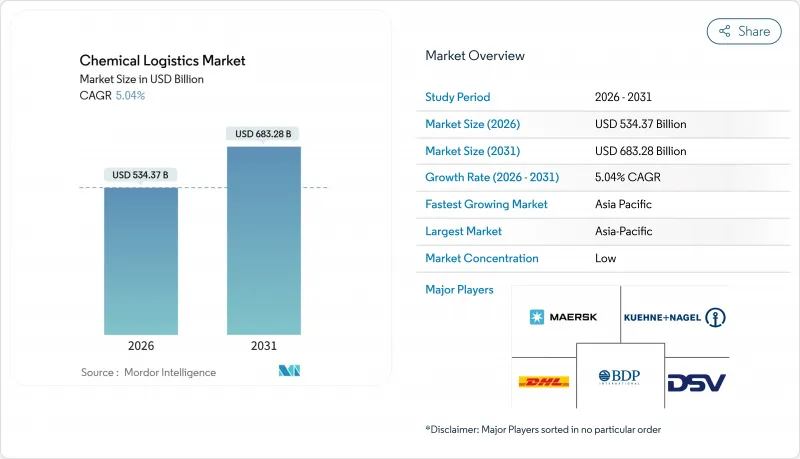
This report is Segmented by Service Type (Transportation, Warehousing, and More), by End-User Industry (Pharmaceutical, Cosmetics, Oil & Gas, Specialty Chemicals, and More), by Hazard Class (Hazardous, Non-Hazardous), by Temperature Control (Temperature-Controlled, Non-Temperature-Controlled), by Geography (North America, Europe, and More). The Market Forecasts are Provided in Terms of Value (USD).
Global Chemical Logistics Market Trends and Insights
Expansion of Asian Chemical Production Boosting Long-haul Volumes
India's PCPIR zones and mainland China's capacity additions have shifted export lanes toward Europe and North America, lengthening voyage distances and raising ton-mile demand. Post-Red Sea routing changes have further extended typical Asia-Europe transits, supporting vessel-utilization and intermodal opportunities across rail-sea corridors. Government incentives in India are concentrating output in coastal clusters, yet inland consumption patterns are forcing longer domestic hauls that reward operators with integrated rail, road, and barge solutions.
Rising Use of Multimodal Networks for Hazardous Goods Cost & Safety
Sea-rail systems cut greenhouse-gas emissions by 81% and logistics costs by 70% versus road-only haulage, but adoption hinges on seamless regulatory alignment at modal junctions. The US Federal Railroad Administration highlights dual-mode locomotives and intermittent electrification as cost-effective for bulk chemical corridors when supported by utility partnerships. European operators such as Bertschi already avoid 300,000 tons of CO2 annually through integrated terminals that synchronize rail, barge, and road legs
High Capex-heavy Asset & Insurance Requirements
Stainless-steel ISO tanks, temperature-controlled chassis, and explosion-proof warehouses cost 2-3 times more than general-cargo equivalents. Peacock Container's USD 350 million sustainability-linked facility extension underlines the scale of capital required for fleet renewal. Insurance premiums now absorb up to 5% of revenue for dangerous-goods hauls, magnifying entry barriers.
Other drivers and restraints analyzed in the detailed report include:
- Regulatory Push for Safer, Greener Logistics Assets & Practices
- Outsourcing of Supply-chain Functions to 3PL/4PL Specialists
- Fragmented Multi-jurisdiction Compliance Burdens
For complete list of drivers and restraints, kindly check the Table Of Contents.
Segment Analysis
Transportation retained 65.14% of the chemical logistics market share in 2025 because physical movement remains unavoidable. Yet Other Services, covering blending, compliance management, and orchestration platforms, are forecast to grow at a 6.41% CAGR, reflecting shipper demand for one-stop solutions that reduce administrative burden. Value-added warehousing anchors working-capital programs by positioning inventory near consumption hubs, while digital platforms capture data exhaust that underpins predictive scheduling and emission reporting. DHL's acquisition of CryoPDP added 600,000 temperature-sensitive shipments annually, demonstrating how tuck-ins can accelerate capability expansion.
Second-generation 4PL models monetize orchestration by bundling carrier procurement, control-tower analytics, and compliance documentation in subscription packages. As shippers embed these APIs into enterprise resource planning systems, switching costs rise, allowing logistics providers to defend margins even in commodity haulage. Consequently, the chemical logistics market is witnessing a migration of profit pools from tonnage toward information, risk management, and near-customer customization.
Oil & Gas held 30.57% of the chemical logistics market size in 2025 due to entrenched refinery-to-petrochemical flows, but its low growth exposes providers to price pressure. Specialty Chemicals is slated for a 6.72% CAGR as lithium-ion battery electrolytes and pharmaceutical intermediates demand precision handling, chain-of-custody records, and temperature-stable environments. Argonne National Laboratory projects battery-grade electrolyte output to exceed 1,300 GWh by 2030, multiplying demand for moisture-controlled tank containers.
Pharmaceutical and cosmetics traffic supplies revenue stability because GDP or GMP protocols mandate certified storage and tracked transportation, giving compliant carriers pricing power. Cosmetics raw-materials shifts toward botanical extracts create small-lot, high-frequency lanes that are unsuitable for bulk tanker fleets but ideal for ISO tank relocation and regional depot networks. Thus, the chemical logistics market faces bifurcated growth where low-margin commodity flows coexist with high-service specialty niches requiring differentiated expertise.
Complete Report Scope:
- By Service
- Transportation
- Road
- Rail
- Sea/Ocean
- Air
- Warehousing, Distribution & Inventory Management
- Other Services
- Transportation
- By End-user Industry
- Pharmaceutical
- Cosmetics & Personal Care
- Oil & Gas
- Specialty Chemicals
- Other End-users
- By Hazard Class
- Hazardous Chemicals
- Non-hazardous Chemicals
- By Temperature Control
- Temperature-Controlled (Refrigerated/Heated)
- Non-Temperature-Controlled
- By Geography
- North America
- United States
- Canada
- Mexico
- South America
- Brazil
- Peru
- Chile
- Argentina
- Rest of South America
- Asia-Pacific
- India
- China
- Japan
- Australia
- South Korea
- South East Asia (Singapore, Malaysia, Thailand, Indonesia, Vietnam, Philippines)
- Rest of Asia-Pacific
- Europe
- United Kingdom
- Germany
- France
- Spain
- Italy
- BENELUX (Belgium, Netherlands, Luxembourg)
- NORDICS (Denmark, Finland, Iceland, Norway, Sweden)
- Rest of Europe
- Middle East and Africa
- United Arab Emirates
- Saudi Arabia
- South Africa
- Nigeria
- Rest of Middle East and Africa
- North America
Geography Analysis
Asia-Pacific accounted for 39.21% of global revenue in 2025 and will expand at a 6.31% CAGR through 2031. China's export overcapacity is propelling intra-Asian trade and rerouting cargo toward India and Southeast Asia, creating fresh multimodal lanes where ports, dedicated freight corridors, and coastal shipping converge. India's PCPIR clusters anchor integrated complexes along the western and eastern seaboards, but inland demand growth is extending domestic road-rail legs, amplifying demand for ISO-tank repositioning services.
North America and Europe remain premium markets, underpinned by extensive rail networks, strict safety rules, and high digital-adoption rates. Revised ADR and CLP frameworks in Europe require upgraded fleets and digital labels, encouraging shippers to lock in long-term contracts with certified providers. In North America, integrated rail corridors linking Gulf-Coast petrochemical complexes to Midwest consumers provide cost-effective, low-emission options that favor operators owning trans-load terminals.
South America and Africa offer upside tempered by infrastructure gaps. Prolonged port dwell times in Lagos, Durban, and Mombasa inflate inventory costs and compel carriers to build buffer stocks. The African Continental Free Trade Area aspires to harmonize customs procedures, but interim fragmentation necessitates country-specific expertise and localized partnerships. Despite these hurdles, nearshoring trends in Latin America are driving chemical manufacturers to relocate intermediate-processing stages closer to US buyers, stimulating corridor development for providers with bilingual staff and customs-broker networks.
- DHL Supply Chain
- Kuehne + Nagel International AG
- Maersk Logistics & Services
- HOYER Group
- C.H. Robinson Worldwide
- BDP International
- DSV (incl. DB Schenker)
- Rhenus SE & Co. KG
- A&R Logistics (Quantix)
- CEVA Logistics (Acquired by CMA CGM)
- Al-Futtaim Logistics
- Petrochem Middle East (PME)
- Sinotrans Chemical Logistics
- Bertschi AG
- Suttons Group
- Den Hartogh Logistics
- Brenntag Logistics Services
- MOL Chemical Tankers
- Stolt-Nielsen Ltd.
- Katoen Natie N.V.
- Toll Group
- Yusen Logistics Co., Ltd. (Nippon Yusen Group)
- Hellmann Worldwide Logistics SE & Co. KG*
Additional Benefits:
- The market estimate (ME) sheet in Excel format
- 3 months of analyst support
TABLE OF CONTENTS
1 Introduction
- 1.1 Study Assumptions & Market Definition
- 1.2 Scope of the Study
2 Research Methodology
3 Executive Summary
4 Market Landscape
- 4.1 Market Overview
- 4.2 Market Drivers
- 4.2.1 Expansion of Asian chemical production boosting long-haul volumes
- 4.2.2 Rising use of multimodal networks for hazardous-goods cost & safety
- 4.2.3 Regulatory push for safer, greener logistics assets & practices
- 4.2.4 Outsourcing of supply-chain functions to 3PL/4PL specialists
- 4.2.5 Low-carbon methanol & bio-based chains spawning new corridors
- 4.2.6 AI-driven visibility & digital-twin platforms enabling real-time compliance
- 4.3 Market Restraints
- 4.3.1 High capex-heavy asset & insurance requirements
- 4.3.2 Fragmented multi-jurisdiction compliance burdens
- 4.3.3 Fuel-price volatility compressing operator margins
- 4.3.4 Shortage of certified hazmat drivers in emerging markets
- 4.4 Value / Supply-Chain Analysis
- 4.5 Technological Innovations in the Industry
- 4.6 Government Regulations and Policies
- 4.7 Porter's Five Forces
- 4.7.1 Threat of New Entrants
- 4.7.2 Bargaining Power of Buyers/Consumers
- 4.7.3 Bargaining Power of Suppliers
- 4.7.4 Threat of Substitute Services (In-house Logistics)
- 4.7.5 Intensity of Competitive Rivalry
- 4.8 Impact of Geopolitical Events on the Market
5 Market Size & Growth Forecasts (Value)
- 5.1 By Service
- 5.1.1 Transportation
- 5.1.1.1 Road
- 5.1.1.2 Rail
- 5.1.1.3 Sea/Ocean
- 5.1.1.4 Air
- 5.1.2 Warehousing, Distribution & Inventory Management
- 5.1.3 Other Services
- 5.1.1 Transportation
- 5.2 By End-user Industry
- 5.2.1 Pharmaceutical
- 5.2.2 Cosmetics & Personal Care
- 5.2.3 Oil & Gas
- 5.2.4 Specialty Chemicals
- 5.2.5 Other End-users
- 5.3 By Hazard Class
- 5.3.1 Hazardous Chemicals
- 5.3.2 Non-hazardous Chemicals
- 5.4 By Temperature Control
- 5.4.1 Temperature-Controlled (Refrigerated/Heated)
- 5.4.2 Non-Temperature-Controlled
- 5.5 By Geography
- 5.5.1 North America
- 5.5.1.1 United States
- 5.5.1.2 Canada
- 5.5.1.3 Mexico
- 5.5.2 South America
- 5.5.2.1 Brazil
- 5.5.2.2 Peru
- 5.5.2.3 Chile
- 5.5.2.4 Argentina
- 5.5.2.5 Rest of South America
- 5.5.3 Asia-Pacific
- 5.5.3.1 India
- 5.5.3.2 China
- 5.5.3.3 Japan
- 5.5.3.4 Australia
- 5.5.3.5 South Korea
- 5.5.3.6 South East Asia (Singapore, Malaysia, Thailand, Indonesia, Vietnam, Philippines)
- 5.5.3.7 Rest of Asia-Pacific
- 5.5.4 Europe
- 5.5.4.1 United Kingdom
- 5.5.4.2 Germany
- 5.5.4.3 France
- 5.5.4.4 Spain
- 5.5.4.5 Italy
- 5.5.4.6 BENELUX (Belgium, Netherlands, Luxembourg)
- 5.5.4.7 NORDICS (Denmark, Finland, Iceland, Norway, Sweden)
- 5.5.4.8 Rest of Europe
- 5.5.5 Middle East and Africa
- 5.5.5.1 United Arab Emirates
- 5.5.5.2 Saudi Arabia
- 5.5.5.3 South Africa
- 5.5.5.4 Nigeria
- 5.5.5.5 Rest of Middle East and Africa
- 5.5.1 North America
6 Competitive Landscape
- 6.1 Market Concentration
- 6.2 Strategic Moves
- 6.3 Market Share Analysis
- 6.4 Company Profiles (includes Global level Overview, Market level overview, Core Segments, Financials as available, Strategic Information, Market Rank/Share for key companies, Products & Services, and Recent Developments)
- 6.4.1 DHL Supply Chain
- 6.4.2 Kuehne + Nagel International AG
- 6.4.3 Maersk Logistics & Services
- 6.4.4 HOYER Group
- 6.4.5 C.H. Robinson Worldwide
- 6.4.6 BDP International
- 6.4.7 DSV (incl. DB Schenker)
- 6.4.8 Rhenus SE & Co. KG
- 6.4.9 A&R Logistics (Quantix)
- 6.4.10 CEVA Logistics (Acquired by CMA CGM)
- 6.4.11 Al-Futtaim Logistics
- 6.4.12 Petrochem Middle East (PME)
- 6.4.13 Sinotrans Chemical Logistics
- 6.4.14 Bertschi AG
- 6.4.15 Suttons Group
- 6.4.16 Den Hartogh Logistics
- 6.4.17 Brenntag Logistics Services
- 6.4.18 MOL Chemical Tankers
- 6.4.19 Stolt-Nielsen Ltd.
- 6.4.20 Katoen Natie N.V.
- 6.4.21 Toll Group
- 6.4.22 Yusen Logistics Co., Ltd. (Nippon Yusen Group)
- 6.4.23 Hellmann Worldwide Logistics SE & Co. KG*
7 Market Opportunities & Future Outlook
- 7.1 White-space & Unmet-need Assessment

