PUBLISHER: Mordor Intelligence | PRODUCT CODE: 2125743

PUBLISHER: Mordor Intelligence | PRODUCT CODE: 2125743
United Kingdom Chemical Logistics - Market Share Analysis, Industry Trends & Statistics, Growth Forecasts (2026 - 2031)
According to Mordor Intelligence, the United Kingdom chemical logistics market size was valued at USD 7.58 billion in 2025 and estimated to grow from USD 7.93 billion in 2026 to reach USD 9.94 billion by 2031, at a CAGR of 4.62% during the forecast period (2026-2031).
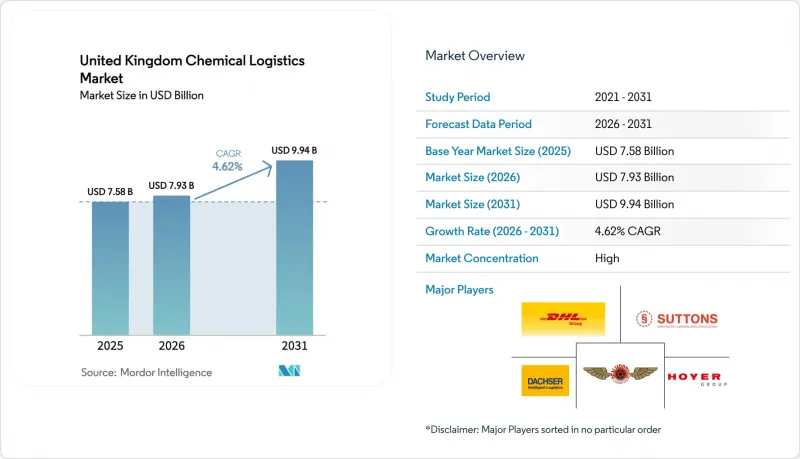
This report is Segmented by Service (Transportation, Warehousing, Distribution & Inventory Management, and More), by End User (Pharmaceuticals, Cosmetics, and More), by Hazard Class (Hazardous Chemicals, and Non-Hazardous Chemicals), by Temperature Control (Temperature-Controlled and More), and by Geography (England, Scotland, and More). The Market Forecasts are Provided in Terms of Value (USD).
United Kingdom Chemical Logistics Market Trends and Insights
UK-centric Chemical Cluster Expansion in Teesside
Teesside's Net Zero Teesside and H2Teesside projects are consolidating chemical production and carbon capture infrastructure, creating specialized transport corridors for CO2 and hydrogen. BP's commitment to capture up to 4 million tons of CO2 annually is stimulating new ISO-tank demand for liquefied CO2 and blue hydrogen feedstocks. Integration with the East Coast Cluster is shifting traditional point-to-point trucking into circular flows that blend pipeline, rail, and road legs. Logistics providers are therefore investing in modular ISO-tank farms capable of switching between liquid CO2, ammonia, and hydrogen. Coupled with Teesside's direct deep-sea access, these capabilities position the region as a launchpad for low-carbon chemical exports. The ripple effect extends northwards as Scottish terminals re-gear to back-haul hydrogen and captured CO2, reinforcing the United Kingdom chemical logistics market's resilience.
On-site Storage Capacity Constraints at Petro-Chem Ports
Major terminals such as Immingham are running at 85-90% utilization, materially above the 70-75% efficiency benchmark. Dwell-time inflation has reached 15% since 2023, forcing shippers to split loads and accept 12-18% higher unit transport costs. COMAH zoning and planning rules restrict fast expansion, so operators are pivoting to hub-and-spoke designs backed by GBP 78 million (USD 99.29 million) of new intermediate storage in 2024 . IoT-enabled inventory platforms have cut buffer stock needs by up to 12%, easing but not eliminating the bottleneck. Together, these factors keep warehousing services on a robust growth curve within the United Kingdom chemical logistics market.
Limited Rail-tanker Slots at Key Terminals
Shared lines with passenger traffic and decades-old loading racks mean chemical trains frequently miss optimal departure windows. The resulting backlogs push shippers toward more road legs, elevating costs and carbon footprints. Digital allocation tools that pool slot requests across multiple operators have raised rail utilization modestly, yet a structural gap remains until new sidings are built. Forward-looking providers mix rail for trunk haul with road final mile to trim emissions while keeping schedules credible. Despite mitigation, the constraint clips 0.5 percentage points from the United Kingdom chemical logistics market's potential CAGR.
Other drivers and restraints analyzed in the detailed report include:
- Digital ADR Compliance Platforms Accelerating Turn-around
- Growing Hydrogen-Economy Demand for ISO-Tank Transport
- Driver Shortage for ADR Class 8 & 6.1
For complete list of drivers and restraints, kindly check the Table Of Contents.
Segment Analysis
Transportation accounted for 66.20% of the United Kingdom chemical logistics market in 2025, a position underpinned by road haulage, which moves more than 70% of volumes. Warehousing, distribution and inventory management is the fastest-rising category, expanding at a 5.34% CAGR and steadily lifting its portion of the United Kingdom chemical logistics market size. Digitally orchestrated cross-docking, temperature-segmented bays and COMAH-compliant inert-gas storage convert warehouses into margin-rich service hubs.
Integrated service contracts are therefore blurring the lines between trucking and storage. Operators such as Bertschi run inland depots that splice rail spurs into tank-container yards, pairing line-haul decarbonization with just-in-time inventory. The model cuts handling steps and embeds value-added services like blending. As a result, transport's share will moderate despite absolute growth, while warehousing and "other services" such as customs and regulatory consulting capture more revenue inside the United Kingdom chemical logistics market.
Oil & gas retained a 30.40% share of the United Kingdom chemical logistics market in 2025, but the segment's outlook is tempered by energy-transition dynamics and refiners' efficiency drives. Pharmaceuticals, in contrast, are set to rise at a 6.68% CAGR thanks to persistently high R&D spend and stringent temperature specs for active ingredients. Temperature-validated packaging across ambient, refrigerated, frozen, and Cryo bands is now standard for the pharma supply chain.
Second-tier industries such as cosmetics and specialty chemicals lean heavily on flexible, smaller-lot deliveries aligned to rapid formulation changeovers. Logistics providers differentiate on GMP compliance and batch-traceability rather than pure hazard handling. Together, these shifts nudge the United Kingdom chemical logistics market toward nimbler, quality-assured services. Oil & gas players are responding by repurposing ADR tank farms for alternative fuels and carbon-capture intermediates, sustaining asset utilization while the fossil share of throughput declines.
Complete Report Scope:
- By Service
- Transportation
- Road
- Rail
- Sea/Ocean
- Air
- Warehousing, Distribution & Inventory Management
- Other Services
- Transportation
- By End-user Industry
- Pharmaceuticals
- Cosmetics & Personal Care
- Oil & Gas
- Specialty Chemicals
- Other End-users
- By Hazard Class
- Hazardous Chemicals
- Non-hazardous Chemicals
- By Temperature Control
- Temperature-Controlled (Refrigerated/Heated)
- Non-Temperature-Controlled
- By Geography
- England
- Scotland
- Wales
- Northern Ireland
List of Companies Covered in this Report:
- DHL Supply Chain
- Suttons Group
- Hoyer Group
- Den Hartogh Logistics
- DACHSER UK
- Rhenus Logistics
- CEVA Logistics
- BDP International
- C.H. Robinson
- XPO Logistics
- Wincanton
- Bertschi AG
- Kuehne + Nagel
- DSV
- Maersk Logistics & Services
- GEFCO Chemical
- Univar Solutions (3PL)
- AW Jenkinson Logistics
- GEODIS UK Ltd
- DFDS Logistics
- John K Philips Transport
- Waberer's International UK
- PD Ports Logistics
- Europa Worldwide Group
Additional Benefits:
- The market estimate (ME) sheet in Excel format
- 3 months of analyst support
TABLE OF CONTENTS
1 Introduction
- 1.1 Study Assumptions & Market Definition
- 1.2 Scope of the Study
2 Research Methodology
3 Executive Summary
4 Market Landscape
- 4.1 Market Overview
- 4.2 Market Drivers
- 4.2.1 UK-centric Chemical Cluster Expansion in Teesside
- 4.2.2 On-site Storage Capacity Constraints at Petro-Chem Ports
- 4.2.3 Digital ADR Compliance Platforms Accelerating Turn-around
- 4.2.4 Growing Hydrogen Economy Demand for ISO-Tank Transport
- 4.2.5 Sharp Rise in Contract Packaging for Agri-chem Exports
- 4.2.6 Post-Brexit Divergent REACH Rules Creating Logistics Demand
- 4.3 Market Restraints
- 4.3.1 Limited Rail-tanker Slots at Key Terminals
- 4.3.2 Driver Shortage for ADR Class 8 & 6.1
- 4.3.3 Strict CO2-Based Road Tolls on M25 Corridor
- 4.3.4 Community Opposition to Bulk Chemical Warehousing
- 4.4 Supply-Chain / Value-Chain Analysis
- 4.5 Technological Innovations in the Industry
- 4.6 Government Regulations and Policies
- 4.7 Porter's Five Forces
- 4.7.1 Bargaining Power of Suppliers
- 4.7.2 Bargaining Power of Buyers
- 4.7.3 Threat of New Entrants
- 4.7.4 Threat of Substitutes
- 4.7.5 Competitive Rivalry
- 4.8 Impact of Geopolitical Events on the Market
5 Market Size & Growth Forecasts (Value & Volume)
- 5.1 By Service
- 5.1.1 Transportation
- 5.1.1.1 Road
- 5.1.1.2 Rail
- 5.1.1.3 Sea/Ocean
- 5.1.1.4 Air
- 5.1.2 Warehousing, Distribution & Inventory Management
- 5.1.3 Other Services
- 5.1.1 Transportation
- 5.2 By End-user Industry
- 5.2.1 Pharmaceuticals
- 5.2.2 Cosmetics & Personal Care
- 5.2.3 Oil & Gas
- 5.2.4 Specialty Chemicals
- 5.2.5 Other End-users
- 5.3 By Hazard Class
- 5.3.1 Hazardous Chemicals
- 5.3.2 Non-hazardous Chemicals
- 5.4 By Temperature Control
- 5.4.1 Temperature-Controlled (Refrigerated/Heated)
- 5.4.2 Non-Temperature-Controlled
- 5.5 By Geography
- 5.5.1 England
- 5.5.2 Scotland
- 5.5.3 Wales
- 5.5.4 Northern Ireland
6 Competitive Landscape
- 6.1 Market Concentration
- 6.2 Strategic Moves
- 6.3 Market Share Analysis
- 6.4 Company Profiles (includes Global-level Overview, Market-level Overview, Core Segments, Financials as available, Strategic Information, Market Rank/Share, Products & Services, Recent Developments)
- 6.4.1 DHL Supply Chain
- 6.4.2 Suttons Group
- 6.4.3 Hoyer Group
- 6.4.4 Den Hartogh Logistics
- 6.4.5 DACHSER UK
- 6.4.6 Rhenus Logistics
- 6.4.7 CEVA Logistics
- 6.4.8 BDP International
- 6.4.9 C.H. Robinson
- 6.4.10 XPO Logistics
- 6.4.11 Wincanton
- 6.4.12 Bertschi AG
- 6.4.13 Kuehne + Nagel
- 6.4.14 DSV
- 6.4.15 Maersk Logistics & Services
- 6.4.16 GEFCO Chemical
- 6.4.17 Univar Solutions (3PL)
- 6.4.18 AW Jenkinson Logistics
- 6.4.19 GEODIS UK Ltd
- 6.4.20 DFDS Logistics
- 6.4.21 John K Philips Transport
- 6.4.22 Waberer's International UK
- 6.4.23 PD Ports Logistics
- 6.4.24 Europa Worldwide Group
7 Market Opportunities & Future Outlook
- 7.1 White-space & Unmet-Need Assessment

