
PUBLISHER: Mordor Intelligence | PRODUCT CODE: 2100012

PUBLISHER: Mordor Intelligence | PRODUCT CODE: 2100012
Europe E-commerce Watch - Market Share Analysis, Industry Trends & Statistics, Growth Forecasts (2026 - 2031)
According to Mordor Intelligence, the Europe e-commerce watch market size is expected to grow from USD 8.53 billion in 2025 to USD 9.07 billion in 2026 and is forecast to reach USD 12.37 billion by 2031 at 6.39% CAGR over 2026-2031.
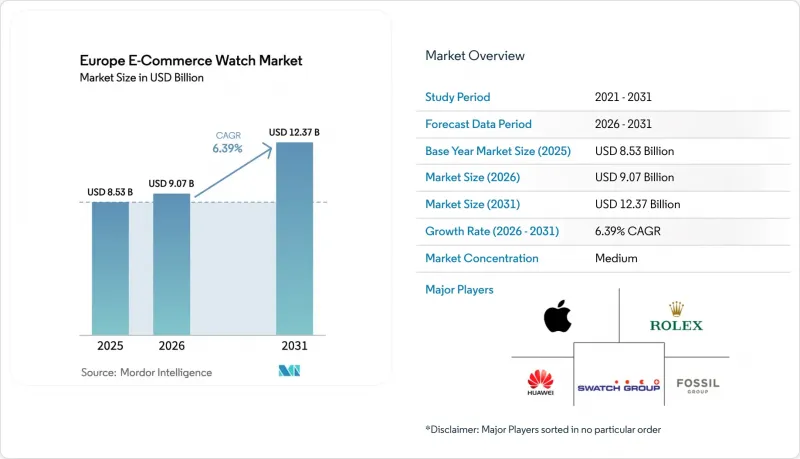
This report is Segmented by Product Type (Quartz/Mechanical and Digital Watch), Category (Mass and Premium), End User (Men, Women, and Unisex), Platform Type (Third-Party Marketplace and Company-Owned Platform), and Geography (Germany, United Kingdom, Italy, France, Spain, Netherlands, Poland, Belgium, Sweden, and Rest of Europe). The Market Forecasts are Provided in Terms of Value (USD).
Europe E-commerce Watch Market Trends and Insights
Flexible and Diverse Payment Options
Payment flexibility has become a key factor in sales conversion, with companies like Payabl reporting that 43% of European consumers abandon purchases due to complex checkout processes, limited payment options, and insufficient payment authentication methods . PayPal maintains a dominant position with 50% usage across Europe, offering consumers a trusted and secure payment method through its robust fraud protection and buyer protection policies. Mobile payment preferences are transforming European retail, as card payments increase and cash usage decreases across all age groups, driven by the convenience, security, and speed of digital transactions, along with the growing integration of contactless payment technologies. This shift benefits luxury watch e-commerce, where transaction values frequently exceed consumers' single-payment thresholds, necessitating flexible payment solutions such as installment plans, digital wallets, and buy-now-pay-later options that accommodate high-value purchases. The European Payments Initiative's development of unified payment systems aims to reduce cross-border transaction barriers by standardizing payment processes, regulations, and settlement mechanisms, allowing smaller watch retailers to compete with established marketplace platforms in the international market while ensuring compliance with regional payment standards and security protocols.
Technological Advancement
Smartwatch manufacturers are incorporating AI coaching, advanced biosensors, and digital identification features into their devices. The AI coaching functions deliver personalized fitness recommendations, workout guidance, and real-time performance analysis using individual user data and activity patterns. Samsung recorded a 74% increase in unit sales during Q1 2025, demonstrating robust consumer demand for connected wellness devices. Swiss manufacturers are implementing blockchain-based certificates for authenticity verification and secondary market trading. These certificates establish a transparent ownership record and combat counterfeiting in the luxury watch segment, while documenting service history and maintenance records. The addition of advanced health monitoring capabilities, including non-invasive glucose measurement and sleep tracking, has transformed smartwatches from fitness trackers into comprehensive health management tools. Sleep monitoring includes analysis of sleep phases, breathing patterns, heart rate variability, and customized recommendations for sleep quality improvement. These technological developments are driving growth in the market, especially in premium and health-focused segments, as consumers seek devices offering comprehensive health insights and preventive care features.
Availability of Counterfeit Products
The proliferation of counterfeit watches threatens brand integrity and consumer trust in the watch market. E-commerce platforms face increasing difficulty in maintaining marketplace accessibility while protecting brands, as counterfeiters utilize sophisticated social media marketing and direct-to-consumer distribution channels. The rise in counterfeit trade has led to significant revenue losses for legitimate watch manufacturers and retailers, while also compromising consumer safety through substandard materials and manufacturing processes. In 2024, Chrono24 introduced an authenticity verification program to combat counterfeit products, implementing advanced digital authentication technologies and expert verification processes. However, advanced counterfeiting techniques continue to challenge authentication processes, with counterfeiters adopting high-quality materials and replicating serial numbers. The European Union's Digital Services Act implementation establishes comprehensive regulatory frameworks for online platforms, which may enhance counterfeit identification and removal procedures through mandatory due diligence requirements and improved cooperation between platforms and rights holders.
Other drivers and restraints analyzed in the detailed report include:
- Influence of Social Media Platforms and Celebrity Endorsements
- Rising Demand for Premium and Luxury Watches
- Competition from Brick-and-Mortar Stores
For complete list of drivers and restraints, kindly check the Table Of Contents.
Segment Analysis
The Europe E-commerce Watch Market maintains a 64.80% of revenue in 2025 for quartz and mechanical watches, while projecting a 6.75% CAGR for digital watches through 2031. The market growth stems from connected wearables offering comprehensive health monitoring systems, integrated payment capabilities, and advanced AI-powered features, particularly attracting consumers under 35. Mechanical watches maintain their market position through collectors who value their exceptional longevity, intricate craftsmanship, and investment potential. The digital watch segment is expected to double by 2030, as heritage timepieces sustain their value through limited production numbers, historical significance, and verified authenticity.
The smartwatch segment expands through consistent product updates, technological innovations, and strategic mobile carrier partnerships. European mobile providers enhance adoption by integrating sophisticated payment applications and offering bundled service packages. Traditional watch manufacturers respond by developing hybrid models that combine advanced digital functionality with classical design elements and traditional watchmaking expertise. The certified pre-owned mechanical watch market demonstrates stability through established online platforms and trusted authentication processes, indicating sustained demand and market maturity in the European online watch market.
Mass watches represent 67.96% of the 2025 turnover in the Europe E-commerce Watch Market, while premium watches demonstrate a robust CAGR of 7.13%. Consumer preferences are increasingly shifting toward investing in single high-quality timepieces instead of multiple lower-priced watches, which has significantly increased average transaction values across the market. The segment's sustained growth is driven by carefully controlled annual production volumes, transparent and structured waiting list systems, and exceptional craftsmanship that meets museum-grade standards.
The mass-market segment maintains substantial sales volumes through strategic promotional activities and seasonal discount events, ensuring accessible price points for new customers entering the market. The certified pre-owned market serves as a vital alternative acquisition channel for premium timepieces, substantially reducing waiting times compared to authorized boutiques. The European online market for premium watches continues to expand, benefiting from sophisticated cross-border shipping infrastructure and comprehensive warranty services standardized across European territories.
Complete Report Scope:
- By Product Type
- Quartz/Mechanical
- Digital Watch
- Smart Watches
- Other Digital Types
- By Category
- Mass
- Premium
- By End User
- Men
- Women
- Unisex
- By Platform Type
- Third-Party Marketplace
- Company-Owned Platform
- By Country
- Germany
- United Kingdom
- Italy
- France
- Spain
- Netherlands
- Poland
- Belgium
- Sweden
- Rest of Europe
List of Companies Covered in this Report:
- Apple Inc.
- Huawei Technologies Co. Ltd.
- Samsung Electronics Co. Ltd.
- Fossil Group Inc.
- Rolex SA
- The Swatch Group Ltd.
- Google LLC
- Garmin Ltd.
- Compagnie Financiere Richemont SA
- Citizen Watch Co. Ltd.
- Seiko Group
- Casio Computer Co. Ltd.
- Xiaomi Corp.
- Zepp Health Corp
- LVMH Moet Hennessy Louis Vuitton SE
- Chrono24 GmbH
- NOMOS Glashttue/SA
- UHRENFABRIK JUNGHANS GMBH & CO.KG.
- Maurice Lacroix SA
- Citychamp Watch & Jewellery Group Ltd.
Additional Benefits:
- The market estimate (ME) sheet in Excel format
- 3 months of analyst support
TABLE OF CONTENTS
1 INTRODUCTION
- 1.1 Study Assumptions and Market Definition
- 1.2 Scope of the Study
2 RESEARCH METHODOLOGY
3 EXECUTIVE SUMMARY
4 MARKET LANDSCAPE
- 4.1 Market Overview
- 4.2 Market Drivers
- 4.2.1 Flexible and Diverse Payment Options
- 4.2.2 Promotion and Discounts Enticing Consumer to Make Purchase
- 4.2.3 Technological Advancement
- 4.2.4 Growing Smartphone and Internet Penetration
- 4.2.5 Influence of Social Media Platforms and Celebrity Endorsements
- 4.2.6 Rising Demand for Premium and Luxury Watches
- 4.3 Market Restraints
- 4.3.1 Availablity of Counterfeit Products
- 4.3.2 Logistical Challenges in Fulfillment and Delivery
- 4.3.3 Competition from Brick-and-Mortar Stores and Alternative Retail Channels
- 4.3.4 Rising Production and Operational Costs
- 4.4 Consumer Behaviour Analysis
- 4.5 Regulatory Outlook
- 4.6 Porter's Five Forces
- 4.6.1 Bargaining Power of Suppliers
- 4.6.2 Bargaining Power of Buyers
- 4.6.3 Threat of New Entrants
- 4.6.4 Threat of Substitutes
- 4.6.5 Degree of Competition
5 MARKET SIZE AND GROWTH FORECASTS (VALUE)
- 5.1 By Product Type
- 5.1.1 Quartz/Mechanical
- 5.1.2 Digital Watch
- 5.1.2.1 Smart Watches
- 5.1.2.2 Other Digital Types
- 5.2 By Category
- 5.2.1 Mass
- 5.2.2 Premium
- 5.3 By End User
- 5.3.1 Men
- 5.3.2 Women
- 5.3.3 Unisex
- 5.4 By Platform Type
- 5.4.1 Third-Party Marketplace
- 5.4.2 Company-Owned Platform
- 5.5 By Country
- 5.5.1 Germany
- 5.5.2 United Kingdom
- 5.5.3 Italy
- 5.5.4 France
- 5.5.5 Spain
- 5.5.6 Netherlands
- 5.5.7 Poland
- 5.5.8 Belgium
- 5.5.9 Sweden
- 5.5.10 Rest of Europe
6 COMPETITIVE LANDSCAPE
- 6.1 Market Concentration
- 6.2 Strategic Moves
- 6.3 Market Share Analysis
- 6.4 Company Profiles (includes Global-level Overview, Market-level Overview, Core Segments, Financials as available, Strategic Information, Market Rank/Share for key companies, Products and Services, and Recent Developments)
- 6.4.1 Apple Inc.
- 6.4.2 Huawei Technologies Co. Ltd.
- 6.4.3 Samsung Electronics Co. Ltd.
- 6.4.4 Fossil Group Inc.
- 6.4.5 Rolex SA
- 6.4.6 The Swatch Group Ltd.
- 6.4.7 Google LLC
- 6.4.8 Garmin Ltd.
- 6.4.9 Compagnie Financiere Richemont SA
- 6.4.10 Citizen Watch Co. Ltd.
- 6.4.11 Seiko Group
- 6.4.12 Casio Computer Co. Ltd.
- 6.4.13 Xiaomi Corp.
- 6.4.14 Zepp Health Corp
- 6.4.15 LVMH Moet Hennessy Louis Vuitton SE
- 6.4.16 Chrono24 GmbH
- 6.4.17 NOMOS Glashttue/SA
- 6.4.18 UHRENFABRIK JUNGHANS GMBH & CO.KG.
- 6.4.19 Maurice Lacroix SA
- 6.4.20 Citychamp Watch & Jewellery Group Ltd.
7 MARKET OPPORTUNITIES AND FUTURE OUTLOOK

