PUBLISHER: Mordor Intelligence | PRODUCT CODE: 2121837

PUBLISHER: Mordor Intelligence | PRODUCT CODE: 2121837
European Smartwatch - Market Share Analysis, Industry Trends & Statistics, Growth Forecasts (2026 - 2031)
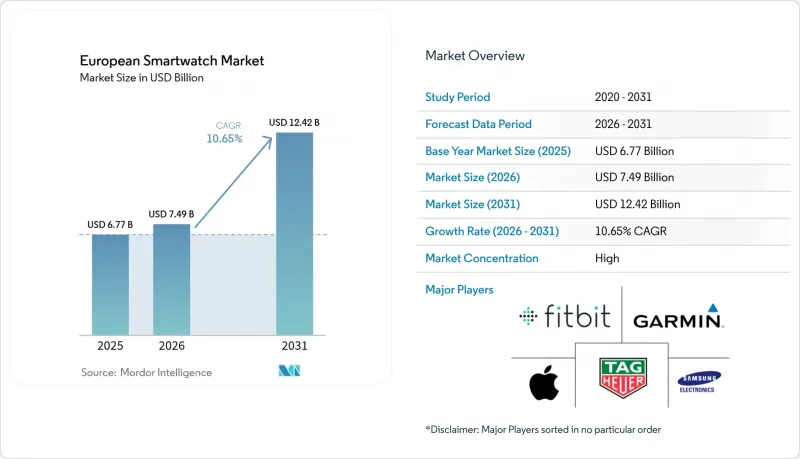
According to Mordor Intelligence, the european smartwatche market size in 2026 is estimated at USD 7.49 billion, growing from 2025 value of USD 6.77 billion with 2031 projections showing USD 12.42 billion, growing at 10.65% CAGR over 2026-2031.
This report is Segmented by Operating System (watchOS, Wear OS [Android], and More), Display Technology (AMOLED, Micro-LED, and More), Application (Personal Assistance and Notifications, Health & Medical Monitoring, and More), End-User Demographic (Gen Z [18-24], Millennials [25-40], and More), Distribution Channel (Online [E-Commerce and Brand. Com], Offline - CE Retail, and More), and Geography.
European Smartwatch Market Trends and Insights
Growing Adoption of Health and Fitness Monitoring
European consumers increasingly view smartwatches as clinical tools, not lifestyle add-ons. The Pixel Watch 3 gained FDA clearance for Loss-of-Pulse detection, setting a precedent for on-wrist medical diagnostics.Samsung's BioActive Sensor now includes advanced glycation measurements that flag metabolic risk. Withings' ScanWatch Nova extends battery life to 30 days while adding ECG, SpO2, and temperature sensors. Insurers use these readings to refine risk scoring and reimbursement models, strengthening demand. Hospitals pilot remote-patient-monitoring programs that feed continuous vitals into electronic health records, lowering follow-up visits.
Expansion of LTE/5G-Enabled Standalone Watches
Carrier eSIM activation removes the smartphone tether and positions smartwatches as safety devices for children, seniors, and outdoor athletes. Vodafone's OneNumber plan at GBP 7.50 per month allows a single data allowance across wrist and phone, driving penetration in the UK and Italy.Manufacturers re-engineer antennas and battery housings to maintain sub-13 mm thickness while meeting 24-hour endurance targets. Independent connectivity underpins fall detection, SOS messaging, and over-the-air diagnostics, widening addressable segments. Carriers benefit from incremental service revenue and lower churn, prompting cross-selling into family plans.
GDPR-Driven Data-Privacy Concerns
Smartwatch vendors must appoint EU representatives, conduct algorithm risk assessments, and store sensitive biometric data inside the EEA. Germany's regulator fined several fitness-app operators in 2025 for inadequate consent workflows, raising awareness among consumers. The forthcoming AI Act classifies on-device predictive health scoring as high risk and mandates human-override options. Compliance raises firmware and legal costs, slowing releases from smaller Asian brands lacking local counsel. Some firms offset by adding on-device processing, reducing cloud uploads, and offering paid data-sovereignty tiers for enterprise clients.
Other drivers and restraints analyzed in the detailed report include:
- Rise of Contactless Payments via NFC-Enabled Watches
- Corporate Wellness Subsidies for Smartwatches
- Margin Pressure from Mid-/Low-Tier ASP Erosion
For complete list of drivers and restraints, kindly check the Table Of Contents.
Segment Analysis
The European smartwatch market logged 53.68% share for watchOS in 2025, translating into the largest installed base of apps and accessories. HarmonyOS, pre-loaded across all new Huawei wearables from 2025, is projected to record a 17.25% CAGR as Chinese expatriate communities and value-seekers migrate to the ecosystem. Wear OS maintains relevance through Samsung's Galaxy Watch6 and Google's Pixel Watch 3, anchoring Android phone users who value Google Assistant and access to the Play Store. Sustained competition now hinges on cross-device continuity. Apple syncs medication reminders across watch, phone, and Mac, while Huawei pairs smartwatches with Harmony-powered cars for keyless entry. The European smartwatch market is increasingly rewarding platforms that can localize apps, such as Monese banking or Deezer music, for each language. Compliance updates for GDPR appear to be implemented fastest on watchOS, giving Apple an enterprise edge; however, Huawei offsets this by open-sourcing compliance libraries to local developers.
AMOLED held 70.38% of the European smartwatch market size in 2025, owing to mature supply chains and thin form factors. Micro-LED promises double the nits brightness and 30% power savings, supporting sunlight readability at ski resorts and Mediterranean beaches. The technology is forecast to grow at a 20.55% CAGR once backend yields rise and wafer-level mass transfer costs fall.Luxury makers such as TAG Heuer and Montblanc have reserved early Micro-LED batches for USD 1,500-plus SKUs, banking on early-adopter willingness to pay. TFT-LCD survives in sub-EUR 80 price bands and kids' trackers where battery longevity trumps color depth. The European smartwatch industry may adopt dual-sourcing models, where mid-range lines utilize hybrid OLED backplanes while testing Micro-LED pilots in 2027.
Complete Report Scope:
- By Operating System
- watchOS
- Wear OS (Android)
- HarmonyOS
- Proprietary / Other OS
- By Display Technology
- AMOLED
- Micro-LED
- TFT-LCD / MIP
- By Application
- Personal Assistance and Notifications
- Health and Medical Monitoring
- Fitness and Sports
- Payments and Commerce
- By End-user Demographic
- Gen Z (18-24)
- Millennials (25-40)
- Gen X (41-56)
- Seniors (57+)
- By Distribution Channel
- Online (E-commerce and Brand.com)
- Offline - CE Retail
- Offline - Watch and Jewellery
- Telco Carriers
- By Country
- United Kingdom
- Germany
- France
- Italy
- Spain
- Netherlands
- Nordics (Sweden, Norway, Denmark, Finland)
- Rest of Europe
List of Companies Covered in this Report:
- Apple Inc.
- Samsung Electronics Co., Ltd.
- Huawei Technologies Co., Ltd.
- Garmin Ltd.
- Fitbit (Alphabet Inc.)
- TAG Heuer SA
- Fossil Group Inc.
- Polar Electro Oy
- Withings SAS
- Xiaomi Corporation
- Suunto Oy
- Mobvoi Inc.
- Amazfit (Zepp Health)
- Montblanc (Richemont)
- Citizen Watch Co., Ltd.
- Casio Computer Co., Ltd.
- Oppo Co., Ltd.
- OnePlus Technology Co., Ltd.
- Alpina (Frederique Constant Group)
Additional Benefits:
- The market estimate (ME) sheet in Excel format
- 3 months of analyst support
TABLE OF CONTENTS
1 INTRODUCTION
- 1.1 Study Assumptions and Market Definition
- 1.2 Scope of the Study
2 RESEARCH METHODOLOGY
3 EXECUTIVE SUMMARY
4 MARKET LANDSCAPE
- 4.1 Market Overview
- 4.2 Market Drivers
- 4.2.1 Growing adoption of health and fitness monitoring
- 4.2.2 Expansion of LTE/5G-enabled standalone watches
- 4.2.3 Rise of contactless payments via NFC-enabled watches
- 4.2.4 Corporate wellness subsidies for smartwatches
- 4.2.5 EU digital-product-passport push for circular electronics
- 4.3 Market Restraints
- 4.3.1 GDPR-driven data-privacy concerns
- 4.3.2 Margin pressure from mid-/low-tier ASP erosion
- 4.3.3 Micro-LED display supply constraints
- 4.4 Value / Supply-Chain Analysis
- 4.5 Regulatory Landscape
- 4.6 Technological Outlook
- 4.7 Porter's Five Forces Analysis
- 4.7.1 Bargaining Power of Suppliers
- 4.7.2 Bargaining Power of Buyers
- 4.7.3 Threat of New Entrants
- 4.7.4 Intensity of Competitive Rivalry
- 4.7.5 Threat of Substitutes
5 MARKET SIZE AND GROWTH FORECASTS (VALUE)
- 5.1 By Operating System
- 5.1.1 watchOS
- 5.1.2 Wear OS (Android)
- 5.1.3 HarmonyOS
- 5.1.4 Proprietary / Other OS
- 5.2 By Display Technology
- 5.2.1 AMOLED
- 5.2.2 Micro-LED
- 5.2.3 TFT-LCD / MIP
- 5.3 By Application
- 5.3.1 Personal Assistance and Notifications
- 5.3.2 Health and Medical Monitoring
- 5.3.3 Fitness and Sports
- 5.3.4 Payments and Commerce
- 5.4 By End-user Demographic
- 5.4.1 Gen Z (18-24)
- 5.4.2 Millennials (25-40)
- 5.4.3 Gen X (41-56)
- 5.4.4 Seniors (57+)
- 5.5 By Distribution Channel
- 5.5.1 Online (E-commerce and Brand.com)
- 5.5.2 Offline - CE Retail
- 5.5.3 Offline - Watch and Jewellery
- 5.5.4 Telco Carriers
- 5.6 By Country
- 5.6.1 United Kingdom
- 5.6.2 Germany
- 5.6.3 France
- 5.6.4 Italy
- 5.6.5 Spain
- 5.6.6 Netherlands
- 5.6.7 Nordics (Sweden, Norway, Denmark, Finland)
- 5.6.8 Rest of Europe
6 COMPETITIVE LANDSCAPE
- 6.1 Market Concentration
- 6.2 Strategic Moves
- 6.3 Market Share Analysis
- 6.4 Company Profiles (includes Global level Overview, Market level overview, Core Segments, Financials as available, Strategic Information, Market Rank/Share for key companies, Products and Services, and Recent Developments)
- 6.4.1 Apple Inc.
- 6.4.2 Samsung Electronics Co., Ltd.
- 6.4.3 Huawei Technologies Co., Ltd.
- 6.4.4 Garmin Ltd.
- 6.4.5 Fitbit (Alphabet Inc.)
- 6.4.6 TAG Heuer SA
- 6.4.7 Fossil Group Inc.
- 6.4.8 Polar Electro Oy
- 6.4.9 Withings SAS
- 6.4.10 Xiaomi Corporation
- 6.4.11 Suunto Oy
- 6.4.12 Mobvoi Inc.
- 6.4.13 Amazfit (Zepp Health)
- 6.4.14 Montblanc (Richemont)
- 6.4.15 Citizen Watch Co., Ltd.
- 6.4.16 Casio Computer Co., Ltd.
- 6.4.17 Oppo Co., Ltd.
- 6.4.18 OnePlus Technology Co., Ltd.
- 6.4.19 Alpina (Frederique Constant Group)
7 MARKET OPPORTUNITIES AND FUTURE OUTLOOK
- 7.1 White-space and Unmet-need Assessment

