
PUBLISHER: Mordor Intelligence | PRODUCT CODE: 2100011

PUBLISHER: Mordor Intelligence | PRODUCT CODE: 2100011
North America E-commerce Watch - Market Share Analysis, Industry Trends & Statistics, Growth Forecasts (2026 - 2031)
According to Mordor Intelligence, the North America e-commerce watch market size was valued at USD 13.30 billion in 2025 and estimated to grow from USD 14.01 billion in 2026 to reach USD 18.13 billion by 2031, at a CAGR of 5.30% during the forecast period (2026-2031).
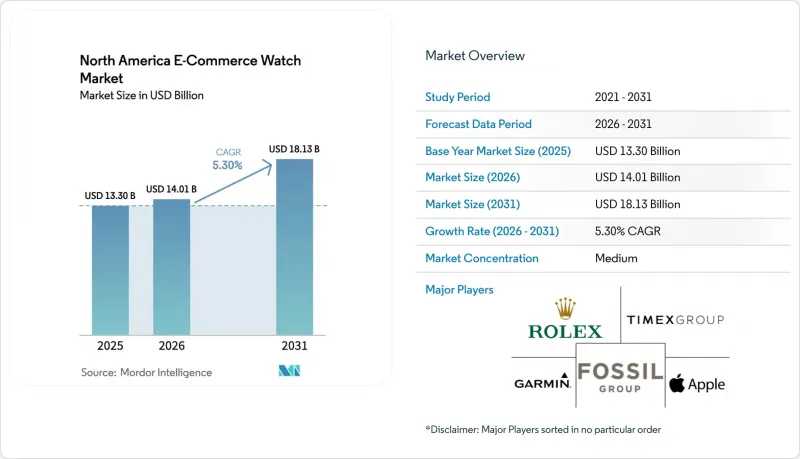
This report is Segmented by Product Type (Quartz/Mechanical and Digital Watch), Category (Mass and Premium), End User (Men, Women, and Unisex), Platform Type (Third-Party Marketplace and Company-Owned Platform), and Geography (United States, Canada, Mexico, and Rest of North America). The Market Forecasts are Provided in Terms of Value (USD).
North America E-commerce Watch Market Trends and Insights
Flexible and Diverse Payment Options
Payment flexibility has emerged as a critical competitive differentiator, with digital wallet adoption fundamentally reshaping transaction patterns across North American e-commerce. Consumers increasingly prefer platforms that provide diverse payment methods, including credit/debit cards, digital wallets, and buy-now-pay-later (BNPL) services. Additionally, BNPL (Buy Now, Pay Later) services have gained substantial traction. These payment options not only enhance customer convenience but also reduce cart abandonment rates, which is a critical factor in driving e-commerce sales. Furthermore, the integration of secure payment gateways and the adoption of advanced technologies, such as tokenization and encryption, have bolstered consumer trust in online transactions. The availability of secure and diverse payment methods has become a key differentiator for e-commerce platforms, further fueling the growth of the e-commerce watch market in the region.
Promotion and Discounts Enticing Consumers to Make Purchases
Promotional strategies have transitioned from relying solely on traditional seasonal sales to incorporating advanced dynamic pricing algorithms and personalized discount mechanisms. These approaches actively adapt to individual consumer behavior patterns, enabling brands to engage more effectively with their target audience. The Consumer Technology Association reports that 233 million American adults are expected to make technology purchases during the 2024 holiday season. Among these consumers, 41% began their shopping before November, creating an extended promotional period that benefits online watch retailers . This prolonged purchasing window allows brands to actively implement tiered promotional strategies, which help maximize revenue while preserving their brand positioning. These strategies not only help maximize revenue but also strengthen customer relationships and preserve brand positioning in a competitive market.
Availability of Counterfeit Products
Counterfeit products are widely available, posing a significant restraint on the North American e-commerce watch market. The proliferation of counterfeit watches undermines consumer trust and affects the revenue of legitimate sellers. These fake products are often sold at lower prices, making it challenging for authentic brands to compete. Additionally, the presence of counterfeit goods can damage brand reputation and lead to increased costs for companies investing in anti-counterfeiting measures. Counterfeit products also create confusion among consumers, as it becomes difficult to differentiate between genuine and fake items, further eroding confidence in online platforms. The lack of stringent regulations and enforcement mechanisms in some areas exacerbates the issue, allowing counterfeiters to exploit loopholes and continue their operations. This persistent challenge not only impacts the profitability of established brands but also discourages new entrants from entering the market.
Other drivers and restraints analyzed in the detailed report include:
- Technological Advancement in Terms of Design
- Growing Smartphone and Internet Penetration
- Logistical Challenges in Fulfillment and Delivery
For complete list of drivers and restraints, kindly check the Table Of Contents.
Segment Analysis
Quartz/mechanical models accounted for 56.05% of the market share in 2025. This dominance highlights the sustained popularity of heritage engineering and the tactile appeal these watches offer. Quartz watches, known for their precision and low maintenance, continue to attract a significant consumer base. Additionally, mechanical watches, often regarded as luxury items, appeal to enthusiasts who value craftsmanship and intricate designs. The combination of these factors has solidified the position of quartz and mechanical watches as a cornerstone of the North American e-commerce watch market, catering to both practical and luxury-oriented consumers.
On the other hand, digital watches, led by the growing adoption of smartwatches, are forecast to grow at a CAGR of 5.68% through 2031. The increasing demand for smartwatches is driven by their multifunctionality, including fitness tracking, connectivity features, and health monitoring capabilities. These watches have become an integral part of the wearable technology trend, appealing to tech-savvy consumers and fitness enthusiasts alike. Furthermore, advancements in smartwatch technology, such as improved battery life, enhanced user interfaces, and compatibility with various devices, are expected to further boost their adoption. This growth reflects a shift in consumer preferences toward technologically advanced and versatile timepieces in the North American e-commerce watch market.
In 2025, price-sensitive consumers in the North American e-commerce watch market gravitated towards mass-market SKUs, which dominated the market with a 66.92% share. These products appeal to a broad audience by offering reliable style statements at affordable prices. The mass-market segment benefits from high demand among consumers who prioritize cost-effectiveness without compromising on basic quality and design. Additionally, the availability of a wide range of designs, colors, and functionalities in this segment has further fueled its popularity. E-commerce platforms have played a significant role in driving sales for mass-market watches by offering competitive pricing, discounts, and convenient delivery options.
However, the premium segment is poised to grow at a faster pace, with a projected CAGR of 5.86%. This growth is driven by increasing consumer interest in high-quality, luxury timepieces that offer exclusivity and superior craftsmanship. Premium watches are gaining traction among affluent buyers and style-conscious individuals who view these products as status symbols and long-term investments. The segment's robust growth reflects a shift in consumer preferences toward premiumization within the e-commerce watch market. Furthermore, the rising influence of social media and celebrity endorsements has amplified the appeal of premium watches, making them aspirational products for a growing segment of consumers.
Complete Report Scope:
- By Product Type
- Quartz/Mechanical
- Digital Watch
- Smart Watches
- Other Digital Types
- By Category
- Mass
- Premium
- By End User
- Men
- Women
- Unisex
- By Platform Type
- Third-Party Marketplace
- Company-owned Platform
- By Country
- United States
- Canada
- Mexico
- Rest of North America
List of Companies Covered in this Report:
- Apple Inc.
- Garmin Ltd.
- Fossil Group Inc.
- Timex Group B.V.
- Rolex SA
- Google LLC (Fitbit)
- Casio Computer Co., Ltd.
- Sony Corporation
- Samsung Electronics Co., Ltd.
- Citizen Watch Co., Ltd.
- WHOOP, Inc.
- Xiaomi Corporation
- Huawei Technologies Co., Ltd.
- Weiss Watch Company, LLC
- Bulova Corporation
- LG Electronics Inc.
- Polar Electro Oy
- Richemont SA
- Swatch Group AG
- Coros Wearables Inc.
Additional Benefits:
- The market estimate (ME) sheet in Excel format
- 3 months of analyst support
TABLE OF CONTENTS
1 INTRODUCTION
- 1.1 Study Assumptions and Market Definition
- 1.2 Scope of the Study
2 RESEARCH METHODOLOGY
3 EXECUTIVE SUMMARY
4 MARKET LANDSCAPE
- 4.1 Market Overview
- 4.2 Market Drivers
- 4.2.1 Flexible and diverse payment options
- 4.2.2 Promotion and discounts enticing consumer to make purchase
- 4.2.3 Technological advancement in terms of design
- 4.2.4 Growing smartphone and internet penetration
- 4.2.5 Influence of social media platforms and celebrity endorsements
- 4.2.6 Rising demand for premium and luxury watches
- 4.3 Market Restraints
- 4.3.1 Availability of counterfeit products
- 4.3.2 Logistical challenges in fulfillment and delivery
- 4.3.3 Competition from brick-and-mortar stores and alternative retail channels
- 4.3.4 Rising production and operational costs
- 4.4 Consumer Behaviour Analysis
- 4.5 Regulatory Outlook
- 4.6 Porter's Five Forces Analysis
- 4.6.1 Bargaining Power of Suppliers
- 4.6.2 Bargaining Power of Buyers
- 4.6.3 Threat of New Entrants
- 4.6.4 Threat of Substitutes
- 4.6.5 Degree of Competition
5 MARKET SIZE AND GROWTH FORECASTS (VALUE)
- 5.1 By Product Type
- 5.1.1 Quartz/Mechanical
- 5.1.2 Digital Watch
- 5.1.2.1 Smart Watches
- 5.1.2.2 Other Digital Types
- 5.2 By Category
- 5.2.1 Mass
- 5.2.2 Premium
- 5.3 By End User
- 5.3.1 Men
- 5.3.2 Women
- 5.3.3 Unisex
- 5.4 By Platform Type
- 5.4.1 Third-Party Marketplace
- 5.4.2 Company-owned Platform
- 5.5 By Country
- 5.5.1 United States
- 5.5.2 Canada
- 5.5.3 Mexico
- 5.5.4 Rest of North America
6 COMPETITIVE LANDSCAPE
- 6.1 Market Concentration
- 6.2 Strategic Moves
- 6.3 Market Share Analysis
- 6.4 Company Profiles (includes Global level Overview, Market level overview, Core Segments, Financials as available, Strategic Information, Market Rank/Share for key companies, Products & Services, and Recent Developments)
- 6.4.1 Apple Inc.
- 6.4.2 Garmin Ltd.
- 6.4.3 Fossil Group Inc.
- 6.4.4 Timex Group B.V.
- 6.4.5 Rolex SA
- 6.4.6 Google LLC (Fitbit)
- 6.4.7 Casio Computer Co., Ltd.
- 6.4.8 Sony Corporation
- 6.4.9 Samsung Electronics Co., Ltd.
- 6.4.10 Citizen Watch Co., Ltd.
- 6.4.11 WHOOP, Inc.
- 6.4.12 Xiaomi Corporation
- 6.4.13 Huawei Technologies Co., Ltd.
- 6.4.14 Weiss Watch Company, LLC
- 6.4.15 Bulova Corporation
- 6.4.16 LG Electronics Inc.
- 6.4.17 Polar Electro Oy
- 6.4.18 Richemont SA
- 6.4.19 Swatch Group AG
- 6.4.20 Coros Wearables Inc.
7 MARKET OPPORTUNITIES AND FUTURE OUTLOOK

