PUBLISHER: Mordor Intelligence | PRODUCT CODE: 2120633

PUBLISHER: Mordor Intelligence | PRODUCT CODE: 2120633
Asia Pacific Smart Watch - Market Share Analysis, Industry Trends & Statistics, Growth Forecasts (2026 - 2031)
According to Mordor Intelligence, Asia Pacific smart watch market size in 2026 is estimated at USD 73.59 billion, growing from 2025 value of USD 61.65 billion with 2031 projections showing USD 178.16 billion, growing at 19.36% CAGR over 2026-2031.
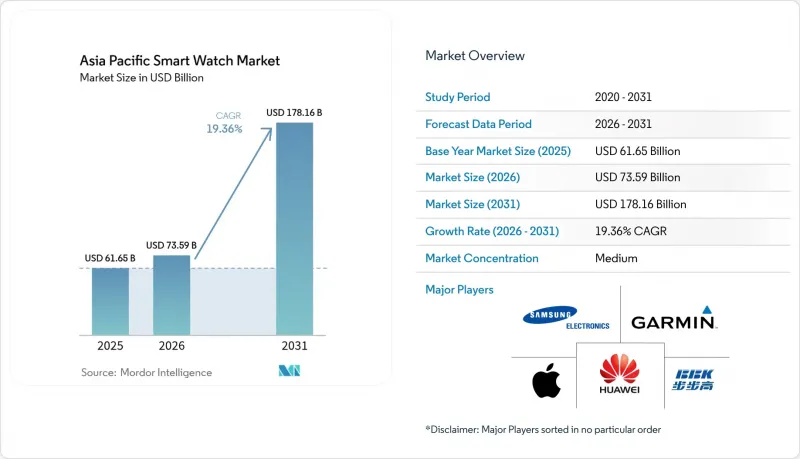
This report is Segmented by Operating System (WatchOS, Android/Wear OS, and More), Display Technology (AMOLED, PMOLED, TFT LCD), Connectivity (Bluetooth Only, Bluetooth + Cellular, 5G Standalone), Application (Personal Assistance, Medical and Health Monitoring, and More), and Country. The Market Forecasts are Provided in Terms of Value (USD).
Asia Pacific Smart Watch Market Trends and Insights
Proliferation of Health and Fitness Sensors in Affordable Smart Watches
Sensor miniaturization has transformed entry-level units into full health dashboards that track heart rate, SpO2, and stress indicators. Huawei's Watch GT 5 debuted at JPY 1,488 (USD 207) in China and EUR 249 (USD 279) in Europe with TruSense analytics, pushing sophisticated biometrics into mid-price tiers . China consequently recorded 18.7% year-over-year shipment growth to 11.1 million units in Q2 2024. Samsung's Galaxy Watch8 adds AI-driven sleep and vascular-load insights to mainstream models. Blood-pressure and glucose-trend features now enter mass-market price points, expanding demand beyond fitness enthusiasts into chronic-disease management cohorts.
Ecosystem Lock-in Strategies by Smartphone OEMs
Proprietary integration heightens switching costs. Apple links iPhone hydration-tracking IP with WatchOS health data, encouraging brand loyalty within Japan, where iOS holds 59% mobile OS share. Samsung interlocks Galaxy handsets, watches, and Samsung Health for unified user journeys. Huawei's HarmonyOS secures top global wrist-worn market share for two straight quarters. Consumers increasingly prioritize compatibility over individual hardware specs when selecting devices, reshaping the competitive contours of the Asia Pacific smart watch market.
Short Replacement Cycles Driving E-waste Regulation
Smart watches average two- to three-year lifespans, half that of smartphones, amplifying electronic waste volumes. South Korea's expanded RoHS and Extended Producer Responsibility requirements now encompass wearables and will fully apply by 2028. India's E-Waste Management Rules set escalating collection targets, compelling OEMs to fund take-back logistics that erode margins. Compliance favors vendors with robust reverse-supply chains and may consolidate shares within the Asia Pacific smart watch market.
Other drivers and restraints analyzed in the detailed report include:
- Rapid 5G Rollout Enabling Always-Connected Features
- Insurance-Linked Wellness Premium Discounts
- Battery-Life Limitations in Advanced Displays
For complete list of drivers and restraints, kindly check the Table Of Contents.
Segment Analysis
WatchOS secured 40.68% of the Asia Pacific smart watch market share in 2025 on seamless iPhone integration amid Apple's 18% Q4 shipment decline. The Asia Pacific smart watch market size tied to WatchOS is forecast to expand in lockstep with premium handset upgrades despite intensifying regional price competition. Android/Wear OS rebounds through Samsung's Galaxy Watch8, which embeds on-device Gemini AI, while Huawei continues HarmonyOS diversification.
Real-Time Operating Systems are climbing at 19.65% CAGR as industrial, medical, and ultra-long-life use cases demand deterministic performance. RTOS solutions often forego expansive app libraries for predictable latency and extended battery profiles. Regulatory data-localization mandates in China and India further catalyze domestic OS innovation, ensuring a pluralistic software landscape inside the Asia Pacific smart watch market.
AMOLED comprised 51.97% revenue across the Asia Pacific smart watch market in 2025, driven by Samsung's vertical integration and pixel-level illumination benefits that sustain always-on modes without excessive drain. Elevated brightness and wide color gamuts enhance medical imaging readability and outdoor fitness visibility.
PMOLED's 19.72% CAGR underscores its resonance in entry-level tiers where affordability and low-power traits resonate. TFT LCD maintains relevance in cost-sensitive Southeast Asian markets. Micro-LED prototypes showcase AMOLED-grade visuals with lower energy usage but carry premium price tags, signaling a potential inflection point later in the decade for the Asia Pacific smart watch industry.
Complete Report Scope:
- By Operating System
- WatchOS
- Android/Wear OS
- Real-Time Operating Systems (RTOS)
- Other Operating Systems
- By Display Technology
- AMOLED
- PMOLED
- TFT LCD
- By Connectivity
- Bluetooth Only
- Bluetooth + Cellular (LTE/eSIM)
- 5G Standalone
- By Application
- Personal Assistance
- Medical and Health Monitoring
- Sports and Fitness
- Other Applications (Kids and Elderly Safety, etc.)
- By Country
- China
- India
- Japan
- South Korea
- Australia and New Zealand
- South East Asia
- Rest of Asia Pacific
List of Companies Covered in this Report:
- Apple Inc.
- Samsung Electronics Co., Ltd.
- Huawei Technologies Co., Ltd.
- Xiaomi Corporation
- OPPO Co. Ltd.
- BBK Electronics Industry Co., Ltd.
- Garmin Ltd.
- Fitbit, Inc. (Google LLC)
- Zepp Health Corporation
- Fossil Group Inc.
- Sony Group Corporation
- LG Electronics Inc.
- Lenovo Group Limited
- Titan Company Ltd. (Fastrack Smart)
- Noise (Nexxbase Marketing Private Limited)
- boAt (Imagine Marketing Ltd.)
- Polar Electro OY
- Suunto Oy (Anta Sports)
- Mobvoi Information Technology Co., Ltd.
Additional Benefits:
- The market estimate (ME) sheet in Excel format
- 3 months of analyst support
TABLE OF CONTENTS
1 INTRODUCTION
- 1.1 Study Assumptions and Market Definition
- 1.2 Scope of the Study
2 RESEARCH METHODOLOGY
3 EXECUTIVE SUMMARY
4 MARKET LANDSCAPE
- 4.1 Market Overview
- 4.2 Market Drivers
- 4.2.1 Proliferation of health and fitness sensors in affordable smart watches
- 4.2.2 Ecosystem lock-in strategies by smartphone OEMs
- 4.2.3 Rapid 5G rollout enabling always-connected features
- 4.2.4 Insurance-linked wellness premium discounts
- 4.2.5 Local contract-manufacturing incentives in India and Vietnam
- 4.2.6 Integration of eSIM and contactless payment raising daily utility
- 4.3 Market Restraints
- 4.3.1 Short replacement cycles driving e-waste regulation
- 4.3.2 Battery-life limitations in advanced displays
- 4.3.3 Tightening data-privacy laws in China and India
- 4.3.4 High tariffs on imported components
- 4.4 Value Chain Analysis
- 4.5 Regulatory Landscape
- 4.6 Porter's Five Forces Analysis
- 4.6.1 Bargaining Power of Suppliers
- 4.6.2 Bargaining Power of Buyers
- 4.6.3 Threat of New Entrants
- 4.6.4 Threat of Substitute Products
- 4.6.5 Intensity of Competitive Rivalry
- 4.7 Impact of Macroeconomic Factors on the Market
5 MARKET SIZE AND GROWTH FORECASTS (VALUE)
- 5.1 By Operating System
- 5.1.1 WatchOS
- 5.1.2 Android/Wear OS
- 5.1.3 Real-Time Operating Systems (RTOS)
- 5.1.4 Other Operating Systems
- 5.2 By Display Technology
- 5.2.1 AMOLED
- 5.2.2 PMOLED
- 5.2.3 TFT LCD
- 5.3 By Connectivity
- 5.3.1 Bluetooth Only
- 5.3.2 Bluetooth + Cellular (LTE/eSIM)
- 5.3.3 5G Standalone
- 5.4 By Application
- 5.4.1 Personal Assistance
- 5.4.2 Medical and Health Monitoring
- 5.4.3 Sports and Fitness
- 5.4.4 Other Applications (Kids and Elderly Safety, etc.)
- 5.5 By Country
- 5.5.1 China
- 5.5.2 India
- 5.5.3 Japan
- 5.5.4 South Korea
- 5.5.5 Australia and New Zealand
- 5.5.6 South East Asia
- 5.5.7 Rest of Asia Pacific
6 COMPETITIVE LANDSCAPE
- 6.1 Market Concentration
- 6.2 Strategic Moves
- 6.3 Market Share Analysis
- 6.4 Company Profiles (includes Global level Overview, Market level overview, Core Segments, Financials as available, Strategic Information, Market Rank/Share for key companies, Products and Services, and Recent Developments)
- 6.4.1 Apple Inc.
- 6.4.2 Samsung Electronics Co., Ltd.
- 6.4.3 Huawei Technologies Co., Ltd.
- 6.4.4 Xiaomi Corporation
- 6.4.5 OPPO Co. Ltd.
- 6.4.6 BBK Electronics Industry Co., Ltd.
- 6.4.7 Garmin Ltd.
- 6.4.8 Fitbit, Inc. (Google LLC)
- 6.4.9 Zepp Health Corporation
- 6.4.10 Fossil Group Inc.
- 6.4.11 Sony Group Corporation
- 6.4.12 LG Electronics Inc.
- 6.4.13 Lenovo Group Limited
- 6.4.14 Titan Company Ltd. (Fastrack Smart)
- 6.4.15 Noise (Nexxbase Marketing Private Limited)
- 6.4.16 boAt (Imagine Marketing Ltd.)
- 6.4.17 Polar Electro OY
- 6.4.18 Suunto Oy (Anta Sports)
- 6.4.19 Mobvoi Information Technology Co., Ltd.
7 MARKET OPPORTUNITIES AND FUTURE OUTLOOK
- 7.1 White-space and Unmet-Need Assessment

