PUBLISHER: Mordor Intelligence | PRODUCT CODE: 2121514

PUBLISHER: Mordor Intelligence | PRODUCT CODE: 2121514
Middle East And Africa Smartwatch - Market Share Analysis, Industry Trends & Statistics, Growth Forecasts (2026 - 2031)
According to Mordor Intelligence, the Middle East and Africa smartwatch market size was valued at USD 1.78 billion in 2025 and is estimated to grow from USD 2.04 billion in 2026 to reach USD 3.63 billion by 2031, at a CAGR of 12.22% during the forecast period (2026-2031).
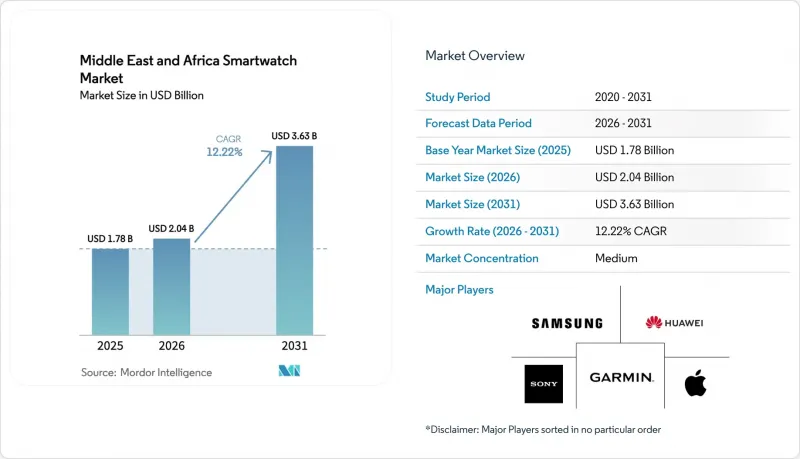
This report is Segmented by Operating System (WatchOS, Android Wear OS, and More), Display Type (AMOLED, PMOLED, TFT LCD, Microled), Connectivity (Bluetooth Only, Cellular LTE/5G, Hybrid, NFC-Enabled), Price Range (Premium, Mid-Range, Budget), Application (Personal Assistance, Medical, Sports and Fitness, and More), and Geography. The Market Forecasts are Provided in Terms of Value (USD).
Middle East And Africa Smartwatch Market Trends and Insights
Proliferation of eSIM-Based LTE Smartwatches
Standalone connectivity is shifting watches from companion gadgets to independent communication tools. GCC operators activate eSIM profiles in minutes and increasingly bundle 12-month data plans with every LTE device. 5G RedCap pilots in Kuwait and the UAE have cut radio costs to below USD 20 per module and reduced power consumption by roughly 50%, making mid-range cellular models viable. Use cases move beyond fitness, enabling fall-detection alerts routed straight to emergency dispatch and remote glucose monitoring for diabetics. Government procurement also favors LTE watches for national tele-medicine pilots, ensuring sustained demand through 2031.
Rapid Expansion of Fintech-Enabled Wearable Payments
Banks across the region now embed tokenized debit credentials directly into watch operating systems. First Abu Dhabi Bank, Emirates NBD, and Boubyan Bank rolled out watch wallets between 2024 and 2025, after which contactless watch payments became table stakes at grocery stores and metro gates. Transaction-fee sharing allows banks to subsidize hardware, trimming the effective retail price of many mid-range models by up to 20%. This creates a positive flywheel: higher watch penetration yields more payment volume, which in turn funds deeper discounts and marketing spend.
Data-Privacy Regulations Limiting Monetization
Federal Decree-Law 45 of 2021 in the UAE and Saudi Arabia's Personal Data Protection Law require explicit opt-in consent for every secondary use of health data, thereby squeezing ad-supported business models. Cloud providers must host personal health records on in-country servers, pushing up infrastructure costs. As a result, brands that rely on analytics revenue now depend more heavily on hardware margins and subscription upgrades.
Other drivers and restraints analyzed in the detailed report include:
- Government-Led Digital-Health Initiatives in the GCC
- Mainstream Adoption of AI-Driven Wellness Analytics
- High Import Tariffs on Finished Wearables in Africa
For complete list of drivers and restraints, kindly check the Table Of Contents.
Segment Analysis
The Middle East and Africa smartwatch market size for operating-system sales highlights WatchOS with a 52.31% share in 2025; however, HarmonyOS is forecast to post a 13.11% CAGR, the fastest rate among its rivals. Apple's closed loop of hardware, cloud services, and healthcare partnerships secures loyalty among affluent iPhone owners, but its premium pricing leaves room for Huawei and Samsung. HarmonyOS gains traction by embedding Arabic and Swahili interfaces and striking profit-sharing deals with GCC telcos that preload apps for grocery, stock trading, and ride-hailing services. Android Wear OS appeals to open-ecosystem advocates, leveraging Google Wallet and a vast library of watch faces. Over the forecast window, no single platform is likely to exceed 60% dominance, ensuring a multi-OS landscape that favors cross-platform app developers.
Growing regulatory scrutiny over data sovereignty further shapes demand. Vendors that keep processing on the device, rather than the cloud, reduce compliance friction in Saudi Arabia and South Africa. As sensor arrays become more sophisticated, adding vendors that can push real-time analytics to the edge for cuffless blood-pressure and non-invasive glucose monitoring platforms will command higher average selling prices and lower churn, thereby strengthening ecosystem lock-in.
AMOLED delivered 68.19% of 2025 shipments, confirming its cost-performance sweet spot. The Middle East and Africa smartwatch market share for AMOLED hinges on its deep blacks and thin profile, as well as the requirements for always-on faces and bezel-less industrial design. Yet, the relentless summer sun in Riyadh and Dubai exposes OLED burn-in and forces maximum-brightness modes that significantly reduce battery life. Samsung's forthcoming 2.1-inch MicroLED panel, rated at 4,000 nits, promises 33% brighter output at roughly half the power draw, unlocking seven-day endurance even with outdoor workouts.
Yield rates remain the principal bottleneck, so MicroLED will debut in USD 500-plus models before cascading into mid-range tiers by 2028. TFT LCD and PMOLED will retreat to rugged field watches, children's trackers, and sub-USD 50 fitness bands. Vendors that couple MicroLED with adaptive-refresh firmware and ambient-light sensors will extend run-time without user input, a critical differentiator for hikers and oil-field workers operating far from chargers.
Complete Report Scope:
- By Operating System
- WatchOS
- Android Wear OS
- HarmonyOS
- Other Operating Systems
- By Display Type
- AMOLED
- PMOLED
- TFT LCD
- MicroLED
- By Connectivity
- Bluetooth Only
- Cellular (LTE/5G)
- Hybrid (Bluetooth + Wi-Fi)
- NFC-enabled
- By Price Range
- Premium (Above USD 400)
- Mid-range (USD 200-399)
- Budget (Below USD 199)
- By Application
- Personal Assistance
- Medical
- Sports and Fitness
- Other Applications
- By Geography
- Middle East
- United Arab Emirates
- Saudi Arabia
- Turkey
- Rest of Middle East
- Africa
- South Africa
- Kenya
- Nigeria
- Rest of Africa
- Middle East
List of Companies Covered in this Report:
- Apple Inc.
- Samsung Electronics Co. Ltd
- Garmin Ltd
- Fitbit Inc.
- Huawei Technologies Co. Ltd
- Sony Corporation
- Lenovo Group Limited
- Zepp Health Corp.
- LG Electronics Inc.
- Fossil Group Inc.
- Xiaomi Corporation
- OPPO Electronics Corporation
- Imagine Marketing Ltd.
- Mobvoi Information Technology Company Limited
- Suunto Oy
- Polar Electro Oy
- Boltt Sports Technologies Pvt Ltd
- Honor Device Co. Ltd
- Titan Company Limited
Additional Benefits:
- The market estimate (ME) sheet in Excel format
- 3 months of analyst support
TABLE OF CONTENTS
1 INTRODUCTION
- 1.1 Study Assumptions and Market Definition
- 1.2 Scope of the Study
2 RESEARCH METHODOLOGY
3 EXECUTIVE SUMMARY
4 MARKET LANDSCAPE
- 4.1 Market Overview
- 4.2 Market Drivers
- 4.2.1 Proliferation of eSIM-Based LTE Smartwatches
- 4.2.2 Rapid Expansion Of Fintech-Enabled Wearable Payments
- 4.2.3 Government-Led Digital Health Initiatives In GCC
- 4.2.4 Localization Incentives For Consumer Electronics Manufacturing
- 4.2.5 Rising Health Consciousness and Fitness Club Memberships
- 4.2.6 Mainstream Adoption Of AI-Driven Wellness Analytics
- 4.3 Market Restraints
- 4.3.1 Data-Privacy Regulations Limiting Health Data Monetization
- 4.3.2 High Import Tariffs on Finished Wearables in Key African Markets
- 4.3.3 Battery-Life Limitations Restricting Medical Certifications
- 4.3.4 Security Vulnerabilities in Low-Cost Android Clones
- 4.4 Industry Value Chain Analysis
- 4.5 Regulatory Landscape
- 4.6 Technological Outlook
- 4.7 Impact of Macroeconomic Factors on the Market
- 4.8 Porter's Five Forces Analysis
- 4.8.1 Bargaining Power of Suppliers
- 4.8.2 Bargaining Power of Buyers
- 4.8.3 Threat of New Entrants
- 4.8.4 Threat of Substitutes
- 4.8.5 Intensity of Competitive Rivalry
- 4.9 Impact of COVID-19 on the Market
- 4.10 Investment Analysis
5 MARKET SIZE AND GROWTH FORECASTS (VALUE)
- 5.1 By Operating System
- 5.1.1 WatchOS
- 5.1.2 Android Wear OS
- 5.1.3 HarmonyOS
- 5.1.4 Other Operating Systems
- 5.2 By Display Type
- 5.2.1 AMOLED
- 5.2.2 PMOLED
- 5.2.3 TFT LCD
- 5.2.4 MicroLED
- 5.3 By Connectivity
- 5.3.1 Bluetooth Only
- 5.3.2 Cellular (LTE/5G)
- 5.3.3 Hybrid (Bluetooth + Wi-Fi)
- 5.3.4 NFC-enabled
- 5.4 By Price Range
- 5.4.1 Premium (Above USD 400)
- 5.4.2 Mid-range (USD 200-399)
- 5.4.3 Budget (Below USD 199)
- 5.5 By Application
- 5.5.1 Personal Assistance
- 5.5.2 Medical
- 5.5.3 Sports and Fitness
- 5.5.4 Other Applications
- 5.6 By Geography
- 5.6.1 Middle East
- 5.6.1.1 United Arab Emirates
- 5.6.1.2 Saudi Arabia
- 5.6.1.3 Turkey
- 5.6.1.4 Rest of Middle East
- 5.6.2 Africa
- 5.6.2.1 South Africa
- 5.6.2.2 Kenya
- 5.6.2.3 Nigeria
- 5.6.2.4 Rest of Africa
- 5.6.1 Middle East
6 COMPETITIVE LANDSCAPE
- 6.1 Market Concentration
- 6.2 Strategic Moves
- 6.3 Market Share Analysis
- 6.4 Company Profiles (includes Global Level Overview, Market Level Overview, Core Segments, Financials as Available, Strategic Information, Market Rank/Share for Key Companies, Products and Services, and Recent Developments)
- 6.4.1 Apple Inc.
- 6.4.2 Samsung Electronics Co. Ltd
- 6.4.3 Garmin Ltd
- 6.4.4 Fitbit Inc.
- 6.4.5 Huawei Technologies Co. Ltd
- 6.4.6 Sony Corporation
- 6.4.7 Lenovo Group Limited
- 6.4.8 Zepp Health Corp.
- 6.4.9 LG Electronics Inc.
- 6.4.10 Fossil Group Inc.
- 6.4.11 Xiaomi Corporation
- 6.4.12 OPPO Electronics Corporation
- 6.4.13 Imagine Marketing Ltd.
- 6.4.14 Mobvoi Information Technology Company Limited
- 6.4.15 Suunto Oy
- 6.4.16 Polar Electro Oy
- 6.4.17 Boltt Sports Technologies Pvt Ltd
- 6.4.18 Honor Device Co. Ltd
- 6.4.19 Titan Company Limited
7 MARKET OPPORTUNITIES AND FUTURE OUTLOOK
- 7.1 White-space and Unmet-Need Assessment

