PUBLISHER: Mordor Intelligence | PRODUCT CODE: 2120595

PUBLISHER: Mordor Intelligence | PRODUCT CODE: 2120595
North America Smart Watch - Market Share Analysis, Industry Trends & Statistics, Growth Forecasts (2026 - 2031)
According to Mordor Intelligence, North America smart watch market size in 2026 is estimated at USD 61.74 billion, growing from 2025 value of USD 53.10 billion with 2031 projections showing USD 131.24 billion, growing at 16.28% CAGR over 2026-2031.
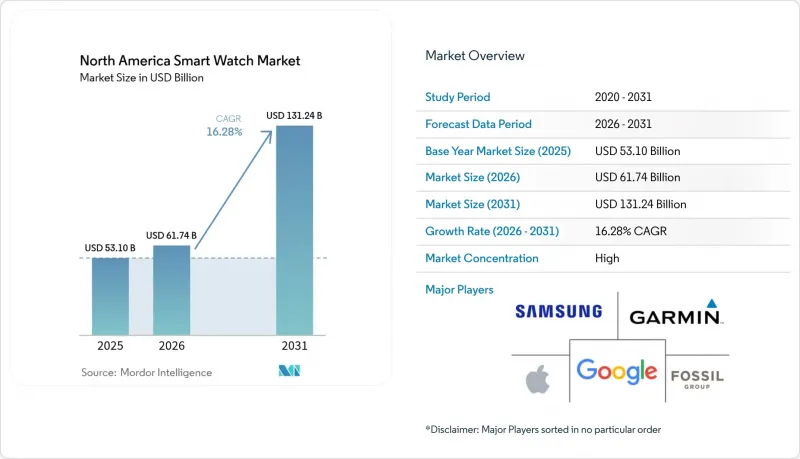
This report is Segmented by Operating System (watchOS, Wear OS, and More), Display Type (AMOLED, and More), Application (Personal Assistance, and More), Connectivity (Bluetooth Only, and More), Price Range (<=USD 199, and More), Distribution Channel (Online Native and Omni-Channel Retail), End-User Demographic (15-34 Years, and More), and Country. The Market Forecasts are Provided in Terms of Value (USD).
North America Smart Watch Market Trends and Insights
Rapid Biosensing Accuracy Gains
Sensor-fusion algorithms now combine photoplethysmography, electrocardiography, and bio-impedance readings to cut atrial-fibrillation false positives below 5%. Samsung's ECG App v1.3 received FDA clearance in 2024, validating clinical-grade performance and opening reimbursement paths via Medicare's Remote Patient Monitoring codes. Accuracy improvements position watches to complement or even substitute specialized medical devices in ambulatory settings. Device makers embed redundant sensor arrays that sustain measurement precision if one sensor fails, boosting reliability for chronic-care patients. As these capabilities proliferate across price tiers, the North America smart watch market gains a broader medical user base, moving adoption beyond fitness-oriented early adopters. Clinical validation also attracts enterprise wellness buyers seeking verified outcomes data rather than general wellness indicators.
Expansion of FDA-Cleared Smartwatch Health Functions
The U.S. FDA Digital Health Center of Excellence has shortened clearance timelines from 18 months to 8 months for established quality-system holders. Abbott's non-invasive Lingo CGM won clearance in 2024, demonstrating momentum for additional glucose and sleep-apnea applications. Shorter pathways create defensible moats for brands with Compliance teams, elevating barriers to entry. Developers respond by expanding regulatory focus groups and investing in human-factors engineering to meet the agency's post-market surveillance expectations. Cross-border harmonization discussions with Health Canada foreground similar frameworks, promising a wider regional payoff. Each new health clearance enriches platform stickiness, prompting app developers and insurers to lean toward ecosystems with the broadest set of regulated functions.
Private-Equity Roll-Ups Raising ASP Volatility
Acquisitions such as Fossil's smartwatch IP sale to Google in 2024 sparked product-line pruning that left retailers with inventory shortfalls. Newly consolidated owners often phase out overlapping SKUs, causing temporary price drops, followed by hikes once portfolios settle. Volatility complicates procurement for employers and insurers that budget annual device refreshes. Channel partners hedge by diversifying vendors, slightly diluting loyalty to single ecosystems and eroding network effects. Brands attempting premium repositioning face resistance if prior discounting has anchored consumer expectations.
Other drivers and restraints analyzed in the detailed report include:
- Wider Insurance Reimbursement for Remote Monitoring
- On-Device AI Accelerating Battery-Efficient UX
- Persistent Data-Privacy Litigation Exposure
For complete list of drivers and restraints, kindly check the Table Of Contents.
Segment Analysis
The operating system split defines ecosystem loyalty and app availability. In 2025, watchOS held a 52.68% North America smart watch market share courtesy of Apple's tight hardware-software integration and its catalog of FDA-cleared health applications. The switch by Samsung from Tizen to Wear OS realigned development resources, giving Google's platform a 17.25% CAGR through 2031. Within the North America smart watch market size, Wear OS is positioned to capture medical device clearances faster because of Google's dedicated Regulatory Affairs group that now incorporates Fitbit IP assets.
Consumer choice now hinges on data-portability promises; employers prefer platform-agnostic fleets where iOS and Android phones coexist. Developers leverage Google's Gemini APIs to build cross-OEM health dashboards, boosting Wear OS's appeal. Apple counters by expanding HealthKit analytics and optimizing battery life via the S10 chip. Proprietary real-time operating systems survive in industrial applications that demand certified deterministic performance but lack consumer scale. The OS race will increasingly mirror smartphone market dynamics, making cross-platform services crucial for end-user flexibility.
AMOLED panels owned 47.15% revenue share in 2025 within the North America smart watch market size and are growing at 17.05% CAGR as brightness and power management improve. Always-on displays with LTPO backplanes allow refresh-rate throttling to 1 Hz, preserving battery without sacrificing glanceability. Micro-LED prototypes demonstrate superior luminance for outdoor workers, yet production costs remain steep.
TFT-LCD retains relevance in budget tiers, especially the <=USD 199 segment scaling at 17.15% CAGR. OEMs shift older AMOLED tooling to mid-tier lines, further compressing price gaps. Display advances correlate directly with medical readability requirements; higher contrast and color fidelity enhance waveform visibility for ECG or SpO2 readings, making premium displays integral to health-centric models.
Sports and fitness still dominated usage in 2025 at 40.20%, but medical and health monitoring is the fastest-rising application at 17.45% CAGR. Insurers reimburse atrial-fibrillation detection and blood-pressure trends, driving device selection in older demographics. Younger users continue to value VO2-max and training-load analytics, yet even they migrate toward recovery metrics like heart-rate variability.
Enterprise wellness programs integrate stress-scoring algorithms and sleep-quality indexing to forecast absenteeism risks. Industrial users adopt watches for lone-worker safety using fall detection and SOS messaging. The broadening application mix underlines why the North America smart watch market requires flexible sensor arrays and customizable dashboards.
Complete Report Scope:
- By Operating System
- watchOS
- Wear OS (Android)
- Proprietary/RTOS
- Other OS
- By Display Type
- AMOLED
- PMOLED
- TFT-LCD
- Micro-LED
- By Application
- Personal Assistance
- Medical/Health Monitoring
- Sports/Fitness
- Industrial/Field Service
- By Connectivity
- Bluetooth Only
- Bluetooth + Cellular (LTE/eSIM)
- Bluetooth + Wi-Fi
- By Price Range
- <= USD 199
- USD 200 - 399
- >= USD 400
- By Distribution Channel
- Online Native
- Omni-channel Retail
- By End-user Demographic
- 15-34 Years
- 35-54 Years
- ? 55 Years
- By Country
- United States
- Canada
- Mexico
List of Companies Covered in this Report:
- Apple Inc.
- Google LLC (Fitbit LLC)
- Garmin Ltd.
- Samsung Electronics Co., Ltd.
- Fossil Group, Inc.
- Zepp Health Corporation (Amazfit)
- Huawei Technologies Co., Ltd.
- Kronoz LLC (MyKronoz)
- Sony Group Corporation
- Withings SA
- Polar Electro Oy
- Mobvoi Information Technology Co., Ltd.
- Xiaomi Corporation
- LG Electronics Inc.
- Suunto Oy
- Casio Computer Co., Ltd.
- TAG Heuer SA
- Michael Kors (Capri Holdings Ltd.)
- COROS Wearables Inc.
- Montblanc-Simplo GmbH
- Movado Group, Inc.
- Timex Group USA, Inc.
Additional Benefits:
- The market estimate (ME) sheet in Excel format
- 3 months of analyst support
TABLE OF CONTENTS
1 INTRODUCTION
- 1.1 Study Assumptions and Market Definition
- 1.2 Scope of the Study
2 RESEARCH METHODOLOGY
3 EXECUTIVE SUMMARY
4 MARKET LANDSCAPE
- 4.1 Market Overview
- 4.2 Market Drivers
- 4.2.1 Rapid gains in integrated biosensing accuracy
- 4.2.2 Expansion of FDA?cleared smartwatch health functions
- 4.2.3 Wider insurance reimbursement for remote monitoring
- 4.2.4 On-device AI accelerating battery-efficient UX
- 4.2.5 Cross-OEM roaming eSIM partnerships
- 4.2.6 Corporate wellness incentive programs
- 4.3 Market Restraints
- 4.3.1 Private-equity roll-ups raising ASP volatility
- 4.3.2 Persistent data-privacy litigation exposure
- 4.3.3 Rare-earth magnets supply-chain chokepoints
- 4.3.4 Plateauing first-time adopter pool post-2027
- 4.4 Industry Value Chain Analysis
- 4.5 Regulatory Landscape
- 4.6 Technological Outlook
- 4.7 Porter's Five Forces Analysis
- 4.7.1 Bargaining Power of Suppliers
- 4.7.2 Bargaining Power of Buyers
- 4.7.3 Threat of New Entrants
- 4.7.4 Threat of Substitute Products
- 4.7.5 Intensity of Competitive Rivalry
- 4.8 Impact of Macroeconomic Trends on the Market
5 MARKET SIZE AND GROWTH FORECASTS (VALUES)
- 5.1 By Operating System
- 5.1.1 watchOS
- 5.1.2 Wear OS (Android)
- 5.1.3 Proprietary/RTOS
- 5.1.4 Other OS
- 5.2 By Display Type
- 5.2.1 AMOLED
- 5.2.2 PMOLED
- 5.2.3 TFT-LCD
- 5.2.4 Micro-LED
- 5.3 By Application
- 5.3.1 Personal Assistance
- 5.3.2 Medical/Health Monitoring
- 5.3.3 Sports/Fitness
- 5.3.4 Industrial/Field Service
- 5.4 By Connectivity
- 5.4.1 Bluetooth Only
- 5.4.2 Bluetooth + Cellular (LTE/eSIM)
- 5.4.3 Bluetooth + Wi-Fi
- 5.5 By Price Range
- 5.5.1 <= USD 199
- 5.5.2 USD 200 - 399
- 5.5.3 >= USD 400
- 5.6 By Distribution Channel
- 5.6.1 Online Native
- 5.6.2 Omni-channel Retail
- 5.7 By End-user Demographic
- 5.7.1 15-34 Years
- 5.7.2 35-54 Years
- 5.7.3 ? 55 Years
- 5.8 By Country
- 5.8.1 United States
- 5.8.2 Canada
- 5.8.3 Mexico
6 COMPETITIVE LANDSCAPE
- 6.1 Market Concentration
- 6.2 Strategic Moves
- 6.3 Market Share Analysis
- 6.4 Company Profiles (includes Global level Overview, Market level Overview, Core Segments, Financials as available, Strategic Information, Market Rank/Share, Products and Services, Recent Developments)
- 6.4.1 Apple Inc.
- 6.4.2 Google LLC (Fitbit LLC)
- 6.4.3 Garmin Ltd.
- 6.4.4 Samsung Electronics Co., Ltd.
- 6.4.5 Fossil Group, Inc.
- 6.4.6 Zepp Health Corporation (Amazfit)
- 6.4.7 Huawei Technologies Co., Ltd.
- 6.4.8 Kronoz LLC (MyKronoz)
- 6.4.9 Sony Group Corporation
- 6.4.10 Withings SA
- 6.4.11 Polar Electro Oy
- 6.4.12 Mobvoi Information Technology Co., Ltd.
- 6.4.13 Xiaomi Corporation
- 6.4.14 LG Electronics Inc.
- 6.4.15 Suunto Oy
- 6.4.16 Casio Computer Co., Ltd.
- 6.4.17 TAG Heuer SA
- 6.4.18 Michael Kors (Capri Holdings Ltd.)
- 6.4.19 COROS Wearables Inc.
- 6.4.20 Montblanc-Simplo GmbH
- 6.4.21 Movado Group, Inc.
- 6.4.22 Timex Group USA, Inc.
7 MARKET OPPORTUNITIES AND FUTURE OUTLOOK
- 7.1 White-space and Unmet-Need Assessment

