PUBLISHER: Mordor Intelligence | PRODUCT CODE: 2100677

PUBLISHER: Mordor Intelligence | PRODUCT CODE: 2100677
Germany E-commerce - Market Share Analysis, Industry Trends & Statistics, Growth Forecasts (2026 - 2031)
According to Mordor Intelligence, the Germany e-commerce market size stood at USD 113.95 billion in 2026 and is projected to reach USD 159.26 billion by 2031, translating into a 6.93% CAGR for the period.
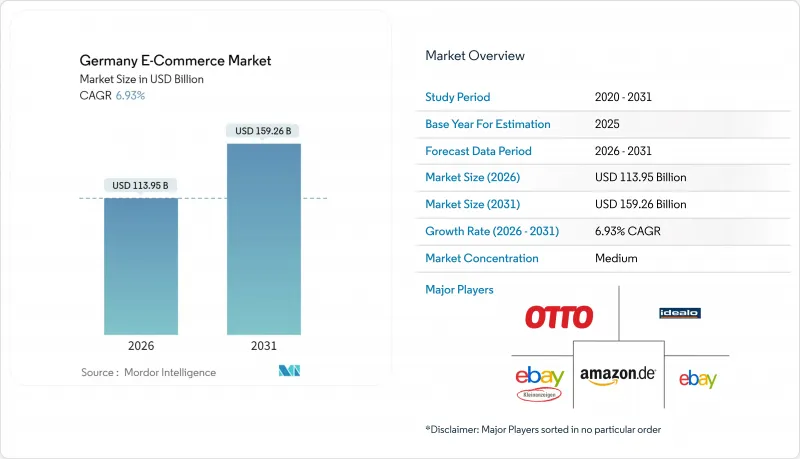
This report is Segmented by Business Model (B2C, and B2B), Device Type for B2C (Smartphone/Mobile, Desktop and Laptop, and More), Payment Method for B2C (Credit/Debit Cards, Digital Wallets, BNPL, and More), Product Category for B2C (Beauty and Personal Care, Consumer Electronics, Fashion and Apparel, Food and Beverages, and More), and Geography. The Market Forecasts are Provided in Terms of Value in USD.
Germany E-commerce Market Trends and Insights
Expansion of SEPA-Friendly Payment Options Fuels Conversion Rates
Universal coverage of SEPA instant payments in October 2025 removed the final clearance bottleneck in German checkout flows, delivering sub-10-second settlement and erasing foreign-exchange opacity for cross-border shoppers. Payment processors documented a 12% drop in cart abandonment for the 25-44 age cohort, while merchants saved 40-60 basis points per transaction compared with card rails. Small businesses now capture incremental margin that subsidizes free returns and loyalty vouchers. The rails also reinforce the cultural preference for direct debit, easing entry for regional sellers and lowering their dependence on global wallet providers. Strong customer-authentication rules embedded in PSD2 ensure biometric security without degrading user experience, keeping fraud below card-network averages.
Rise of Quick-Commerce Start-Ups Drives Same-Day Delivery Demand
Start-ups such as Flink and Gorillas secured EUR 890 million in 2024-2025 funding, deploying 340 micro-fulfillment centers clustered within 2 kilometers of dense neighborhoods. Consulting estimates indicate quick-commerce captured 6% of grocery spend in Germany's ten largest metros by 2025. Order density above 12 drops per rider per hour keeps unit economics marginally positive, but limits viable expansion to affluent urban cores. Supermarket chains reacted by partnering with or acquiring these ventures to protect share, with REWE investing EUR 50 million to extend 10-minute delivery into 15 additional cities. While growth is explosive, profitability hinges on technology-driven routing and labor availability, making the segment sensitive to wage inflation.
Last-Mile Labor Shortages Amid Aging Workforce Hinder The Market
Germany's courier workforce contracted 7% year-over-year in 2025 as the under-35 labor pool shrank, compelling carriers to raise wages 11%. The shortage is acute in secondary cities where warehouse jobs with regular schedules lure drivers away. Autonomous sidewalk robots tested by DHL struggle to exceed 6 km/h and remain confined to pedestrian zones, limiting scalability. The labor squeeze delays same-day rollouts beyond metro cores and inflates delivery surcharges paid by rural consumers, nudging some shoppers back to click-and-collect. Proposed visa relaxations for non-EU logistics workers face political opposition, implying structural tightness through at least 2027.
Other drivers and restraints analyzed in the detailed report include:
- Digitalization Of Mittelstand Procurement Platforms
- Integration Of AI-Powered Personalization Engines Increases Basket Size
- Compliance Costs of VerpackG And Recycling Mandates Hinder The Market
For complete list of drivers and restraints, kindly check the Table Of Contents.
Segment Analysis
The Germany E-commerce Market size for business-to-consumer activity amounted to 85.23% of total value in 2025, validating the mature status of consumer platforms. Conversely, business-to-business channels are forecast to expand at a 9.24% CAGR, propelled by legally mandated supply-chain transparency that pushes Mittelstand firms toward cloud procurement. Industrial buyers appreciate higher basket values, often between EUR 500 and EUR 5,000, cushioning fulfillment costs. Marketplace operators leverage compliance modules that auto-populate certificates, turning regulation into a service differentiator. Yet, legacy on-premises ERP still dominates 60% of mid-market manufacturers, forcing temporary middleware bridges. Integration rollouts typically last 12-18 months, slowing immediate conversion but creating a multi-year runway for platform vendors. The convergence implies that B2B may command a markedly larger Germany E-commerce Market share by the end of the decade without cannibalizing the consumer side.
B2C continues to add value through mobile-first design, influencer discovery, and subscription commerce, although its growth decelerates as urban penetration reaches saturation. Quick-commerce is cannibalizing supermarket foot traffic, spurring incumbents to embed dark stores into existing networks. Loyalty ecosystems that fuse streaming, payments, and logistics further deepen customer lock-in. Despite this, rising compliance and labor costs erode B2C margins, incentivizing diversification into higher-ticket verticals and cross-border sales. Over time, the dual-engine growth model stabilizes the Germany E-commerce Market by balancing steady consumer volumes with faster-growing enterprise procurement.
Smartphones accounted for 63.12% of B2C orders in 2025, and mobile purchasing volume is rising at a 7.01% CAGR. Progressive web apps remove the friction of native downloads, while biometric authentication trims checkout to a single tap. Retailers optimizing for 5G speeds report 9-percentage-point improvements in mobile conversion. Desktops remain preferred for complex, high-consideration purchases and for business procurement exchanges. Tablet share is marginal, servicing kiosk and couch-commerce use cases. Mobile average basket values trail desktop, at EUR 52 versus EUR 89, reflecting impulse behavior and screen constraints.
Mobile-centric UX delivers 40% higher session-to-purchase ratios thanks to auto-fill payment credentials and geo-triggered promotions. However, device fingerprinting becomes less reliable as privacy-savvy users clear cookies and rotate IP addresses, complicating fraud models. In the Germany E-commerce Market, mitigation strategies include behavioral biometrics and carrier-level identity tokens. As 5G rollouts blanket rural districts, mobile will cement its lead, yet desktop retains a niche in enterprise workflows where multi-line orders and spreadsheet uploads demand larger screens.
Complete Report Scope:
- By Business Model
- B2C
- B2B
- By Device Type (B2C)
- Smartphone / Mobile
- Desktop and Laptop
- Other Device Types
- By Payment Method (B2C)
- Credit and Debit Cards
- Digital Wallets
- Buy Now Pay Later (BNPL)
- Other Payment Methods
- By Product Category (B2C)
- Beauty and Personal Care
- Consumer Electronics
- Fashion and Apparel
- Food and Beverages
- Furniture and Home
- Toys, DIY and Media
- Other Product Categories
List of Companies Covered in this Report:
- Amazon.de
- Otto GmbH and Co KG
- Idealo Internet GmbH
- eBay.de
- eBay Kleinanzeigen
- Zalando SE
- MediaMarktSaturn Retail Group
- Lidl Stiftung and Co. KG
- Kaufland.de
- Aldi Nord and Sud (Online)
- About You GmbH
- Douglas GmbH
- REWE Digital GmbH
- dm-drogerie markt GmbH
- Thomann GmbH
- Notebooksbilliger AG
- Cyberport GmbH
- Conrad Electronic SE
- Check24 Vergleichsportal GmbH
- Real Digital SE
- Falke KGaA (D2C)
Additional Benefits:
- The market estimate (ME) sheet in Excel format
- 3 months of analyst support
TABLE OF CONTENTS
1 INTRODUCTION
- 1.1 Study Assumptions and Market Definition
- 1.2 Scope of the Study
2 RESEARCH METHODOLOGY
3 EXECUTIVE SUMMARY
4 MARKET LANDSCAPE
- 4.1 Market Overview
- 4.2 Market Drivers
- 4.2.1 Expansion of SEPA-friendly Payment Options Fuels Conversion Rates
- 4.2.2 Federal Gigabit Initiative Widens Rural High-Speed Coverage
- 4.2.3 Rise of Quick-Commerce Start-ups Drives Same-Day Delivery Demand
- 4.2.4 Digitalisation of Mittelstand Procurement Platforms (B2B) Drives the Market
- 4.2.5 Sustainability-Driven Preference for Carbon-Neutral Shipping Drives the Market
- 4.2.6 Integration of AI-Powered Personalisation Engines Increases Basket Size
- 4.3 Market Restraints
- 4.3.1 Compliance Costs of VerpackG and Recycling Mandates Hinder the Market
- 4.3.2 Last-Mile Labour Shortages Amid Ageing Workforce Hinder the Market
- 4.3.3 Bundeskartellamt Scrutiny on Dominant Marketplaces Hinders the Market
- 4.3.4 Competition from Ultra-Low-Cost Cross-Border Marketplaces Erodes Domestic Margins
- 4.4 Industry Value Chain Analysis
- 4.5 Regulatory Outlook
- 4.6 Porter's Five Forces Analysis
- 4.6.1 Bargaining Power of Suppliers
- 4.6.2 Bargaining Power of Buyers/Consumers
- 4.6.3 Threat of New Entrants
- 4.6.4 Threat of Substitutes
- 4.6.5 Intensity of Competitive Rivalry
- 4.7 Demographic and Consumer Behaviour Analysis
- 4.8 Cross-Border E-commerce Analysis
- 4.9 Germany's Positioning in Europe E-commerce
- 4.10 Assessment of Macroeconomic Trends on the Market
5 MARKET SIZE AND GROWTH FORECASTS (VALUE)
- 5.1 By Business Model
- 5.1.1 B2C
- 5.1.2 B2B
- 5.2 By Device Type (B2C)
- 5.2.1 Smartphone / Mobile
- 5.2.2 Desktop and Laptop
- 5.2.3 Other Device Types
- 5.3 By Payment Method (B2C)
- 5.3.1 Credit and Debit Cards
- 5.3.2 Digital Wallets
- 5.3.3 Buy Now Pay Later (BNPL)
- 5.3.4 Other Payment Methods
- 5.4 By Product Category (B2C)
- 5.4.1 Beauty and Personal Care
- 5.4.2 Consumer Electronics
- 5.4.3 Fashion and Apparel
- 5.4.4 Food and Beverages
- 5.4.5 Furniture and Home
- 5.4.6 Toys, DIY and Media
- 5.4.7 Other Product Categories
6 COMPETITIVE LANDSCAPE
- 6.1 Market Concentration
- 6.2 Strategic Moves
- 6.3 Market Share Analysis
- 6.4 Company Profiles (includes Global Level Overview, Market Level Overview, Core Segments, Financials as available, Strategic Information, Market Rank/Share, Products and Services, Recent Developments)
- 6.4.1 Amazon.de
- 6.4.2 Otto GmbH and Co KG
- 6.4.3 Idealo Internet GmbH
- 6.4.4 eBay.de
- 6.4.5 eBay Kleinanzeigen
- 6.4.6 Zalando SE
- 6.4.7 MediaMarktSaturn Retail Group
- 6.4.8 Lidl Stiftung and Co. KG
- 6.4.9 Kaufland.de
- 6.4.10 Aldi Nord and Sud (Online)
- 6.4.11 About You GmbH
- 6.4.12 Douglas GmbH
- 6.4.13 REWE Digital GmbH
- 6.4.14 dm-drogerie markt GmbH
- 6.4.15 Thomann GmbH
- 6.4.16 Notebooksbilliger AG
- 6.4.17 Cyberport GmbH
- 6.4.18 Conrad Electronic SE
- 6.4.19 Check24 Vergleichsportal GmbH
- 6.4.20 Real Digital SE
- 6.4.21 Falke KGaA (D2C)
7 MARKET OPPORTUNITIES AND FUTURE OUTLOOK
- 7.1 White-Space and Unmet-Need Assessment

