PUBLISHER: Mordor Intelligence | PRODUCT CODE: 2100678

PUBLISHER: Mordor Intelligence | PRODUCT CODE: 2100678
Italy E-commerce - Market Share Analysis, Industry Trends & Statistics, Growth Forecasts (2026 - 2031)
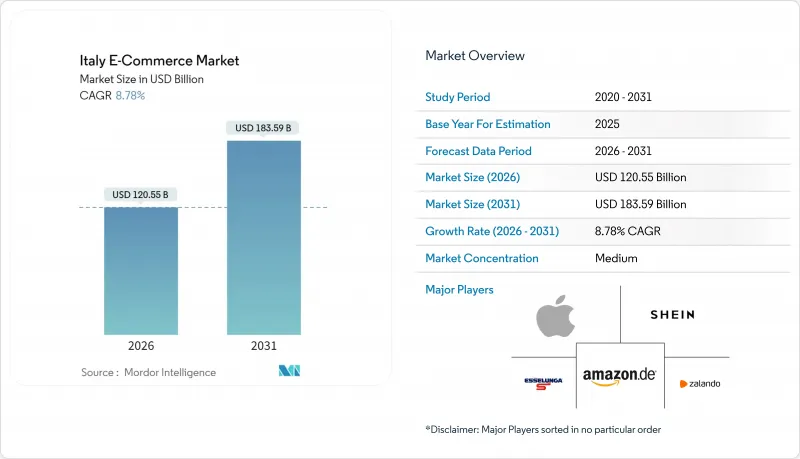
According to Mordor Intelligence, the Italy e-commerce market size reached USD 120.55 billion in 2026 and is projected to climb to USD 183.59 billion by 2031, reflecting an 8.78% CAGR.
This report is Segmented by Business Model (B2C, and B2B), Device Type (Smartphone/Mobile, Desktop and Laptop, and More), Payment Method (Credit and Debit Cards, Digital Wallets, BNPL, and More), Product Category (Beauty and Personal Care, Consumer Electronics, Fashion and Apparel, Food and Beverages, Furniture and Home, and More), and Geography. The Market Forecasts are Provided in Terms of Value (USD).
Italy E-commerce Market Trends and Insights
Adoption Of Account-To-Account Instant Payments
Real-time SEPA Instant rails became mandatory for all Italian banks in 2025, eliminating two-day settlement delays and interchange fees that averaged 1.5% of order value. Merchants in Lombardy and Emilia-Romagna adopted instant-payment modules 35% faster than peers elsewhere, improving margins on low-ticket grocery and electronics orders. Domestic fintech Satispay embedded the rails into its wallet, giving 380,000 merchants sub-10-second settlement and raising its user base to 5 million. Instant transfers also meet strong customer authentication rules without one-time passwords, trimming checkout abandonment rates. Together, these factors position instant payments as the default tender type for repeat transactions nationwide.
Rising Mobile-Commerce Adoption Among 25-34-Year-Olds
Smartphones generated 56.42% of online transaction value in 2025, propelled by contactless software POS terminals that jumped from 40,000 units in 2023 to 152,000 in 2024. Short-form video commerce, spearheaded by TikTok Shop, now redirects traffic straight into one-tap checkout pipelines handled by Zalando's ZEOS network. Wearable devices added EUR 2.5 billion in 2024 volume, widening the definition of mobile commerce beyond phones. Biometric logins satisfy PSD2 authentication with minimal friction, an advantage that amplifies conversion among younger cohorts. As a result, median purchase time on smartphones fell to 2.8 minutes in 2025, down from 4.2 minutes two years earlier.
Stringent PSD2 Strong Customer Authentication Friction
Italian regulators apply PSD2 rules so strictly that two-factor checks trigger even on sub-EUR 30 orders if merchants lack transaction-risk-analysis waivers. Banca d'Italia data show 18% of online payments failed authentication in H1 2025, up from 14% a year earlier. Shoppers older than 55, already under-represented online, abandon carts at a 28% rate when redirected to banking apps. Fashion and electronics sellers, where average tickets exceed EUR 50, lose up to one-quarter of sessions when strong customer authentication steps in. Any regulatory relief is unlikely before 2027, compelling retailers to fine-tune exemption logic to reclaim conversions.
Other drivers and restraints analyzed in the detailed report include:
- Surge In Same-Day Delivery Infrastructure
- Government Spinta Digitale Tax Credits For SME Digitalization
- Fragmented Last-Mile Logistics In Southern Regions
For complete list of drivers and restraints, kindly check the Table Of Contents.
Segment Analysis
B2C transactions controlled 85.34% of the Italy E-commerce Market share in 2025, yet the Italy E-commerce Market size for B2B orders is projected to outpace consumer growth at an 11.87% CAGR, lifted by compulsory e-invoicing that removed turnover thresholds in 2024. Mandatory use of the national Sistema di Interscambio automates three-way matching and speeds cash application, which reduces working-capital drag for manufacturers in Veneto, Lombardy, and Emilia-Romagna.
Repeat purchasing and bulk baskets give B2B sellers stronger margin profiles than fashion or grocery sites, even as mobile procurement apps mirror consumer-grade usability. Transition 4.0 credits, covering half of the cloud-ERP investment, align directly with the EUR 80,000 median project cost logged by Invitalia, accelerating platform deployments that sync to the EU one-stop VAT regime.
Smartphones captured 56.42% of 2025 basket value and will widen their lead as software POS installations pass 200,000 units by 2027. Desktop sessions still yield order values 18% higher than mobile, reflecting their role in big-ticket electronics and furniture, but their share is slipping two percentage points each year.
Wearables added EUR 2.5 billion in 2024 volume, indicating that the Italy E-commerce Market is extending to any connected device with biometric login. The Italy E-commerce Market size tied to desktops is shrinking, yet the channel remains critical for older buyers and corporate procurement teams that need spreadsheet-style interfaces.
Complete Report Scope:
- By Business Model
- B2C
- B2B
- By Device Type (B2C)
- Smartphone / Mobile
- Desktop and Laptop
- Other Device Types
- By Payment Method (B2C)
- Credit and Debit Cards
- Digital Wallets
- BNPL
- Other Payment Methods
- By Product Category (B2C)
- Beauty and Personal Care
- Consumer Electronics
- Fashion and Apparel
- Food and Beverages
- Furniture and Home
- Toys, DIY and Media
- Other Product Categories
List of Companies Covered in this Report:
- Mediamarket S.p.A.
- Esselunga S.p.A.
- Unieuro S.p.A.
- eBay Inc.
- Decathlon Italia S.r.l.
- Alibaba Singapore E-Commerce Private Limited
- Zalando SE
- ePRICE S.p.A.
- IKEA Italia Retail S.r.l.
- Carrefour Italia S.p.A.
- Roadget Business Pte. Ltd.
- Apple Inc.
- Privalia Venta Directa S.A.U.
- Internet Bookshop Italia S.r.l.
- YOOX NET-A-PORTER GROUP S.p.A.
- Monclick S.r.l.
- Leroy Merlin Italia S.r.l.
- OVS S.p.A.
- Deco Italia Societa Consortile a r.l.
- Scalapay S.r.l.
- Subito.it S.r.l.
- Satispay Europe S.A.
Additional Benefits:
- The market estimate (ME) sheet in Excel format
- 3 months of analyst support
TABLE OF CONTENTS
1 INTRODUCTION
- 1.1 Study Assumptions and Market Definition
- 1.2 Scope of the Study
2 RESEARCH METHODOLOGY
3 EXECUTIVE SUMMARY
4 MARKET LANDSCAPE
- 4.1 Market Overview
- 4.2 Market Drivers
- 4.2.1 Surge in Same-Day Delivery Infrastructure Across Northern Italy
- 4.2.2 Rising Mobile-Commerce Adoption Among 25-34 Age Cohort
- 4.2.3 Government "Spinta Digitale" Tax Credits for SME Digitalization
- 4.2.4 Cross-Border Marketplace Participation via EU Single-VAT Regime
- 4.2.5 Rapid Penetration of Ultra-Fast Grocery Delivery Start-ups in Tier-2 Cities
- 4.2.6 Adoption of Account-to-Account Instant Payments (SEPA Instant) at Checkout
- 4.3 Market Restraints
- 4.3.1 Fragmented Last-Mile Logistics in Southern Regions
- 4.3.2 Stringent PSD2 Strong Customer Authentication Friction
- 4.3.3 Cyber-Fraud Spike on Digital Wallets Post-COVID
- 4.3.4 Persistent Digital-Skills Gap Among >55 SME Owners
- 4.4 Industry Value Chain Analysis
- 4.5 Regulatory and Technological Outlook
- 4.6 Porter's Five Forces Analysis
- 4.6.1 Bargaining Power of Suppliers
- 4.6.2 Bargaining Power of Buyers
- 4.6.3 Threat of New Entrants
- 4.6.4 Threat of Substitutes
- 4.6.5 Intensity of Competitive Rivalry
- 4.7 Demographic Trend Analysis (Internet and Income)
- 4.8 Cross-Border E-Commerce Analysis
- 4.8.1 Italy's Position in European E-Commerce
- 4.9 Impact of Macroeconomic Factors on the Market
5 MARKET SIZE AND GROWTH FORECASTS (VALUE)
- 5.1 By Business Model
- 5.1.1 B2C
- 5.1.2 B2B
- 5.2 By Device Type (B2C)
- 5.2.1 Smartphone / Mobile
- 5.2.2 Desktop and Laptop
- 5.2.3 Other Device Types
- 5.3 By Payment Method (B2C)
- 5.3.1 Credit and Debit Cards
- 5.3.2 Digital Wallets
- 5.3.3 BNPL
- 5.3.4 Other Payment Methods
- 5.4 By Product Category (B2C)
- 5.4.1 Beauty and Personal Care
- 5.4.2 Consumer Electronics
- 5.4.3 Fashion and Apparel
- 5.4.4 Food and Beverages
- 5.4.5 Furniture and Home
- 5.4.6 Toys, DIY and Media
- 5.4.7 Other Product Categories
6 COMPETITIVE LANDSCAPE
- 6.1 Market Concentration
- 6.2 Strategic Moves
- 6.3 Market Share Analysis
- 6.4 Company Profiles (includes Global Level Overview, Market Level Overview, Core Segments, Financials as available, Strategic Information, Market Rank/Share, Products and Services, Recent Developments)
- 6.4.1 Mediamarket S.p.A.
- 6.4.2 Esselunga S.p.A.
- 6.4.3 Unieuro S.p.A.
- 6.4.4 eBay Inc.
- 6.4.5 Decathlon Italia S.r.l.
- 6.4.6 Alibaba Singapore E-Commerce Private Limited
- 6.4.7 Zalando SE
- 6.4.8 ePRICE S.p.A.
- 6.4.9 IKEA Italia Retail S.r.l.
- 6.4.10 Carrefour Italia S.p.A.
- 6.4.11 Roadget Business Pte. Ltd.
- 6.4.12 Apple Inc.
- 6.4.13 Privalia Venta Directa S.A.U.
- 6.4.14 Internet Bookshop Italia S.r.l.
- 6.4.15 YOOX NET-A-PORTER GROUP S.p.A.
- 6.4.16 Monclick S.r.l.
- 6.4.17 Leroy Merlin Italia S.r.l.
- 6.4.18 OVS S.p.A.
- 6.4.19 Deco Italia Societa Consortile a r.l.
- 6.4.20 Scalapay S.r.l.
- 6.4.21 Subito.it S.r.l.
- 6.4.22 Satispay Europe S.A.
7 MARKET OPPORTUNITIES AND FUTURE OUTLOOK
- 7.1 White-Space and Unmet Need Assessment

