PUBLISHER: Mordor Intelligence | PRODUCT CODE: 2113457

PUBLISHER: Mordor Intelligence | PRODUCT CODE: 2113457
Italy Home Appliances - Market Share Analysis, Industry Trends & Statistics, Growth Forecasts (2026 - 2031)
According to Mordor Intelligence, the Italy home appliances market size was valued at USD 9.45 billion in 2025 and is estimated to grow from USD 9.82 billion in 2026 to reach USD 11.58 billion by 2031, at a CAGR of 3.36% during the forecast period (2026-2031).
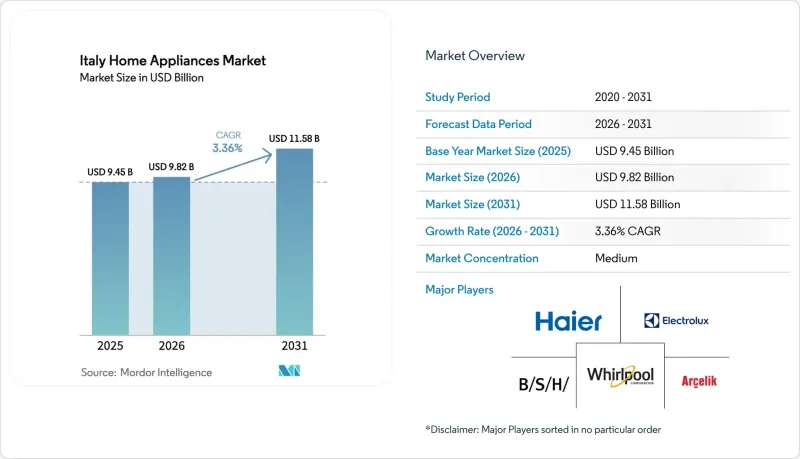
This report is Segmented by Product (Major Appliances and Small Appliances), Distribution Channel (Multi-Brand Stores, Exclusive Brand Outlets, Online, and Other Distribution Channels), and Geography (North-West, Central, and Rest of Italy). Market Forecasts are Provided in Terms of Value (USD).
Italy Home Appliances Market Trends and Insights
Energy-Efficiency Regulations Driving Accelerated Replacement Cycles
Italy's 2025 Budget Law extends the Furniture and Appliances Bonus, allowing a 50% tax deduction on eligible appliance purchases up to EUR 5,000 for homes undergoing renovation, provided that products meet Class A energy thresholds. The updated policy stance away from fossil-fuel appliances is also channeling consumer adoption toward electric heat pumps and induction cooking, reinforcing a replacement wave for older, inefficient units. This mix of incentives and regulations is extending the upgrade cycle in the Italy home appliances market as manufacturers align assortments and pricing to energy labels and lifetime cost-of-ownership.
Surge in Smart/Connected-Appliance Adoption Supported by Broadband Penetration
Smart appliances have reached 40% of households by 2025 as fiber connectivity spreads across major cities and as consumers seek convenience, usage insights, and energy savings through app-linked control. Haier Europe's hOn platform integrates with an Italian digital energy supplier so that users can schedule cycles at off-peak hours tied to real-time electricity prices, enabling measurable bill reductions alongside lower grid strain. Samsung's SmartThings adds household safety and care features through connected devices, positioning white goods within a broader home ecosystem that can automate energy-aware behavior. The adoption curve is strongest in urban regions where income and network coverage support premium features, and these factors amplify ecosystem stickiness in the Italy home appliances market. Despite momentum, interoperability remains a hurdle for mainstream users, although incremental support for cross-brand standards is improving the user experience over time.
Inflation-Driven Squeeze on Discretionary Spending
Households contended with real-income pressure in 2024 and early 2025, which tempered upgrades in non-essential categories and favored value-led offerings. The most pronounced impact emerged in regions with lower income levels, where price sensitivity was high, and promotions drove a disproportionate share of volume. Brands expanded accessible price points for efficient models to preserve category momentum, often pairing affordability with energy savings to support adoption. Promotions and financing options became more prominent, although sustained discounting risks eroding margins if input costs remain elevated in the Italy home appliances market. These dynamics reinforced the importance of after-sales networks and repairability, which help extend product life and protect household budgets.
Other drivers and restraints analyzed in the detailed report include:
- E-Commerce & Omnichannel Retail Growth Expanding Consumer Reach
- 110% "Superbonus" Renovation Scheme Boosting Demand for Efficient White Goods
- Supply-Chain & Raw-Material Price Volatility
For complete list of drivers and restraints, kindly check the Table Of Contents.
Segment Analysis
Major home appliances led Italy's home appliances market with 74.61% market share in 2025 and are expected to grow at a CAGR of 4.21% over the forecast period. This dominance stems from their status as higher-value, long-lasting investments, integral to daily life and the routines of Italian households. Refrigerators followed as a core category, with energy-efficient models gaining ground and digital features helping users optimize food preservation and energy use. Premium models increasingly differentiate through AI-enabled programs and integration with home platforms that schedule cycles based on tariffs and occupancy. These patterns show how mature categories sustain renewal as performance, connectivity, and energy savings converge in the Italy home appliances market.
Small Appliances outpaced growth, driven by shorter replacement cycles and strong demand for convenience, wellness, and at-home beverage experiences. Multifunctional designs, such as air fryers with dehydration features, and compact food-prep devices resonate with smaller households and urban kitchens that prioritize space and utility. The Italy home appliances industry continues to blend design and performance in Small Appliances, capturing cross-category spending from consumers who value modular, counter-friendly systems. Combined with energy-use optimization, these trends reinforce steady upgrade cycles that support the Italy home appliances market.
Complete Report Scope:
- By Product
- Major Home Appliances
- Refrigerators
- Freezers
- Washing Machines
- Dishwashers
- Ovens (Incl. Combi & Microwave)
- Air Conditioners
- Other Major Home Appliances
- Small Home Appliances
- Coffee Makers
- Food Processors
- Grills & Roasters
- Electric Kettles
- Juicers & Blenders
- Air Fryers
- Vacuum Cleaners
- Electric Rice Cookers
- Toasters
- Counter-top Ovens
- Other Small Home Appliances
- Major Home Appliances
- By Distribution Channel
- Multi-Brand Stores
- Exclusive Brand Outlets
- Online
- Other Distribution Channels
- By Geography
- North-West (Lombardy, Piedmont, Liguria, Aosta)
- Central (Tuscany, Lazio, Umbria, Marche)
- Rest of Italy
List of Companies Covered in this Report:
- Whirlpool Corp (incl. Indesit)
- Haier Europe / Candy Hoover
- BSH Hausgerate GmbH
- Electrolux AB
- Arcelik AS (Beko, Grundig)
- Samsung Electronics Co.
- LG Electronics Inc.
- Miele & Cie. KG
- De'Longhi Group
- Smeg S.p.A.
- Gorenje (Hisense Europe)
- Hisense International
- Dyson Ltd
- Groupe SEB (Rowenta, Tefal, Moulinex)
- Elica S.p.A.
- Ariston Thermo Group
- SharkNinja
- Kenwood Ltd
- Philips Domestic Appliances (Versuni)
- Gorenje Group
Additional Benefits:
- The market estimate (ME) sheet in Excel format
- 3 months of analyst support
TABLE OF CONTENTS
1 Introduction
- 1.1 Study Assumptions & Market Definition
- 1.2 Scope of the Study
2 Research Methodology
3 Executive Summary
4 Market Landscape
- 4.1 Market Overview
- 4.2 Market Drivers
- 4.2.1 Energy-efficiency regulations driving accelerated replacement cycles
- 4.2.2 Surge in smart/connected-appliance adoption supported by broadband penetration
- 4.2.3 E-commerce & omnichannel retail growth expanding consumer reach
- 4.2.4 110 % "Superbonus" renovation scheme boosting demand for efficient white goods
- 4.2.5 Premium built-in formats favoured by compact urban kitchens
- 4.2.6 EU "Right-to-Repair" policy stimulating demand for modular up-gradable models
- 4.3 Market Restraints
- 4.3.1 Inflation-driven squeeze on discretionary spending
- 4.3.2 Supply-chain & raw-material price volatility
- 4.3.3 Rising compliance costs from Ecodesign & WEEE directives for SMEs
- 4.3.4 Category saturation lengthening replacement cycles
- 4.4 Industry Value-Chain Analysis
- 4.5 Porter's Five Forces
- 4.5.1 Bargaining Power of Buyers
- 4.5.2 Bargaining Power of Suppliers
- 4.5.3 Threat of New Entrants
- 4.5.4 Threat of Substitutes
- 4.5.5 Competitive Rivalry
- 4.6 Insights into the Latest Trends and Innovations in the Market
- 4.7 Insights on Recent Developments (New Product Launches, Strategic Initiatives, Investments, Partnerships, JVs, Expansion, M&As, etc.) in the Market
5 Market Size & Growth Forecasts
- 5.1 By Product
- 5.1.1 Major Home Appliances
- 5.1.1.1 Refrigerators
- 5.1.1.2 Freezers
- 5.1.1.3 Washing Machines
- 5.1.1.4 Dishwashers
- 5.1.1.5 Ovens (Incl. Combi & Microwave)
- 5.1.1.6 Air Conditioners
- 5.1.1.7 Other Major Home Appliances
- 5.1.2 Small Home Appliances
- 5.1.2.1 Coffee Makers
- 5.1.2.2 Food Processors
- 5.1.2.3 Grills & Roasters
- 5.1.2.4 Electric Kettles
- 5.1.2.5 Juicers & Blenders
- 5.1.2.6 Air Fryers
- 5.1.2.7 Vacuum Cleaners
- 5.1.2.8 Electric Rice Cookers
- 5.1.2.9 Toasters
- 5.1.2.10 Counter-top Ovens
- 5.1.2.11 Other Small Home Appliances
- 5.1.1 Major Home Appliances
- 5.2 By Distribution Channel
- 5.2.1 Multi-Brand Stores
- 5.2.2 Exclusive Brand Outlets
- 5.2.3 Online
- 5.2.4 Other Distribution Channels
- 5.3 By Geography
- 5.3.1 North-West (Lombardy, Piedmont, Liguria, Aosta)
- 5.3.2 Central (Tuscany, Lazio, Umbria, Marche)
- 5.3.3 Rest of Italy
6 Competitive Landscape
- 6.1 Market Concentration
- 6.2 Strategic Moves
- 6.3 Market Share Analysis
- 6.4 Company Profiles (includes Global level Overview, Market level overview, Core Segments, Financials as available, Strategic Information, Market Rank/Share for key companies, Products & Services, and Recent Developments)
- 6.4.1 Whirlpool Corp (incl. Indesit)
- 6.4.2 Haier Europe / Candy Hoover
- 6.4.3 BSH Hausgerate GmbH
- 6.4.4 Electrolux AB
- 6.4.5 Arcelik AS (Beko, Grundig)
- 6.4.6 Samsung Electronics Co.
- 6.4.7 LG Electronics Inc.
- 6.4.8 Miele & Cie. KG
- 6.4.9 De'Longhi Group
- 6.4.10 Smeg S.p.A.
- 6.4.11 Gorenje (Hisense Europe)
- 6.4.12 Hisense International
- 6.4.13 Dyson Ltd
- 6.4.14 Groupe SEB (Rowenta, Tefal, Moulinex)
- 6.4.15 Elica S.p.A.
- 6.4.16 Ariston Thermo Group
- 6.4.17 SharkNinja
- 6.4.18 Kenwood Ltd
- 6.4.19 Philips Domestic Appliances (Versuni)
- 6.4.20 Gorenje Group
7 Market Opportunities & Future Outlook
- 7.1 Circular-economy certified refurbishment hubs for SME retailers
- 7.2 Subscription-based "appliance-as-a-service" models for premium white goods

