PUBLISHER: Mordor Intelligence | PRODUCT CODE: 2113811

PUBLISHER: Mordor Intelligence | PRODUCT CODE: 2113811
France Home Appliances - Market Share Analysis, Industry Trends & Statistics, Growth Forecasts (2026 - 2031)
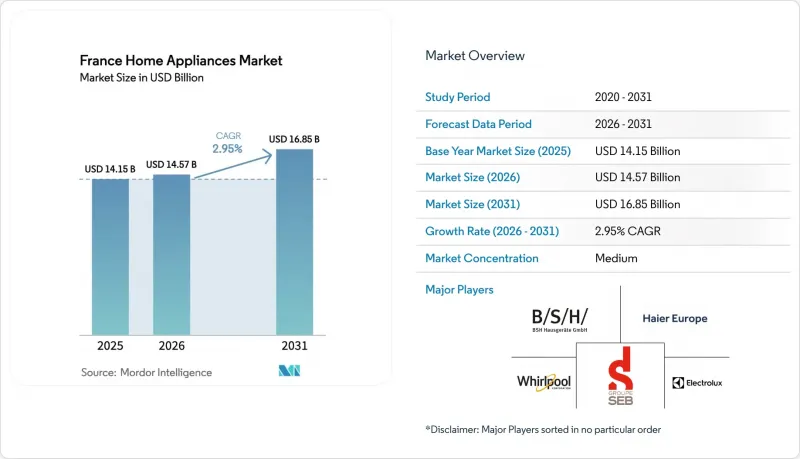
According to Mordor Intelligence, the France home appliances market size is projected to expand from USD 14.15 billion in 2025 and USD 14.57 billion in 2026 to USD 16.85 billion by 2031, registering a CAGR of 2.95% between 2026 to 2031.
This report is Segmented by Product Type (Major Appliances, Small Appliances), Distribution Channel (Multi-Brand Stores, Exclusive Outlets, Online, Others), and Geography (Ile-De-France, Auvergne-Rhone-Alpes, Provence-Alpes-Cote D'Azur, Rest of France). The Market Forecasts are Provided in Value (USD).
France Home Appliances Market Trends and Insights
Energy-Efficiency Regulations Accelerating Replacement Demand
France's rental restrictions on low-performing properties continue to compress decision windows for landlords, which lifts near-term replacement of large appliances aligned with higher efficiency grades . The new EU Ecodesign and energy labeling updates reinforce design targets and practical repair rules that favor efficient refrigerators and heat-pump-based solutions for domestic heating and cooling. National policy signals around the repairability index and spare parts availability also push buyers toward brands with documented durability and upgrade paths . A parallel reform pipeline for building performance certificates creates compliance pressure that flows directly into appliance replacement timelines. Installed base realities still matter since gas systems remain widespread in French housing, and policy shifts continue to pivot owners toward electrified alternatives supported by appliance-grade controls and monitoring.
E-Commerce and Omnichannel Convenience Fueling Purchases
Digital discovery and checkout keep gaining ground as shoppers compare models, energy labels, and delivery promises before completing transactions online or in-store. Retailers that bundle installation, warranty, and service plans convert higher-value baskets more reliably, and this shapes how premium refrigeration, dishwashers, and built-in ovens move through the France home appliances market. Brand-owned direct channels surface for flagship launches, pairing first-party data with controlled logistics for white goods and connected kitchen suites. Click-and-collect helps bridge last-mile constraints on bulky products while preserving service quality around delivery windows and setup. Clear pricing of delivery and installation fees remains a trust drive that reduces cart abandonment and anchors loyalty in a hybrid shopping model.
Inflation-Driven Squeeze on Discretionary Spending
Elevated prices and financing costs have delayed some upgrade cycles for non-essential appliances such as dryers and countertop devices. Household budgets in lower energy-performance homes feel higher energy burdens, which reduces headroom for premium purchases. Consumers gravitate to models with strong durability scores or loyalty-linked service programs that lower the total cost of ownership. Promotions and buy-now-pay-later options help with smooth demand but do not fully offset macro pressure. This restraint narrows the market for mid-tier SKUs while supporting entry-level value and top-tier connected products that promise measurable savings.
Other drivers and restraints analyzed in the detailed report include:
- Refurbished-Appliance Boom Under France's Anti-Waste Law
- Heat-Wave Induced Surge in Residential Cooling Demand
- Semiconductor/Component Shortages Lengthening Product Lead-Times
For complete list of drivers and restraints, kindly check the Table Of Contents.
Segment Analysis
Refrigerators commanded 29.16% of France's 2025 home appliance revenue, and air fryers are the fastest riser with a 4.21% CAGR through 2031, which sets the tone for a mixed cycle of anchor categories and high-velocity countertop devices. Refrigeration continues to premiumize with connected control, food preservation sensors, and modular designs that align with energy labeling and interoperability expectations. Flagship cooling lines emphasize freshness, cameras, and app-driven optimization to reduce waste and improve convenience. For the countertop set, air fryers benefit from convenience and health positioning that compress cook times and energy use for small batches. This barbell pattern supports both value-driven countertop wins and steady demand for core kitchen anchors in the France home appliances market.
The France home appliances industry also sees differentiated replacement cycles, as washing machines and dishwashers hold long lifespans under repairability rules, while premium tiers add features that justify upgrades. Built-in ovens and cooking systems gain share in urban kitchens where space and design drive choices, and connectivity helps with guided cooking and safety. Cooling and air treatment categories expand when heat events intensify, and hybrid HVAC aligns with broader building standards and subsidies. Across major appliances, brands emphasize efficiency, smart scheduling, and remote diagnostics to reduce lifetime costs and service downtime. These product attributes reinforce the upgrade case even as budgets remain tight in parts of the France home appliances market.
Complete Report Scope:
- By Product
- Major Home Appliances
- Refrigerators
- Freezers
- Washing Machines
- Dishwashers
- Ovens (Incl. Combi & Microwave)
- Air Conditioners
- Other Major Home Appliances
- Small Home Appliances
- Coffee Makers
- Food Processors
- Grills & Roasters
- Electric Kettles
- Juicers & Blenders
- Air Fryers
- Vacuum Cleaners
- Electric Rice Cookers
- Toasters
- Counter-top Ovens
- Other Small Home Appliances
- Major Home Appliances
- By Distribution Channel
- Multi-Brand Stores
- Exclusive Brand Outlets
- Online
- Other Distribution Channels
- By Geography
- Ile-de-France
- Auvergne-Rhone-Alpes
- Provence-Alpes-Cote d'Azur
- Rest of France
List of Companies Covered in this Report:
- BSH Hausgerate GmbH
- Whirlpool Corporation
- Electrolux AB
- LG Electronics Inc.
- Samsung Electronics Co., Ltd.
- Miele & Cie. KG
- Haier Europe
- Arcelik A.S. (Beko, Grundig)
- Gorenje (Hisense)
- SMEG S.p.A.
- De'Longhi Group
- Groupe SEB
- Dyson Ltd
- SharkNinja
- Jura Elektroapparate AG
- Versuni (Philips Domestic Appliances)
- Severin Elektrogerate GmbH
- Panasonic Corporation
- Midea Group
- Sharp Corporation
Additional Benefits:
- The market estimate (ME) sheet in Excel format
- 3 months of analyst support
TABLE OF CONTENTS
1 Introduction
- 1.1 Study Assumptions & Market Definition
- 1.2 Scope of the Study
2 Research Methodology
3 Executive Summary
4 Market Landscape
- 4.1 Market Overview
- 4.2 Market Drivers
- 4.2.1 Energy-efficiency regulations accelerating replacement demand
- 4.2.2 E-commerce and omnichannel convenience fueling purchases
- 4.2.3 Refurbished-appliance boom under France's Anti-Waste Law
- 4.2.4 Heat-wave induced surge in residential cooling demand
- 4.2.5 Government heat-pump incentives lifting hybrid appliance sales
- 4.2.6 Smart-home interoperability standards (e.g., Matter) spurring connected-appliance uptake
- 4.3 Market Restraints
- 4.3.1 Inflation-driven squeeze on discretionary spending
- 4.3.2 Semiconductor/component shortages lengthening product lead-times
- 4.3.3 Housing-market slowdown dampening first-time appliance purchases
- 4.3.4 Mandatory long repairability periods delaying replacements
- 4.4 Industry Value-Chain Analysis
- 4.5 Porter's Five Forces
- 4.5.1 Competitive Rivalry
- 4.5.2 Threat of New Entrants
- 4.5.3 Bargaining Power of Suppliers
- 4.5.4 Bargaining Power of Buyers
- 4.5.5 Threat of Substitutes
- 4.6 Insights into the Latest Trends and Innovations in the Market
- 4.7 Insights on Recent Developments (New Product Launches, Strategic Initiatives, Investments, Partnerships, JVs, Expansion, M&As, etc.) in the Market
5 Market Size & Growth Forecasts (Value)
- 5.1 By Product
- 5.1.1 Major Home Appliances
- 5.1.1.1 Refrigerators
- 5.1.1.2 Freezers
- 5.1.1.3 Washing Machines
- 5.1.1.4 Dishwashers
- 5.1.1.5 Ovens (Incl. Combi & Microwave)
- 5.1.1.6 Air Conditioners
- 5.1.1.7 Other Major Home Appliances
- 5.1.2 Small Home Appliances
- 5.1.2.1 Coffee Makers
- 5.1.2.2 Food Processors
- 5.1.2.3 Grills & Roasters
- 5.1.2.4 Electric Kettles
- 5.1.2.5 Juicers & Blenders
- 5.1.2.6 Air Fryers
- 5.1.2.7 Vacuum Cleaners
- 5.1.2.8 Electric Rice Cookers
- 5.1.2.9 Toasters
- 5.1.2.10 Counter-top Ovens
- 5.1.2.11 Other Small Home Appliances
- 5.1.1 Major Home Appliances
- 5.2 By Distribution Channel
- 5.2.1 Multi-Brand Stores
- 5.2.2 Exclusive Brand Outlets
- 5.2.3 Online
- 5.2.4 Other Distribution Channels
- 5.3 By Geography
- 5.3.1 Ile-de-France
- 5.3.2 Auvergne-Rhone-Alpes
- 5.3.3 Provence-Alpes-Cote d'Azur
- 5.3.4 Rest of France
6 Competitive Landscape
- 6.1 Market Concentration
- 6.2 Strategic Moves
- 6.3 Market Share Analysis
- 6.4 Company Profiles (includes Global level Overview, Market level overview, Core Segments, Financials as available, Strategic Information, Market Rank/Share for key companies, Products & Services, and Recent Developments)
- 6.4.1 BSH Hausgerate GmbH
- 6.4.2 Whirlpool Corporation
- 6.4.3 Electrolux AB
- 6.4.4 LG Electronics Inc.
- 6.4.5 Samsung Electronics Co., Ltd.
- 6.4.6 Miele & Cie. KG
- 6.4.7 Haier Europe
- 6.4.8 Arcelik A.S. (Beko, Grundig)
- 6.4.9 Gorenje (Hisense)
- 6.4.10 SMEG S.p.A.
- 6.4.11 De'Longhi Group
- 6.4.12 Groupe SEB
- 6.4.13 Dyson Ltd
- 6.4.14 SharkNinja
- 6.4.15 Jura Elektroapparate AG
- 6.4.16 Versuni (Philips Domestic Appliances)
- 6.4.17 Severin Elektrogerate GmbH
- 6.4.18 Panasonic Corporation
- 6.4.19 Midea Group
- 6.4.20 Sharp Corporation
7 Market Opportunities & Future Outlook
- 7.1 Integrated smart-kitchen ecosystems for space-constrained urban homes
- 7.2 Nationwide refurbishment-as-a-service platforms for large appliances

