PUBLISHER: Mordor Intelligence | PRODUCT CODE: 2113459

PUBLISHER: Mordor Intelligence | PRODUCT CODE: 2113459
Middle East And Africa Home Appliances - Market Share Analysis, Industry Trends & Statistics, Growth Forecasts (2026 - 2031)
According to Mordor Intelligence, Middle East and Africa home appliances market size in 2026 is estimated at USD 25.51 billion, growing from 2025 value of USD 24.02 billion with 2031 projections showing USD 34.5 billion, growing at 6.22% CAGR over 2026-2031.
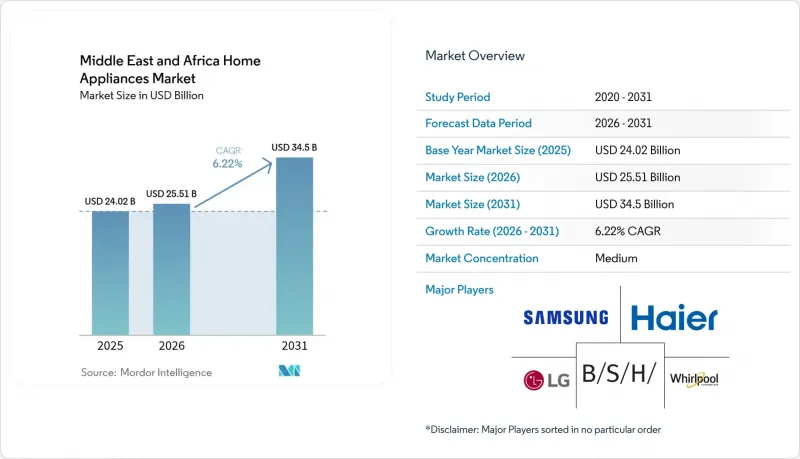
This report is Segmented by Product (Major Home Appliances Including Refrigerators, Freezers, Washing Machines, Dishwashers, Ovens, Air Conditioners; Small Home Appliances, and More), Distribution Channel (Multi-Brand Stores, Exclusive Brand Outlets, Online), and Geography (UAE, Saudi Arabia, South Africa, Nigeria, Rest of MEA). The Market Forecasts are Provided in Terms of Value (USD).
Middle East And Africa Home Appliances Market Trends and Insights
Rising Urbanization & Disposable Income
Accelerating urban migration strengthens demand nodes because city residents favor branded appliances that promise reliability and warranty coverage. Wage growth in Riyadh, Jeddah, and Dubai feeds premium uptake, while burgeoning middle-class households in Lagos and Johannesburg focus on entry-to-mid tiers that blend functionality with affordability. Apartment living drives interest in space-saving washer-dryer combos, air fryers, and robotic vacuums. Higher residential density also lowers last-mile logistics costs, encouraging retailers to offer same-day delivery on large items. Manufacturers that provide micro-financing or buy-now-pay-later plans extend reach to credit-thin consumers, making urbanization a structural tailwind for the Middle East and Africa home appliances market.
Government Electrification Programs
Grid-extension schemes in Kenya, Ghana, and Nigeria collectively connect millions of rural homes each year, creating new first-time buyers for refrigerators and fans. Public incentives often package appliance discounts with energy-efficient bulbs, moving households immediately toward compliant products. Saudi Arabia's air-conditioner replacement plan, which refunds up to SAR 1,000 per compliant unit, shows how government support can move volumes in months. Electrification also attracts component suppliers, because reliable power reduces operational risk for local assembly. For the Middle East and Africa home appliances market, each electrified village represents demand that compounds as income rises.
High Import Duties & Tariffs
Nigeria's tariff structure increases the landed costs of washers by up to 30%, reducing affordability and driving consumers toward refurbished products. To mitigate these costs, major manufacturers adopt semi-knocked-down kits, which qualify for lower duties but require investments in tooling, local labor, and skills development. Tariff volatility poses a significant challenge for quarterly forecasting, as shipments ordered under one tariff regime may arrive after rates have changed. This unpredictability disproportionately impacts smaller brands, which struggle to hedge against such risks. In contrast, larger multinational companies leverage their resources to gain a competitive advantage. However, these dynamics contribute to higher consumer prices across the Middle East and Africa home appliances market. The interplay of tariffs, supply chain adjustments, and market competition continues to shape the region's pricing landscape.
Other drivers and restraints analyzed in the detailed report include:
- Growing E-Commerce Penetration
- Energy-Efficiency Regulations Spurring Replacements
- Currency Volatility in Key African Markets
For complete list of drivers and restraints, kindly check the Table Of Contents.
Segment Analysis
Refrigerators held a 24.12% share of the Middle East and Africa home appliances market in 2025, reflecting their status as a durable necessity in hot climates. By contrast, air fryers led growth with a 7.02% CAGR, underscoring lifestyle shifts toward quick, oil-light cooking. Major appliances remain the revenue anchor because electrification and urban housing programs expand addressable households. Regulations that phase out inefficient compressors encourage repeat sales and lift the Middle East and Africa home appliances market size through premium tiers. Small appliances benefit from shorter innovation cycles; new coffee-grinder variants or multi-purpose blenders spark habitual upgrades. Chinese newcomers leverage global supply chains to introduce affordable smart-enabled models, raising competitive stakes.
Urban kitchens drive demand for compact microwave-oven combos and collapsible food processors. In GCC states, built-in appliances gain favor because luxury villas integrate open-plan kitchens. African buyers prioritize robustness and aftermarket parts availability when selecting major appliances, especially in countries where voltage fluctuations are common. Cross-selling strategies bundle kettles or toasters with refrigerator purchases, elevating basket value. Air conditioners and washers face divergent water-resource realities: high penetration in humid West Africa versus cautious adoption in arid Gulf cities. Energy labels stimulate competition around kWh savings, and marketing now frames purchase decisions around lifetime operating cost rather than upfront price.
Complete Report Scope:
- By Product
- Major Home Appliances
- Refrigerators
- Freezers
- Washing Machines
- Dishwashers
- Ovens (Incl. Combi & Microwave)
- Air Conditioners
- Other Major Home Appliances
- Small Home Appliances
- Coffee Makers
- Food Processors
- Grills & Roasters
- Electric Kettles
- Juicers & Blenders
- Air Fryers
- Vacuum Cleaners
- Electric Rice Cookers
- Toasters
- Countertop Ovens
- Other Small Home Appliances
- Major Home Appliances
- By Distribution Channel
- Multi-Brand Stores
- Exclusive Brand Outlets
- Online
- Other Distribution Channels
- By Geography
- United Arab Emirates
- Saudi Arabia
- South Africa
- Nigeria
- Rest of Middle East And Africa
List of Companies Covered in this Report:
- Samsung Electronics
- LG Electronics
- Whirlpool Corporation
- Haier Smart Home
- BSH Hausgerate (Bosch-Siemens)
- Electrolux AB
- Midea Group
- Hisense International
- Arcelik A.S. (Beko, Defy)
- Panasonic Corporation
- TCL Technology
- Gree Electric Appliances
- Nikai Group
- Al-Futtaim (Aftron)
- Sharp Corporation
- Kenwood Limited
- Philips Domestic Appliances
- Russell Hobbs
- Xiaomi Corporation
- Ramtons Appliances
Additional Benefits:
- The market estimate (ME) sheet in Excel format
- 3 months of analyst support
TABLE OF CONTENTS
1 Introduction
- 1.1 Study Assumptions & Market Definition
- 1.2 Scope of the Study
2 Research Methodology
3 Executive Summary
4 Market Landscape
- 4.1 Market Overview
- 4.2 Market Drivers
- 4.2.1 Rising urbanization & disposable income
- 4.2.2 Government electrification programs
- 4.2.3 Growing e-commerce penetration
- 4.2.4 Energy-efficiency regulations spurring replacements
- 4.2.5 Off-grid solar-powered appliances uptake
- 4.2.6 High-end smart-home adoption in Gulf states
- 4.3 Market Restraints
- 4.3.1 High import duties & tariffs
- 4.3.2 Currency volatility in key African markets
- 4.3.3 GCC water-scarcity limiting washer demand
- 4.3.4 Vibrant second-hand appliance market
- 4.4 Industry Value Chain Analysis
- 4.5 Porter's Five Forces Analysis
- 4.5.1 Threat of New Entrants
- 4.5.2 Bargaining Power of Suppliers
- 4.5.3 Bargaining Power of Buyers
- 4.5.4 Threat of Substitutes
- 4.5.5 Competitive Rivalry
- 4.6 Insights into the Latest Trends and Innovations in the Market
- 4.7 Insights on Recent Developments (New Product Launches, Strategic Initiatives, Investments, Partnerships, JVs, Expansion, M&As, etc.) in the Market
5 Market Size & Growth Forecasts (Value in USD)
- 5.1 By Product
- 5.1.1 Major Home Appliances
- 5.1.1.1 Refrigerators
- 5.1.1.2 Freezers
- 5.1.1.3 Washing Machines
- 5.1.1.4 Dishwashers
- 5.1.1.5 Ovens (Incl. Combi & Microwave)
- 5.1.1.6 Air Conditioners
- 5.1.1.7 Other Major Home Appliances
- 5.1.2 Small Home Appliances
- 5.1.2.1 Coffee Makers
- 5.1.2.2 Food Processors
- 5.1.2.3 Grills & Roasters
- 5.1.2.4 Electric Kettles
- 5.1.2.5 Juicers & Blenders
- 5.1.2.6 Air Fryers
- 5.1.2.7 Vacuum Cleaners
- 5.1.2.8 Electric Rice Cookers
- 5.1.2.9 Toasters
- 5.1.2.10 Countertop Ovens
- 5.1.2.11 Other Small Home Appliances
- 5.1.1 Major Home Appliances
- 5.2 By Distribution Channel
- 5.2.1 Multi-Brand Stores
- 5.2.2 Exclusive Brand Outlets
- 5.2.3 Online
- 5.2.4 Other Distribution Channels
- 5.3 By Geography
- 5.3.1 United Arab Emirates
- 5.3.2 Saudi Arabia
- 5.3.3 South Africa
- 5.3.4 Nigeria
- 5.3.5 Rest of Middle East And Africa
6 Competitive Landscape
- 6.1 Market Concentration
- 6.2 Strategic Moves
- 6.3 Market Share Analysis
- 6.4 Company Profiles (includes Global level Overview, Market level overview, Core Segments, Financials as available, Strategic Information, Market Rank/Share for key companies, Products & Services, and Recent Developments)
- 6.4.1 Samsung Electronics
- 6.4.2 LG Electronics
- 6.4.3 Whirlpool Corporation
- 6.4.4 Haier Smart Home
- 6.4.5 BSH Hausgerate (Bosch-Siemens)
- 6.4.6 Electrolux AB
- 6.4.7 Midea Group
- 6.4.8 Hisense International
- 6.4.9 Arcelik A.S. (Beko, Defy)
- 6.4.10 Panasonic Corporation
- 6.4.11 TCL Technology
- 6.4.12 Gree Electric Appliances
- 6.4.13 Nikai Group
- 6.4.14 Al-Futtaim (Aftron)
- 6.4.15 Sharp Corporation
- 6.4.16 Kenwood Limited
- 6.4.17 Philips Domestic Appliances
- 6.4.18 Russell Hobbs
- 6.4.19 Xiaomi Corporation
- 6.4.20 Ramtons Appliances
7 Market Opportunities & Future Outlook
- 7.1 Rising Demand for Energy-Efficient & Off-Grid Appliances
- 7.2 Shift Toward Climate-Adapted Cooling & Compact Designs

