PUBLISHER: Mordor Intelligence | PRODUCT CODE: 2120478

PUBLISHER: Mordor Intelligence | PRODUCT CODE: 2120478
Europe Home Appliances - Market Share Analysis, Industry Trends & Statistics, Growth Forecasts (2026 - 2031)
According to Mordor Intelligence, the Europe home appliances market size was valued at USD 107.83 billion in 2025 and estimated to grow from USD 110.35 billion in 2026 to reach USD 123.88 billion by 2031, at a CAGR of 2.34% during the forecast period (2026-2031).
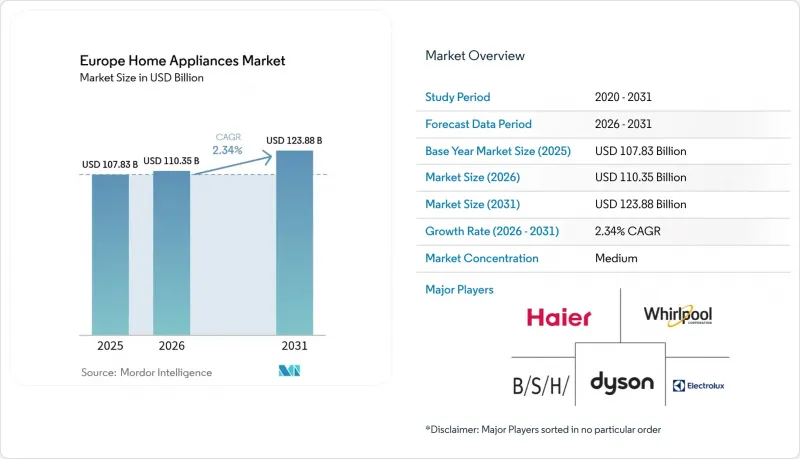
This report is Segmented by Product (Major Home Appliances, Small Home Appliances), Distribution Channel (Multi-Brand Stores, Exclusive Brand Outlets, Online, Other Distribution Channels), and Geography (United Kingdom, Germany, France, Spain, Italy, BENELUX, NORDICS, Rest of Europe). The Market Forecasts are Provided in Terms of Value (USD).
Europe Home Appliances Market Trends and Insights
Energy-Efficiency Labeling & EU Eco-Design Mandates
The ESPR, scheduled for full enforcement in 2026, introduces digital product passports that log energy consumption, material composition, and repairability metrics throughout an appliance's life cycle . Compliance costs raise entry barriers for import-dependent brands, favoring regional manufacturers with embedded sustainability processes. Spare-parts obligations and mandated firmware updates make total cost of ownership a decisive purchase factor. ISO 14006 alignment becomes a core procurement requirement among European retailers, further reinforcing the premium that consumers attach to low-carbon footprints. Brands able to launch A-rated models ahead of statutory deadlines command price premiums and strengthen retailer partnerships.
Rapid Replacement Cycle Driven by Smart-Home Integration
Matter protocol adoption and Thread networking permit appliances to join whole-home energy-management systems, making non-connected units a bottleneck in demand-response programs offered by utilities . Functional obsolescence now arrives sooner than mechanical failure, encouraging 5- to 7-year upgrade cycles. LG's 2024 takeover of Athom, maker of Homey hubs, illustrates a pivot from one-off sales to subscription-based energy-optimization services. Connected models deliver usage data that utilities convert into off-peak rebates, trimming payback periods for premium appliances. Northern Europe, where electricity prices remain high, leads adoption.
Supply-Chain Volatility and Component Shortages
Persistent semiconductor shortages and raw material price volatility continue to disrupt European appliance manufacturing, with plastic resin costs rising 15-20% year-over-year in 2024 while metal prices remain elevated compared to pre-pandemic levels. This cost pressure forces manufacturers to implement selective price increases while absorbing margin compression, particularly affecting mid-market segments where price sensitivity limits pass-through capability. Supply chain resilience becomes a competitive differentiator as companies with diversified sourcing and vertical integration maintain better availability and cost control compared to those dependent on single-source suppliers.
Other drivers and restraints analyzed in the detailed report include:
- Rising Disposable Income in Central & Eastern Europe
- Surge in Heat-Pump Dryer Retrofits Supported by Subsidies
- EU "Right-to-Repair" Rules Extending Product Lifetimes
For complete list of drivers and restraints, kindly check the Table Of Contents.
Segment Analysis
Refrigerators preserved their 23.78% portion of the Europe home appliances market in 2025 as top-mounted freezer models shifted to A-class efficiency ratings that align with upcoming eco-design thresholds. In value terms, refrigerators accounted for USD 25.64 billion of the Europe home appliances market size during 2025, and the segment is tracking a 1.84% CAGR through 2031 as incremental gains from compressor and insulation advances taper. At the opposite end of the growth spectrum, air fryers are scaling from USD 2.38 billion in 2025 to an expected USD 3.02 billion by 2031, reflecting a 4.05% CAGR that outpaces every other small-appliance line. Compact form factors, oil-free cooking, and app-based recipe libraries resonate with single-person and health-conscious households, creating premium sub-segments featuring dual-zone baskets and smart-heat algorithms.
Beyond these headline categories, washing machines and dishwashers integrate turbidity and fabric-sensing technology that adjusts cycle length and resource consumption in real time. Sensor-driven models claim water savings of up to 35% versus legacy machines, an advantage reflected in higher average selling prices. Combination microwave-steam-convection ovens underscore the push toward multi-functionality, capturing space-constrained urban buyers while raising cross-category cannibalization risks. Manufacturers deploy modular platform architectures, enabling rapid SKU proliferation without duplicating engineering expense. Over the forecast horizon, premiumization remains the principal value lever, offsetting the deceleration of pure replacement demand triggered by Right-to-Repair regulations.
Complete Report Scope:
- By Product
- Major Home Appliances
- Refrigerators
- Freezers
- Washing Machines
- Dishwashers
- Ovens (Incl. Combi and Microwave)
- Air Conditioners
- Other Major Home Appliances
- Small Home Appliances
- Coffee Makers
- Food Processors
- Grills and Roasters
- Electric Kettles
- Juicers and Blenders
- Air Fryers
- Vacuum Cleaners
- Electric Rice Cookers
- Other Small Home Appliances
- Major Home Appliances
- By Distribution Channel
- Multi-Brand Stores
- Exclusive Brand Outlets
- Online
- Other Distribution Channels
- By Region
- England
- Scotland
- Wales
- Northern Ireland
List of Companies Covered in this Report:
- Whirlpool Corp.
- BSH Hausgerate GmbH
- Electrolux AB
- Haier Smart Home (Candy/Hoover)
- Dyson Ltd.
- LG Electronics Inc.
- Samsung Electronics Co. Ltd.
- Miele and Cie. KG
- Arcelik A.S. (Beko)
- Gorenje Group
- SharkNinja Operating LLC
- De'Longhi Group
- Kenwood Ltd.
- Russell Hobbs
- Morphy Richards
- Smeg SpA
- Seb Group (Tefal)
- Groupe SEB (Rowenta, Krups)
- Hisense UK
- Liebherr-Hausgerate GmbH
Additional Benefits:
- The market estimate (ME) sheet in Excel format
- 3 months of analyst support
TABLE OF CONTENTS
1 Introduction
- 1.1 Study Assumptions and Market Definition
- 1.2 Scope of the Study
2 Research Methodology
3 Executive Summary
4 Market Landscape
- 4.1 Market Overview
- 4.2 Market Drivers
- 4.2.1 Energy-efficiency regulations and Eco-label compliance surge
- 4.2.2 E-commerce and omnichannel penetration
- 4.2.3 Ageing installed base driving replacement demand
- 4.2.4 Smart-home integration premiums
- 4.2.5 Heat-pump and electrification incentives
- 4.2.6 Subscription/ leasing models for appliances
- 4.3 Market Restraints
- 4.3.1 Inflation-driven squeeze on discretionary spending
- 4.3.2 Supply-chain cost inflation
- 4.3.3 Right-to-repair rules lengthening product lifecycles
- 4.3.4 Shrinking household size limiting multi-appliance uptake
- 4.4 Industry Value Chain Analysis
- 4.5 Porter's Five Forces
- 4.5.1 Threat of New Entrants
- 4.5.2 Bargaining Power of Suppliers
- 4.5.3 Bargaining Power of Buyers
- 4.5.4 Threat of Substitutes
- 4.5.5 Competitive Rivalry
- 4.6 Insights into the Latest Trends and Innovations in the Market
- 4.7 Insights on Recent Developments (New Product Launches, Strategic Initiatives, Investments, Partnerships, JVs, Expansion, MandAs, etc.)
5 Market Size and Growth Forecasts
- 5.1 By Product
- 5.1.1 Major Home Appliances
- 5.1.1.1 Refrigerators
- 5.1.1.2 Freezers
- 5.1.1.3 Washing Machines
- 5.1.1.4 Dishwashers
- 5.1.1.5 Ovens (Incl. Combi and Microwave)
- 5.1.1.6 Air Conditioners
- 5.1.1.7 Other Major Home Appliances
- 5.1.2 Small Home Appliances
- 5.1.2.1 Coffee Makers
- 5.1.2.2 Food Processors
- 5.1.2.3 Grills and Roasters
- 5.1.2.4 Electric Kettles
- 5.1.2.5 Juicers and Blenders
- 5.1.2.6 Air Fryers
- 5.1.2.7 Vacuum Cleaners
- 5.1.2.8 Electric Rice Cookers
- 5.1.2.9 Other Small Home Appliances
- 5.1.1 Major Home Appliances
- 5.2 By Distribution Channel
- 5.2.1 Multi-Brand Stores
- 5.2.2 Exclusive Brand Outlets
- 5.2.3 Online
- 5.2.4 Other Distribution Channels
- 5.3 By Region
- 5.3.1 England
- 5.3.2 Scotland
- 5.3.3 Wales
- 5.3.4 Northern Ireland
6 Competitive Landscape
- 6.1 Market Concentration
- 6.2 Strategic Moves
- 6.3 Market Share Analysis
- 6.4 Company Profiles {(includes Global level Overview, Market level overview, Core Segments, Financials as available, Strategic Information, Market Rank/Share for key companies, Products and Services, and Recent Developments)}
- 6.4.1 Whirlpool Corp.
- 6.4.2 BSH Hausgerate GmbH
- 6.4.3 Electrolux AB
- 6.4.4 Haier Smart Home (Candy/Hoover)
- 6.4.5 Dyson Ltd.
- 6.4.6 LG Electronics Inc.
- 6.4.7 Samsung Electronics Co. Ltd.
- 6.4.8 Miele and Cie. KG
- 6.4.9 Arcelik A.S. (Beko)
- 6.4.10 Gorenje Group
- 6.4.11 SharkNinja Operating LLC
- 6.4.12 De'Longhi Group
- 6.4.13 Kenwood Ltd.
- 6.4.14 Russell Hobbs
- 6.4.15 Morphy Richards
- 6.4.16 Smeg SpA
- 6.4.17 Seb Group (Tefal)
- 6.4.18 Groupe SEB (Rowenta, Krups)
- 6.4.19 Hisense UK
- 6.4.20 Liebherr-Hausgerate GmbH
7 Market Opportunities and Future Outlook
- 7.1 Energy-Efficient and Smart Appliances Aligned with UK Net-Zero Goals
- 7.2 Growth in Compact and Multi-Functional Appliances for Urban Homes

