PUBLISHER: Mordor Intelligence | PRODUCT CODE: 2155659

PUBLISHER: Mordor Intelligence | PRODUCT CODE: 2155659
South America Home Appliances - Market Share Analysis, Industry Trends & Statistics, Growth Forecasts (2026 - 2031)
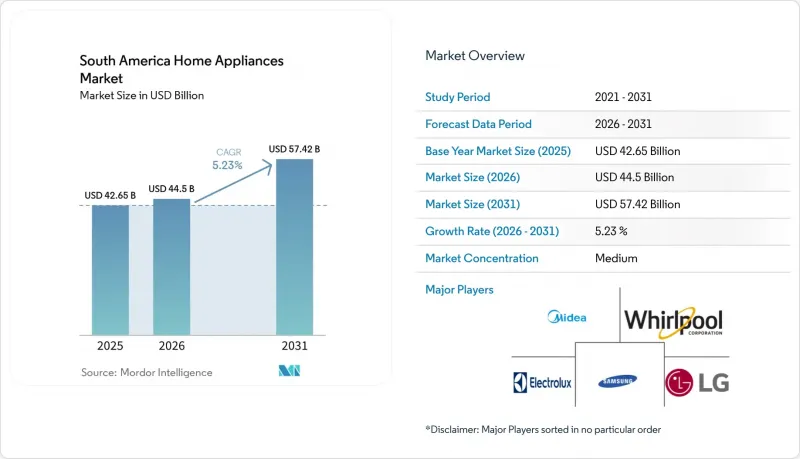
According to Mordor Intelligence, the South America home appliances market size was valued at USD 42.65 billion in 2025 and is estimated to grow from USD 44.5 billion in 2026 to reach USD 57.42 billion by 2031, at a CAGR of 5.2% during the forecast period (2026-2031).
South America Home Appliances Market Trends and Insights
Rising Disposable Income and Consumer Credit Access
Consumer credit functions as an important route to purchase for the South America home appliances market, particularly for higher-priced durable goods. In Argentina, credit cards accounted for 55.1% of appliance purchases in the fourth quarter of 2025. IDB Invest documented more than 131 million retail store cards in Brazil, with annual transactions of USD 9 billion, alongside formal bank credit. This combination expands access beyond households that rely only on conventional bank lending. Argentina recorded 23% growth in appliance unit sales in 2025, supported by lower import prices, broader product availability, and stronger consumer credit conditions. When interest rates increase, the cost of installment plans can rise quickly and postpone replacement purchases.
E-Commerce, Instant Payments and Embedded Financing
Brazil's Pix became the leading online payment method in 2025, accounting for 42% of e-commerce payment value, compared with 41% for credit cards. Pix Automatico launched in June 2025 and can extend recurring debit payments to as many as 60 million Brazilians without credit cards. Embedded lending can use Open Finance data during checkout, linking product research more directly with available credit. Mercado Libre reported foreign exchange-neutral gross merchandise value growth of 30% in Brazil and 126% in Argentina during the first quarter of 2025, with nearly 67 million unique buyers. The shift requires manufacturers and retailers to improve product content, financing choices, and delivery capabilities.
Currency, Tariff and Imported-Component Volatility
South American appliance supply chains remain exposed to changes in exchange rates, tariffs, and imported component costs. Brazil's real depreciated 8% against the United States dollar in 2025, increasing pressure on imported inputs. The announced 50% United States tariff on Brazilian exports in 2025 added uncertainty to pricing decisions and exchange-rate expectations. Brands that import compressors, inverter boards, and motor assemblies must manage higher input costs while serving price-sensitive households. Electrolux described its Latin American second quarter of 2025 as challenging because of weak demand, currency headwinds, and macroeconomic adjustment in Brazil. Localizing production can improve cost visibility, although it requires capital investment before the benefits are realized.
Other drivers and restraints analyzed in the detailed report include:
- Smart-Connected Appliance Adoption
- Urban Housing Formation and Replacement Demand
- High Interest Rates and Durable-Goods Affordability
For complete list of drivers and restraints, kindly check the Table Of Contents.
Segment Analysis
Major Home Appliances accounted for 63.36% of the South America home appliances market size in 2025, led by refrigerators, washing machines, and air conditioning. These categories serve essential household needs and are supported by regular replacement cycles. Air conditioning recorded 16% volume growth in Brazil during 2025, although the broader white-goods category adjusted lower. Dishwashers are gaining interest in Sao Paulo, Buenos Aires, and Santiago as smaller urban households place greater value on time-saving kitchen products. Brazil's INMETRO Ordinance 223/2025 tightened energy-efficiency requirements for refrigerators and freezers from April 2025. The rules shape which products can enter the country and favor suppliers with established certification arrangements. Major appliances also benefit when new housing deliveries turn empty homes into first-time appliance purchases.
Small Home Appliances is forecast to grow at a 6.25% CAGR from 2026 to 2031, faster than the regional total. Demand is supported by air fryers, premium espresso machines, multifunctional food processors, and robot vacuum cleaners. Products purchased during the pandemic are aging, which supports trade-up replacements toward mid-premium models. The category's growth is linked to urban lifestyles and a larger number of dual-income households. The South America home appliances industry also includes companies with strong product refresh capabilities, such as Groupe SEB, SharkNinja, and Versuni. Their broad product ranges allow them to respond more quickly to changing kitchen and floor-care preferences. White-goods suppliers remain important competitors, but their portfolios are more concentrated in refrigeration and laundry.
Complete Report Scope:
- By Product Type
- Major Home Appliances
- Refrigerators
- Freezers
- Washing Machines
- Clothes Dryers
- Dishwashers
- Ovens, Cookers and Ranges
- Microwave Ovens
- Air Conditioners
- Range Hoods and Cooktops
- Other Major Home Appliances
- Small Home Appliances
- Coffee Makers and Espresso Machines
- Food Processors, Juicers and Blenders
- Grills and Roasters
- Electric Kettles
- Air Fryers
- Vacuum Cleaners and Robot Vacuums
- Irons and Garment Steamers
- Toasters, Rice Cookers and Countertop Ovens
- Other Small Home Appliances
- Major Home Appliances
- By Distribution Channel
- Multi-Brand Stores
- Exclusive Brand Outlets
- Online
- Other Distribution Channels
- By Geography
- Brazil
- Peru
- Chile
- Argentina
- Rest of South America
List of Companies Covered in this Report:
- Whirlpool Corporation
- Electrolux AB
- Samsung Electronics Co., Ltd.
- LG Electronics Inc.
- Midea Group Co., Ltd.
- Haier Smart Home Co., Ltd.
- Hisense Home Appliances Group Co., Ltd.
- Gree Electric Appliances Inc.
- Panasonic Holdings Corporation
- BSH Hausgerate GmbH
- Robert Bosch GmbH
- Arcelik A.S.
- Mabe, S.A. de C.V.
- Groupe SEB
- Versuni Holding B.V.
- SharkNinja Operating LLC
- TCL Electronics Holdings Limited
- Britania Eletrodomesticos S.A.
- Mondial Eletrodomesticos Ltda.
- Philco Eletronicos S.A.
Additional Benefits:
- The market estimate (ME) sheet in Excel format
- 3 months of analyst support
TABLE OF CONTENTS
1 Introduction
- 1.1 Study Assumptions & Market Definition
- 1.2 Scope of the Study
2 Research Methodology
3 Executive Summary
4 Market Landscape
- 4.1 Market Overview
- 4.2 Market Drivers
- 4.2.1 Rising Disposable Income and Consumer Credit Access
- 4.2.2 E-Commerce, Instant Payments and Embedded Financing
- 4.2.3 Smart-Connected Appliance Adoption
- 4.2.4 Urban Housing Formation and Replacement Demand
- 4.2.5 Chancay Port-Led Import and Assortment Expansion
- 4.2.6 Energy and Water Stress Accelerating Efficient Appliances
- 4.3 Market Restraints
- 4.3.1 Currency, Tariff and Imported-Component Volatility
- 4.3.2 High Interest Rates and Durable-Goods Affordability
- 4.3.3 Line-Drying Preferences Limiting Clothes-Dryer Penetration
- 4.3.4 Reverse-Logistics and End-of-Life Collection Gaps
- 4.4 Industry Value Chain Analysis
- 4.5 Porter's Five Forces Analysis
- 4.5.1 Threat of New Entrants
- 4.5.2 Bargaining Power of Suppliers
- 4.5.3 Bargaining Power of Buyers
- 4.5.4 Threat of Substitutes
- 4.5.5 Industry Rivalry
- 4.6 Insights into the Latest Trends and Innovations in the Industry
- 4.7 Insights into the Recent Developments (New Product Launches, Strategic Initiatives, Investments, Partnerships, JVs, Expansion, M&As, etc.) in the Industry
5 Market Size & Growth Forecasts (Value in USD Billion)
- 5.1 By Product Type
- 5.1.1 Major Home Appliances
- 5.1.1.1 Refrigerators
- 5.1.1.2 Freezers
- 5.1.1.3 Washing Machines
- 5.1.1.4 Clothes Dryers
- 5.1.1.5 Dishwashers
- 5.1.1.6 Ovens, Cookers and Ranges
- 5.1.1.7 Microwave Ovens
- 5.1.1.8 Air Conditioners
- 5.1.1.9 Range Hoods and Cooktops
- 5.1.1.10 Other Major Home Appliances
- 5.1.2 Small Home Appliances
- 5.1.2.1 Coffee Makers and Espresso Machines
- 5.1.2.2 Food Processors, Juicers and Blenders
- 5.1.2.3 Grills and Roasters
- 5.1.2.4 Electric Kettles
- 5.1.2.5 Air Fryers
- 5.1.2.6 Vacuum Cleaners and Robot Vacuums
- 5.1.2.7 Irons and Garment Steamers
- 5.1.2.8 Toasters, Rice Cookers and Countertop Ovens
- 5.1.2.9 Other Small Home Appliances
- 5.1.1 Major Home Appliances
- 5.2 By Distribution Channel
- 5.2.1 Multi-Brand Stores
- 5.2.2 Exclusive Brand Outlets
- 5.2.3 Online
- 5.2.4 Other Distribution Channels
- 5.3 By Geography
- 5.3.1 Brazil
- 5.3.2 Peru
- 5.3.3 Chile
- 5.3.4 Argentina
- 5.3.5 Rest of South America
6 Competitive Landscape
- 6.1 Market Concentration
- 6.2 Strategic Moves
- 6.3 Market Share Analysis
- 6.4 Company Profiles {(includes Global level Overview, Market level overview, Core Segments, Financials as available, Strategic Information, Market Rank/Share for key companies, Products & Services, and Recent Developments)}
- 6.4.1 Whirlpool Corporation
- 6.4.2 Electrolux AB
- 6.4.3 Samsung Electronics Co., Ltd.
- 6.4.4 LG Electronics Inc.
- 6.4.5 Midea Group Co., Ltd.
- 6.4.6 Haier Smart Home Co., Ltd.
- 6.4.7 Hisense Home Appliances Group Co., Ltd.
- 6.4.8 Gree Electric Appliances Inc.
- 6.4.9 Panasonic Holdings Corporation
- 6.4.10 BSH Hausgerate GmbH
- 6.4.11 Robert Bosch GmbH
- 6.4.12 Arcelik A.S.
- 6.4.13 Mabe, S.A. de C.V.
- 6.4.14 Groupe SEB
- 6.4.15 Versuni Holding B.V.
- 6.4.16 SharkNinja Operating LLC
- 6.4.17 TCL Electronics Holdings Limited
- 6.4.18 Britania Eletrodomesticos S.A.
- 6.4.19 Mondial Eletrodomesticos Ltda.
- 6.4.20 Philco Eletronicos S.A.
7 Market Opportunities & Future Outlook
- 7.1 Affordable Premium Appliances Outside Capital Cities
- 7.2 Dryer Adoption in High-Density and Wet-Climate Corridors

