PUBLISHER: Mordor Intelligence | PRODUCT CODE: 2120428

PUBLISHER: Mordor Intelligence | PRODUCT CODE: 2120428
United States Home Appliance - Market Share Analysis, Industry Trends & Statistics, Growth Forecasts (2026 - 2031)
According to Mordor Intelligence, the United States home appliance market size is expected to grow from USD 87.26 billion in 2025 to USD 90.06 billion in 2026 and is forecast to reach USD 105.45 billion by 2031 at 3.21% CAGR over 2026-2031.
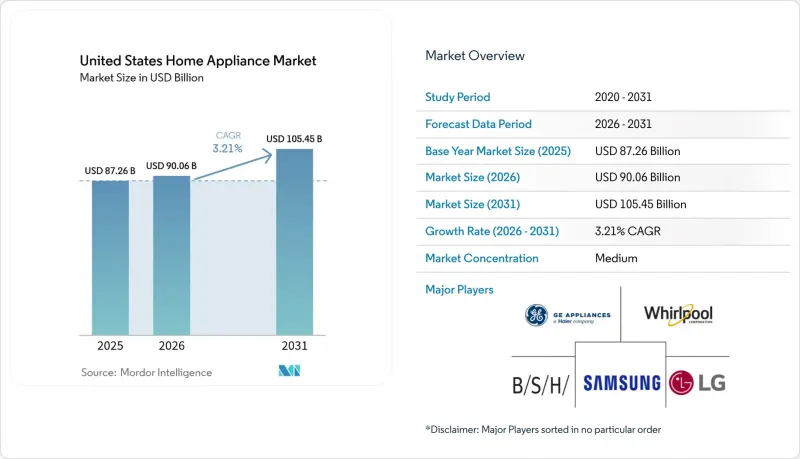
This report is Segmented by Product Type (Major Home Appliances, Including Refrigerators, Other Major Products; Small Home Appliances, Including Coffee Makers, Other Small Appliances), Distribution Channel (Multi-Branded Stores, and Other), Technology (Smart/Connected Appliances, and Other), and Geography (Northeast, Midwest, South, West). The Market Forecasts are Provided in Terms of Value (USD).
United States Home Appliance Market Trends and Insights
Rising Demand For Energy Star & Doe-Compliant Appliances
Federal efficiency mandates are generating a compliance-driven upgrade cycle that shortens traditional replacement timelines. The Department of Energy's 2028 cooking-product standard will require electric cooktops to achieve at least 30% higher efficiency, delivering USD 1.6 billion in cumulative consumer savings. Manufacturers are fast-tracking ENERGY STAR Most Efficient 2025 models across heat pumps, washers, and refrigerators, while utilities leverage the standards to roll out targeted rebates. New water-heater regulations that mandate heat-pump technology for common electric units starting in 2029 are expected to double category efficiency and anchor long-term demand for high-performance models. Predictable compliance dates allow brands to optimize inventory transitions, and regional utilities align incentive budgets with federal timelines to maximize consumer uptake.
Accelerating adoption of smart/IoT-enabled white goods
Connected appliances are shifting from novelty status to ecosystem linchpins that enable whole-home energy management. Samsung's 2025 Bespoke AI refrigerators integrate Voice ID, 9-inch displays, and Matter-ready connectivity, illustrating how premium design meets interoperability. GE Appliances' partnership with ABB adds circuit-level monitoring through the SmartHQ app, giving builders and homeowners actionable insights on appliance loads. Yet 68% of IoT manufacturers cite development hurdles, underscoring competitive advantages for firms that solve integration pain points. With Matter 1.3 now covering kitchen and laundry specifications, consumer hesitation around vendor lock-in is steadily waning, positioning smart features as mainstream differentiators rather than niche add-ons.
Volatile steel & semiconductor costs compress margins
Steel tariffs rose to 50% in June 2025, now covering appliance subcomponents, and pushed major-appliance shelf prices 4% higher in a single month. Major appliance prices increased over 4% in May 2025 alone, with companies like Samsung and LG facing significant cost pressures from imported materials. Hurricane Helene's disruption of North Carolina's Spruce Pine quartz mine, which supplies high-purity materials essential for semiconductor production, created additional supply chain vulnerabilities for smart appliance manufacturers. The semiconductor shortage particularly affects premium connected appliances, where advanced chips enable AI features and energy management capabilities that justify higher price points.
Other drivers and restraints analyzed in the detailed report include:
- IRA heat-pump incentives expanding dryer & HVAC categories
- Social-media-led surge in premium small appliances
- Persistent global logistics & parts shortages
For complete list of drivers and restraints, kindly check the Table Of Contents.
Segment Analysis
Refrigerators held a commanding 27.55% share of the United States home appliance market in 2025, confirming their status as the category anchor for most retailers. Within that base, smart refrigerators are racing ahead at a 11.86% CAGR, fueled by AI-enhanced food tracking and voice-controlled user interfaces that allow consumers to minimize waste and manage energy use. The United States home appliance market size for refrigerators reached USD 24.04 billion in 2025, and incremental growth increasingly skews toward feature-rich variants. Washing machines followed with 24.95% share thanks to steady replacement cycles and shifts toward high-efficiency top loaders, while ovens captured 17.72% share as induction technology builds momentum in electrification-focused states.
Momentum is also evident in floor-care and countertop segments. Vacuum cleaners represented 9.48% of 2025 sales, but robotic units continue to outpace traditional formats as mapping accuracy and smart-home integration improve. Social-media-driven enthusiasm for air fryers, coffee systems, and multicookers widens the small-appliance addressable base and generates aftermarket opportunities for specialized accessories. GE Appliances' Cookcam(TM) AI, which identifies food and recommends settings in real time, illustrates how embedded intelligence can differentiate even mature cooking appliances.
Complete Report Scope:
- By Product Type
- Major Home Appliances
- Refrigerators
- Freezers
- Dishwashing Machines
- Washing Machines
- Ovens
- Air Conditioners
- Other Major Products (Electric Hobs, Ranges, etc.)
- Small Home Appliances
- Coffee Makers
- Food Processors
- Grills & Toasters
- Vacuum Cleaners
- Juicers & Blenders
- Other Small Appliances (Waffle Makers, Egg Cookers, Air Fryers, Kettles, etc.)
- Major Home Appliances
- By Distribution Channel
- Multi-Branded Stores
- Specialty Stores
- E-Commerce
- Other Distribution Channels
- By Technology
- Smart / Connected Appliances
- Energy-Efficient (? 5-Star, Inverter) Appliances
- Conventional Appliances
- By Region (U.S.)
- Northeast
- Midwest
- South
- West
List of Companies Covered in this Report:
- Whirlpool Corporation
- GE Appliances (Haier)
- LG Electronics USA
- Samsung Electronics America
- BSH Home Appliances (Bosch, Thermador)
- Electrolux North America
- Sub-Zero Group
- Miele USA
- Panasonic North America
- Sharp Home Electronics USA
- Dyson Inc.
- iRobot Corporation
- Breville USA
- Keurig Dr Pepper
- Instant Brands
- Traeger Inc.
- Weber Inc.
- Hamilton Beach Brands
- Spectrum Brands (Home & Personal Care)
- SharkNinja
Additional Benefits:
- The market estimate (ME) sheet in Excel format
- 3 months of analyst support
TABLE OF CONTENTS
1 Introduction
- 1.1 Study Assumptions & Market Definition
- 1.2 Scope of the Study
2 Research Methodology
3 Executive Summary
4 Market Landscape
- 4.1 Market Overview
- 4.2 Market Drivers
- 4.2.1 Rising Demand For Energy Star & Doe-Compliant Appliances
- 4.2.2 Accelerating adoption of smart/IoT-enabled white goods
- 4.2.3 IRA heat-pump incentives expanding dryer & HVAC categories
- 4.2.4 Social-media-led surge in premium small appliances
- 4.2.5 BNPL financing boosting large-ticket replacements
- 4.2.6 Electrification push for induction ranges & cooktops
- 4.3 Market Restraints
- 4.3.1 Volatile steel & semiconductor costs compress margins
- 4.3.2 Persistent global logistics & parts shortages
- 4.3.3 Consumer cybersecurity concerns over connected devices
- 4.3.4 Upcoming tighter DOE efficiency rules raising compliance cost
- 4.4 Value / Supply-Chain Analysis
- 4.5 Regulatory Landscape
- 4.6 Technological Outlook
- 4.7 Porter's Five Forces
- 4.7.1 Threat of New Entrants
- 4.7.2 Bargaining Power of Suppliers
- 4.7.3 Bargaining Power of Buyers
- 4.7.4 Threat of Substitutes
- 4.7.5 Competitive Rivalry
5 Market Size & Growth Forecasts
- 5.1 By Product Type
- 5.1.1 Major Home Appliances
- 5.1.1.1 Refrigerators
- 5.1.1.2 Freezers
- 5.1.1.3 Dishwashing Machines
- 5.1.1.4 Washing Machines
- 5.1.1.5 Ovens
- 5.1.1.6 Air Conditioners
- 5.1.1.7 Other Major Products (Electric Hobs, Ranges, etc.)
- 5.1.2 Small Home Appliances
- 5.1.2.1 Coffee Makers
- 5.1.2.2 Food Processors
- 5.1.2.3 Grills & Toasters
- 5.1.2.4 Vacuum Cleaners
- 5.1.2.5 Juicers & Blenders
- 5.1.2.6 Other Small Appliances (Waffle Makers, Egg Cookers, Air Fryers, Kettles, etc.)
- 5.1.1 Major Home Appliances
- 5.2 By Distribution Channel
- 5.2.1 Multi-Branded Stores
- 5.2.2 Specialty Stores
- 5.2.3 E-Commerce
- 5.2.4 Other Distribution Channels
- 5.3 By Technology
- 5.3.1 Smart / Connected Appliances
- 5.3.2 Energy-Efficient (? 5-Star, Inverter) Appliances
- 5.3.3 Conventional Appliances
- 5.4 By Region (U.S.)
- 5.4.1 Northeast
- 5.4.2 Midwest
- 5.4.3 South
- 5.4.4 West
6 Competitive Landscape
- 6.1 Market Concentration
- 6.2 Strategic Moves
- 6.3 Market Share Analysis
- 6.4 Company Profiles {(includes Global level Overview, Market level overview, Core Segments, Financials as available, Strategic Information, Market Rank/Share for key companies, Products & Services, and Recent Developments)}
- 6.4.1 Whirlpool Corporation
- 6.4.2 GE Appliances (Haier)
- 6.4.3 LG Electronics USA
- 6.4.4 Samsung Electronics America
- 6.4.5 BSH Home Appliances (Bosch, Thermador)
- 6.4.6 Electrolux North America
- 6.4.7 Sub-Zero Group
- 6.4.8 Miele USA
- 6.4.9 Panasonic North America
- 6.4.10 Sharp Home Electronics USA
- 6.4.11 Dyson Inc.
- 6.4.12 iRobot Corporation
- 6.4.13 Breville USA
- 6.4.14 Keurig Dr Pepper
- 6.4.15 Instant Brands
- 6.4.16 Traeger Inc.
- 6.4.17 Weber Inc.
- 6.4.18 Hamilton Beach Brands
- 6.4.19 Spectrum Brands (Home & Personal Care)
- 6.4.20 SharkNinja
7 Market Opportunities & Future Outlook
- 7.1 Induction cooktop retrofits in IRA-funded low-income housing
- 7.2 Subscription-based predictive-maintenance services for smart appliances

