PUBLISHER: Mordor Intelligence | PRODUCT CODE: 2113636

PUBLISHER: Mordor Intelligence | PRODUCT CODE: 2113636
Indonesia Real Estate - Market Share Analysis, Industry Trends & Statistics, Growth Forecasts (2026 - 2031)
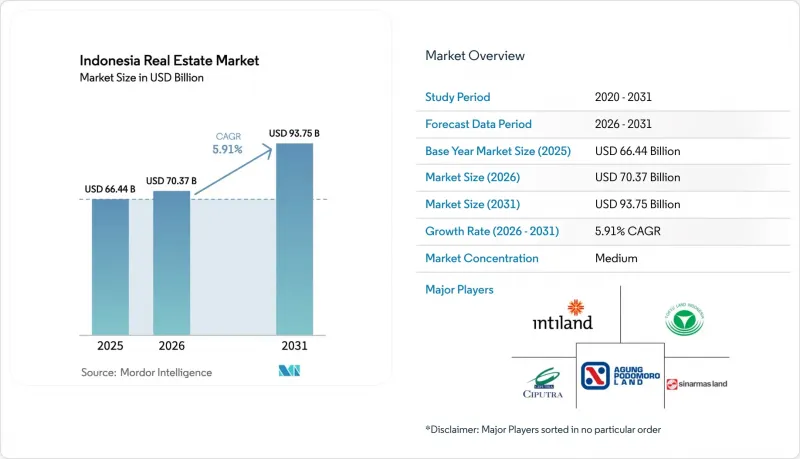
According to Mordor Intelligence, the Indonesia real estate market size is projected to expand from USD 66.44 billion in 2025 and USD 70.37 billion in 2026 to USD 93.75 billion by 2031, registering a CAGR of 5.91% between 2026 to 2031.
This report is Segmented by Business Model (Sales, Rental), by Property Type (Residential [Apartments & Condominiums, Villas & Landed Houses], Commercial [Office, Retail, Logistics, Others]), by End-User (Individuals/Households, Corporates & SMEs, Others), and by Geography (DKI Jakarta, West Java, and More). The Market Forecasts are Provided in Terms of Value (USD).
Indonesia Real Estate Market Trends and Insights
Strong Demographics, Urbanization, and Rising Middle Class Boosting Housing, Retail, and Services Demand
Indonesia's urban cohort passed 59% of the total population in 2024, adding nearly 3 million new city dwellers each year. Household sizes are shrinking, so the absolute need for separate dwelling units is rising even when headcount growth moderates. Developers have responded by offering sub-USD 67,000 two-bedroom apartments that qualify for VAT exemptions, stabilizing primary residential sales as shown by Bank Indonesia's Q3 2025 data. Consumption habits are also shifting toward experiential retail-food halls and co-working cafes-leading builders to fuse commercial podiums into residential towers. This blending of uses allows landlords to monetize common areas through rental income, cushioning them against slower condo sales cycles. Consequently, urban-core projects that mix living, working, and leisure spaces are absorbing capital ahead of single-use schemes.
Infrastructure Push and IKN Nusantara Unlocking Development Corridors and Mixed-Use Pipelines
The USD 15.3 billion state budget for IKN signals more than a new capital; it is catalyzing land grabs along the Balikpapan-Samarinda axis and the Jakarta-Bandung high-speed rail corridor. Private developers prefer adjacent municipalities to the restricted IKN core, where they partner with government agencies on pre-sold civil-servant housing. The rail link slashes Jakarta-Bandung travel to 40 minutes, inflating land values near Tegalluar station by up to 20% and spawning transit-oriented townships. Yet timelines remain sensitive to fiscal allocations, urging firms to hedge by also banking plots in West Java's Cikarang-Karawang belt. Projects able to align with both corridors diversify geographic risk while tapping synchronized demand for residences, retail, and logistics hubs.
Land/Title Complexity, Zoning/Permitting Delays, and Regional Policy Variability Slowing Execution
The national land-registration drive certified 76% of 126 million plots by 2025, yet unresolved customary claims in Kalimantan, Sulawesi, and Papua slow projects by 12-18 months and lift acquisition costs by up to 30%. A USD 653 million World Bank loan targets an extra 4.8 million hectares by 2028, but district-level capacity remains the bottleneck. Regulation No. 5/2025 decentralizes title issuance, allowing Java districts to clear permits in 60 days while some Kalimantan offices take 180 days. Coastal zoning overlaps among forestry, fisheries, and tourism agencies have delayed Lombok resort schemes, forcing developers to add sizable legal contingencies. Consequently, many firms pivot to brownfield joint ventures with state enterprises that own certified land, trading higher costs for execution certainty.
Other drivers and restraints analyzed in the detailed report include:
- "China + 1" FDI and Manufacturing Growth Driving Industrial Parks, Warehousing, and Worker Housing
- Tourism Rebound and MICE Activity Supporting Hotel, Resort, and Lifestyle Mixed-Use Projects
- High Funding Costs and Construction Inflation Tightening Feasibility for New Starts
For complete list of drivers and restraints, kindly check the Table Of Contents.
Segment Analysis
Residential assets commanded 55.1% of the Indonesian real estate market size in 2025, underpinned by a structural housing shortfall and state subsidies for first-time buyers. Yet the segment's 5.2% forecast CAGR trails the overall Indonesian real estate market because price caps and mortgage-rate swings squeeze margins. Logistics buildings, though on a smaller base, are racing ahead at a 6.49% CAGR as EV-battery supply chains pre-lease large-format warehouses near Cikarang and Karawang. Institutional appetite for bond-like cash flows has driven yields to 7-7.5%, narrowing the premium over sovereign bonds.
Developers are now integrating mini-logistics hubs-parcel lockers and cold-storage rooms-into new residential townships, monetizing ground-floor areas once reserved for parking. Meanwhile, Jakarta's CBD offices remain subdued under a 34% vacancy cloud, growing only 4.8% through 2031. Retail properties sit in between, with a 5% trajectory contingent on experiential upgrades. Data-center shells and industrial parks, grouped in "Other," carry a 5.7% growth outlook thanks to the IKN build-out and data-sovereignty rules that favor onshore hosting. ESR Indonesia's USD 148 million pickup of three LOGOS assets in 2024 shows blue-chip capital chasing stabilized logistics clusters.
Complete Report Scope:
- By Business Model
- Sales
- Rental
List of Companies Covered in this Report:
- PT Intiland Development Tbk
- Tokyu Land Indonesia
- Agung Podomoro Land
- Ciputra Group
- Sinar Mas Land
- PP Properti
- Lippo Group
- Trans Property
- Agung Sedayu Group
- PT Pakuwon Jati Tbk
- Summarecon Agung
- LOGOS Property Indonesia
- ESR Indonesia
- DP World Indonesia
- PT Bumi Serpong Damai Tbk
- PT Alam Sutera Realty Tbk
- PT Modernland Realty Tbk
- PT Astra Land Indonesia
- PT Wika Realty
- PT Perumnas
Additional Benefits:
- The market estimate (ME) sheet in Excel format
- 3 months of analyst support
TABLE OF CONTENTS
1 Introduction
- 1.1 Study Assumptions & Market Definition
- 1.2 Scope of the Study
2 Research Methodology
3 Executive Summary
4 Market Insights and Dynamics
- 4.1 Market Overview
- 4.2 Market Drivers
- 4.2.1 Strong demographics, urbanization, and rising middle class boosting housing, retail, and services demand.
- 4.2.2 Infrastructure push and the new capital (IKN Nusantara) unlocking development corridors and mixed-use pipelines.
- 4.2.3 "China+1" FDI and manufacturing growth driving industrial parks, warehousing, and worker housing.
- 4.2.4 Tourism rebound and MICE activity supporting hotel, resort, and lifestyle mixed-use projects.
- 4.2.5 REITs/collective investment schemes and proptech adoption improving capital access and transparency.
- 4.3 Market Restraints
- 4.3.1 Land/title complexity, zoning/permitting delays, and regional policy variability slowing execution.
- 4.3.2 High funding costs and construction inflation tightening feasibility for new starts.
- 4.3.3 Segment-specific oversupply/uneven recovery (e.g., offices in Jakarta) weighing on rents and absorption.
- 4.4 Value / Supply-Chain Analysis
- 4.5 Regulatory Landscape
- 4.6 Technological Outlook (PropTech & Modular Build)
- 4.7 Porter's Five Forces
- 4.7.1 Bargaining Power of Suppliers
- 4.7.2 Bargaining Power of Buyers
- 4.7.3 Threat of New Entrants
- 4.7.4 Threat of Substitutes
- 4.7.5 Intensity of Competitive Rivalry
5 Indonesia Real Estate Market Size & Growth Forecasts (Value, USD bn)
- 5.1 By Business Model
- 5.1.1 Sales
- 5.1.2 Rental
6 Indonesia Real Estate Market Size & Growth Forecasts (Value, USD bn)
- 6.1 By Property Type
- 6.1.1 Residential
- 6.1.1.1 Apartments & Condominiums
- 6.1.1.2 Villas & Landed Houses
- 6.1.2 Commercial
- 6.1.2.1 Office
- 6.1.2.2 Retail
- 6.1.2.3 Logistics
- 6.1.2.4 Others (industrial, hospitality, etc.)
- 6.1.1 Residential
- 6.2 By End-user
- 6.2.1 Individuals / Households
- 6.2.2 Corporates & SMEs
- 6.2.3 Others
- 6.3 By Region
- 6.3.1 DKI Jakarta
- 6.3.2 West Java (Jawa Barat)
- 6.3.3 East Java (Jawa Timur)
- 6.3.4 Rest of Indonesia
7 Competitive Landscape
- 7.1 Market Concentration
- 7.2 Strategic Moves
- 7.3 Market Share Analysis
- 7.4 Company Profiles (includes Global level Overview, Market level overview, Core Segments, Financials as available, Strategic Information, Products & Services, and Recent Developments)
- 7.4.1 PT Intiland Development Tbk
- 7.4.2 Tokyu Land Indonesia
- 7.4.3 Agung Podomoro Land
- 7.4.4 Ciputra Group
- 7.4.5 Sinar Mas Land
- 7.4.6 PP Properti
- 7.4.7 Lippo Group
- 7.4.8 Trans Property
- 7.4.9 Agung Sedayu Group
- 7.4.10 PT Pakuwon Jati Tbk
- 7.4.11 Summarecon Agung
- 7.4.12 LOGOS Property Indonesia
- 7.4.13 ESR Indonesia
- 7.4.14 DP World Indonesia
- 7.4.15 PT Bumi Serpong Damai Tbk
- 7.4.16 PT Alam Sutera Realty Tbk
- 7.4.17 PT Modernland Realty Tbk
- 7.4.18 PT Astra Land Indonesia
- 7.4.19 PT Wika Realty
- 7.4.20 PT Perumnas
8 Market Opportunities & Future Outlook
- 8.1 White-space & Unmet-need Assessment

