PUBLISHER: Mordor Intelligence | PRODUCT CODE: 2116326

PUBLISHER: Mordor Intelligence | PRODUCT CODE: 2116326
US Office Real Estate - Market Share Analysis, Industry Trends & Statistics, Growth Forecasts (2026 - 2031)
According to Mordor Intelligence, the US office real estate market size was valued at USD 369.58 billion in 2025 and estimated to grow from USD 381.48 billion in 2026 to reach USD 447.86 billion by 2031, at a CAGR of 3.22% during the forecast period (2026-2031).
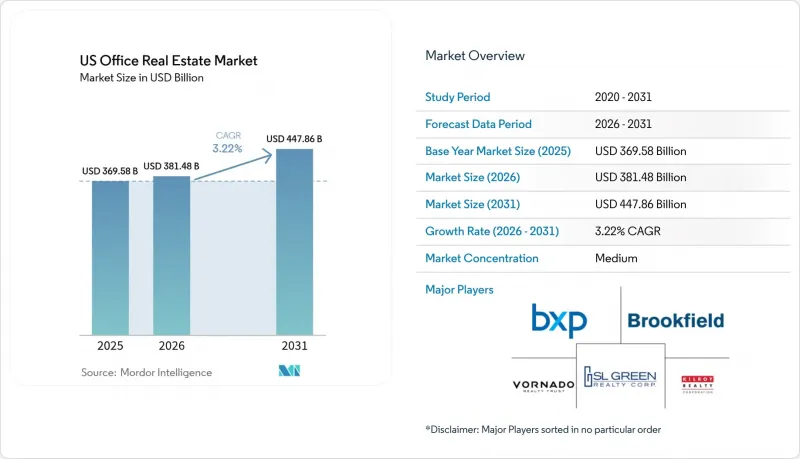
This report is Segmented by Building Grade (Grade A, Grade B, and More), by Transaction Type (Rental and Sales), by End Use (Information Technology (IT & ITES), BFSI (Banking, Financial Services and Insurance), and More) and by States (Texas, California, Florida and More). The Report Offers Market Size and Forecasts in Value (USD) for all the Above Segments.
US Office Real Estate Market Trends and Insights
Growing Tenant Preference for Class A and Sustainable Buildings
Premium offices now serve as recruitment tools that enhance productivity, pushing occupiers to prioritize building quality over rent savings. The General Services Administration's requirement for LEED Gold certification in new federal projects signals a market-wide baseline for quality and sustainability. Owners of certified assets realize stronger rent growth because tenants view environmental credentials as integral to corporate ESG targets. Prime urban buildings with energy-efficient systems and proximity to transit record higher occupancy and command longer lease commitments. Obsolete assets lacking these features face value erosion, reinforcing the bifurcation within the United States office real estate market.
Leasing Demand Supported by Resilient Sectors
Technology, healthcare, and finance collectively drove more than half of 2024 leasing activity, dispelling fears of structural office demand collapse. Amazon's 141,000 sq ft Silicon Valley lease with WeWork underscores selective tech expansion in premium space. Financial institutions maintain physical footprints to satisfy regulatory and client interaction needs. Healthcare providers require specialized office layouts to integrate telehealth with in-person services, sustaining demand even as other sectors downsize. The United States office real estate market thus benefits from a resilient core of industries that continue to lease high-specification space.
Elevated Vacancy Rates in Outdated and Suburban Offices
Functional obsolescence accelerates for buildings with inefficient layouts, limited technology infrastructure, or poor ESG credentials. National vacancy hit record highs in early 2025, with Class C suburban parks posting double-digit vacancy premiums over downtown Class A stock. Reduced daily commuting weakens footfall that once supported suburban retail amenities, further depressing tenant demand. Landlords face difficult investment decisions: undertake expensive upgrades or accept declining cash flows. The drag from obsolete space tempers overall growth in the United States office real estate market.
Other drivers and restraints analyzed in the detailed report include:
- Increased Adoption of Flexible and Short-Term Lease Structures
- Infrastructure Upgrades Improving Office Accessibility
- Delayed Return-to-Office Trends Hindering Space Absorption
For complete list of drivers and restraints, kindly check the Table Of Contents.
Segment Analysis
Grade A buildings represented 58.56% of occupied stock in 2025, underscoring their dominance within the United States office real estate market. Prime assets posted 3.76% forecast CAGR through 2031-well above the broader market-due to a decisive flight-to-quality by tenants. Positive net absorption for Grade A space surpassed 2 million sq ft in Q1 2025, even as overall market absorption remained flat. The United States office real estate market size for Grade A assets is therefore positioned to expand faster than any other grade category over the forecast horizon.
Superior HVAC systems, touchless technologies, and wellness amenities turn premium workplaces into strategic talent-retention tools. Public-sector standards such as the GSA's LEED Gold requirement converge with private-sector ESG targets to cement Grade A credentials as the default specification for large occupiers. Investors harness this momentum, funneling capital into trophy towers and core-plus refurbishments, while pricing discounts for secondary assets widen. Consequently, premium stock is likely to seize a larger United States office real estate market share as obsolete buildings exit competitive inventory.
Complete Report Scope:
- By Building Grade
- Grade A
- Grade B
- Grade C
- By Transaction Type
- Rental
- Sales
- By End Use
- Information Technology (IT & ITES)
- BFSI (Banking, Financial Services and Insurance)
- Business Consulting & Professional Services
- Other Services (Retail, Life-science, Energy, Legal)
- By States
- Texas
- California
- Florida
- New York
- Illinois
- Rest of US
List of Companies Covered in this Report:
- BXP, Inc.
- SL Green Realty Corp.
- Brookfield Properties
- Vornado Realty Trust
- Kilroy Realty Corp.
- Highwoods Properties Inc.
- Alexandria Real Estate Equities Inc.
- Hudson Pacific Properties Inc.
- Cousins Properties Inc.
- Piedmont Office Realty Trust
- Paramount Group Inc.
- Tishman Speyer
- Hines
- Trammell Crow Company
- Skanska USA (Commercial Development)
- Ryan Companies US Inc.
- JLL (Jones Lang LaSalle)
- CBRE Group Inc.
- Cushman & Wakefield
- Newmark Group Inc.
- Colliers International Group Inc.
- Savills North America
Additional Benefits:
- The market estimate (ME) sheet in Excel format
- 3 months of analyst support
TABLE OF CONTENTS
1 Introduction
- 1.1 Study Assumptions & Market Definition
- 1.2 Scope of the Study
2 Research Methodology
3 Executive Summary
4 Market Insights and Dynamics
- 4.1 Market Overview
- 4.2 Market Drivers
- 4.2.1 Growing tenant preference for Class A and sustainable buildings.
- 4.2.2 Leasing demand is supported by resilient sectors like tech, healthcare, and finance.
- 4.2.3 Increased adoption of flexible and short-term lease structures.
- 4.2.4 Infrastructure upgrades improving office accessibility in key urban centres.
- 4.2.5 Sustainability mandates accelerating green-certified building retrofits.
- 4.2.6 Repositioning of Aging Office Stock into Mixed-Use or Life Sciences Spaces
- 4.3 Market Restraints
- 4.3.1 Elevated vacancy rates in outdated and suburban office spaces.
- 4.3.2 Delayed return-to-office trends are hindering space absorption.
- 4.3.3 High interest rates and reduced financing availability are slowing investments.
- 4.3.4 Persistent Sublease Inventory Oversupply in Key Metros
- 4.4 Value / Supply-Chain Analysis
- 4.4.1 Overview
- 4.4.2 Real Estate Developers and Contractors - Key Quantitative and Qualitative Insights
- 4.4.3 Architectural and Engineering Companies - Key Quantitative and Qualitative Insights
- 4.4.4 Building Material and Equipment Companies - Key Quantitative and Qualitative Insights
- 4.5 Government Regulations and Initiatives in the Industry
- 4.6 Technological Innovations in the Office Real Estate Market
- 4.7 Insights into Rental Yields in the Office Real Estate Segment
- 4.8 Insights into the Key Office Real Estate Industry Metrics (Supply, Rentals, Prices, Occupancy/Vacancy (%))
- 4.9 Insights into Office Real Estate Construction Costs
- 4.10 Insights into Office Real Estate Investment
- 4.11 Impact of Remote Working on Space Demand
- 4.12 Porter's Five Forces
- 4.12.1 Threat of New Entrants
- 4.12.2 Bargaining Power of Buyers / Occupiers
- 4.12.3 Bargaining Power of Developers / Landlords
- 4.12.4 Threat of Substitutes (WFH, Flexible Space)
- 4.12.5 Competitive Rivalry
5 Market Size & Growth Forecasts (Value, USD)
- 5.1 By Building Grade
- 5.1.1 Grade A
- 5.1.2 Grade B
- 5.1.3 Grade C
- 5.2 By Transaction Type
- 5.2.1 Rental
- 5.2.2 Sales
- 5.3 By End Use
- 5.3.1 Information Technology (IT & ITES)
- 5.3.2 BFSI (Banking, Financial Services and Insurance)
- 5.3.3 Business Consulting & Professional Services
- 5.3.4 Other Services (Retail, Life-science, Energy, Legal)
- 5.4 By States
- 5.4.1 Texas
- 5.4.2 California
- 5.4.3 Florida
- 5.4.4 New York
- 5.4.5 Illinois
- 5.4.6 Rest of US
6 Competitive Landscape
- 6.1 Market Concentration
- 6.2 Strategic Moves
- 6.3 Company Profiles (includes Global level Overview, Market level overview, Core Segments, Financials as available, Strategic Information, Market Rank/Share, Products & Services, Recent Developments)
- 6.3.1 BXP, Inc.
- 6.3.2 SL Green Realty Corp.
- 6.3.3 Brookfield Properties
- 6.3.4 Vornado Realty Trust
- 6.3.5 Kilroy Realty Corp.
- 6.3.6 Highwoods Properties Inc.
- 6.3.7 Alexandria Real Estate Equities Inc.
- 6.3.8 Hudson Pacific Properties Inc.
- 6.3.9 Cousins Properties Inc.
- 6.3.10 Piedmont Office Realty Trust
- 6.3.11 Paramount Group Inc.
- 6.3.12 Tishman Speyer
- 6.3.13 Hines
- 6.3.14 Trammell Crow Company
- 6.3.15 Skanska USA (Commercial Development)
- 6.3.16 Ryan Companies US Inc.
- 6.3.17 JLL (Jones Lang LaSalle)
- 6.3.18 CBRE Group Inc.
- 6.3.19 Cushman & Wakefield
- 6.3.20 Newmark Group Inc.
- 6.3.21 Colliers International Group Inc.
- 6.3.22 Savills North America
7 Market Opportunities & Future Outlook

