PUBLISHER: Mordor Intelligence | PRODUCT CODE: 2114832

PUBLISHER: Mordor Intelligence | PRODUCT CODE: 2114832
Thailand Motor Insurance - Market Share Analysis, Industry Trends & Statistics, Growth Forecasts (2026 - 2031)
According to Mordor Intelligence, the Thailand motor insurance market size is expected to grow from USD 5.17 billion in 2025 to USD 5.32 billion in 2026 and is forecast to reach USD 6.11 billion by 2031 at 2.81% CAGR over 2026-2031.
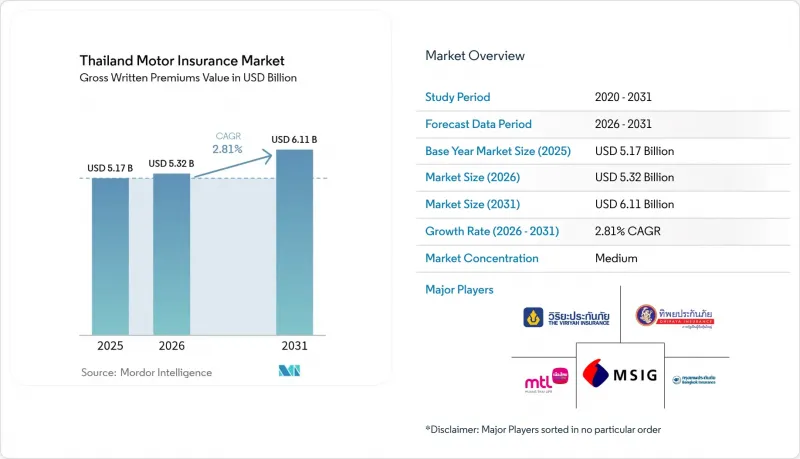
This report is Segmented by Vehicle Type (Car, Motorcycle), Insurance Type (Voluntary, Compulsory), and Distribution Channel (Agents, Brokers, Bancassurance, Other Distribution Channels). The Market Forecasts are Provided in Terms of Value (USD).
Thailand Motor Insurance Market Trends and Insights
Soaring EV registrations and EV-specific tariff codes
Electric vehicle registrations are projected to rise 40% in 2025 following multilayered government incentives that cut import duties, extend purchase rebates, and support charging-network expansion. Insurers that master battery degradation analytics, thermal-runaway probabilities, and residual-value swings tied to aggressive Chinese OEM pricing position themselves as preferred underwriters for both fleet operators and early adopters. The Office of Insurance Commission has introduced dedicated tariff codes for EVs, enabling precision risk-based pricing while separating loss experience from internal-combustion pools. Although early claims data remain limited, front-runners already bundle specialized battery-replacement guarantees and roadside charging support to justify premium differentials. Wider deployment of public chargers in secondary cities lowers range anxiety and broadens the addressable EV customer base, further enlarging Thailand's motor insurance market opportunities. Carriers that lock in partnerships with automakers and charging-station owners create embedded-insurance touchpoints that cement customer stickiness at the point of sale.
Government stimulus for pickup loans and easier credit
Thailand's pickup-loan subsidy slashes upfront interest cost for buyers and relaxes credit scoring, which injects immediate demand into a segment vital for agriculture and small logistics[2]. The program directly links loan disbursement to proof of at least compulsory insurance, thereby driving instant policy growth in underserved rural districts. Easier credit, however, may admit higher-risk borrowers whose driving patterns involve heavier payloads and longer distances, elevating the frequency and severity of claims. Insurers now integrate bureau credit scores with real-time telematics monitoring to filter adverse-selection risks while preserving volume gains. The same stimulus helps diversify Thailand's motor insurance market premium sources beyond urban passenger cars, balancing portfolio exposures. Over the medium term, an expected hand-off from subsidy to organic commercial demand keeps the pickup niche on a path of steady premium generation even as the broader new-car market remains subdued.
23.9% slump in new-car sales dampening premium growth
New-car registrations fell 26% in 2024 as household debt exceeded 90% of GDP, dampening discretionary purchases of passenger vehicles. The downturn cuts the pipeline for comprehensive policy originations because first-year coverage tends to be richest in scope and premium. Affluent urban consumers delay replacing existing cars, further eroding high-ticket policy volumes that traditionally buoy Thailand's motor insurance market profitability. Pickup-truck subsidies cushion some of the blow in rural markets but do not fully offset lost revenue from premium sedans and SUVs. Carriers pivot by upselling telematics-based savings to owners of older vehicles, converting retention risk into a cross-sell opportunity. Nevertheless, without a rebound in auto retail sales, the near-term drag on aggregate written premium remains material, shaving an estimated 0.7 percentage points off market CAGR.
Other drivers and restraints analyzed in the detailed report include:
- OIC-approved premium hikes on rising accident claims
- Digital direct-to-consumer platforms are scaling rapidly
- Inflation-driven parts and repair costs surge, squeezing margins
For complete list of drivers and restraints, kindly check the Table Of Contents.
Segment Analysis
Cars contributed 92.96% to Thailand's motor insurance market size in 2025, reflecting their higher insured value and broader uptake of voluntary comprehensive policies. The segment is forecast to expand at a 3.05% CAGR, outpacing motorcycles and commercial vans, which underscores continued urbanization and rising household incomes. Despite commanding a small slice of premium income, motorcycles constitute the bulk of road-fatality cases, forcing carriers to manage frequency exposure through tighter underwriting criteria and premium differentiation. Electric sedans and crossovers accelerate share within the car category, prompting insurers to develop battery-warranty add-ons and charging-station liability clauses. In the fleet niche, ride-hailing companies shift toward EVs to comply with emission targets, furnishing carriers with bulk policy volumes tied to telematics-monitored safety programs. High-end sports cars remain heavily concentrated in Bangkok, creating localized high-severity exposure that carriers hedge with reinsurance.
The motorcycle line, although lower in premium per unit, offers scale that attracts specialized players who use mobile apps for instant compulsory-policy issuance at roadside checkpoints. Pickup trucks, buoyed by government stimulus, add a stable layer of growth in rural provinces by supporting logistics for agriculture and SMEs. Hybrid vehicles act as bridge technology, and their dual powertrains lead to nuanced pricing that factors both conventional engine parts and battery packs. Over the forecast horizon, portfolio balance across vehicle types is expected to make the Thailand motor insurance market less sensitive to any single segment shock.
Complete Report Scope:
- By Vehicle Type
- Car
- Motorcycle
- By Insurance Type
- Voluntary
- Compulsory
- By Distribution Channel
- Agents
- Brokers
- Bancassurance
- Other Distribution Channels
List of Companies Covered in this Report:
- The Viriyah Insurance
- Dhipaya Insurance
- Bangkok Insurance
- Muang Thai Insurance
- MSIG Insurance (Thailand)
- AXA Insurance (Thailand)
- Allianz Ayudhya General Insurance
- Tokio Marine Insurance (Thailand)
- Sompo Insurance (Thailand)
- Chubb Samaggi Insurance
- Thaivivat Insurance
- Syn Mun Kong Insurance
- Thai Sri Insurance
- Krungthai Panich Insurance (KPI)
- LMG Insurance (Thailand)
- Generali Insurance (Thailand)
- Mittare Insurance
- Deves Insurance
- InsurTech: Roojai
- InsurTech: Sunday
Additional Benefits:
- The market estimate (ME) sheet in Excel format
- 3 months of analyst support
TABLE OF CONTENTS
1 Introduction
- 1.1 Study Assumptions & Market Definition
- 1.2 Scope of the Study
2 Research Methodology
3 Executive Summary
4 Market Landscape
- 4.1 Market Overview
- 4.2 Market Drivers
- 4.2.1 Soaring EV registrations and EV-specific tariff codes
- 4.2.2 Government stimulus for pickup loans & easier credit
- 4.2.3 OIC-approved premium hikes on rising accident claims
- 4.2.4 Digital direct-to-consumer platforms scaling rapidly
- 4.2.5 Usage-based "drive-any-car" products gaining traction
- 4.2.6 Embedded cover tied to ride-hailing & e-commerce fleets
- 4.3 Market Restraints
- 4.3.1 23.9 % slump in new-car sales dampening premium growth
- 4.3.2 Inflation-driven parts & repair cost surge squeezing margins
- 4.3.3 Data-privacy & telematics-consent hurdles
- 4.3.4 Chinese EV price war heightening residual-value risk
- 4.4 Value / Supply-Chain Analysis
- 4.5 Regulatory Landscape
- 4.6 Technological Outlook
- 4.7 Porter's Five Forces
- 4.7.1 Threat of New Entrants
- 4.7.2 Bargaining Power of Buyers
- 4.7.3 Bargaining Power of Suppliers
- 4.7.4 Threat of Substitutes
- 4.7.5 Competitive Rivalry
5 Market Size & Growth Forecasts (Gross Written Premium, Value)
- 5.1 By Vehicle Type
- 5.1.1 Car
- 5.1.2 Motorcycle
- 5.2 By Insurance Type
- 5.2.1 Voluntary
- 5.2.2 Compulsory
- 5.3 By Distribution Channel
- 5.3.1 Agents
- 5.3.2 Brokers
- 5.3.3 Bancassurance
- 5.3.4 Other Distribution Channels
6 Competitive Landscape
- 6.1 Market Concentration
- 6.2 Strategic Moves
- 6.3 Market Share Analysis
- 6.4 Company Profiles {(includes Global level Overview, Market level overview, Core Segments, Financials as available, Strategic Information, Market Rank/Share for key companies, Products & Services, and Recent Developments)}
- 6.4.1 The Viriyah Insurance
- 6.4.2 Dhipaya Insurance
- 6.4.3 Bangkok Insurance
- 6.4.4 Muang Thai Insurance
- 6.4.5 MSIG Insurance (Thailand)
- 6.4.6 AXA Insurance (Thailand)
- 6.4.7 Allianz Ayudhya General Insurance
- 6.4.8 Tokio Marine Insurance (Thailand)
- 6.4.9 Sompo Insurance (Thailand)
- 6.4.10 Chubb Samaggi Insurance
- 6.4.11 Thaivivat Insurance
- 6.4.12 Syn Mun Kong Insurance
- 6.4.13 Thai Sri Insurance
- 6.4.14 Krungthai Panich Insurance (KPI)
- 6.4.15 LMG Insurance (Thailand)
- 6.4.16 Generali Insurance (Thailand)
- 6.4.17 Mittare Insurance
- 6.4.18 Deves Insurance
- 6.4.19 InsurTech: Roojai
- 6.4.20 InsurTech: Sunday
7 Market Opportunities & Future Outlook
- 7.1 Adoption of Usage-Based Insurance (UBI) and Telematics Technologies
- 7.2 Tailored Products for Electric Vehicle (EV) Ownership Surge

