PUBLISHER: Mordor Intelligence | PRODUCT CODE: 2120370

PUBLISHER: Mordor Intelligence | PRODUCT CODE: 2120370
Vegetable Oil - Market Share Analysis, Industry Trends & Statistics, Growth Forecasts (2026 - 2031)
According to Mordor Intelligence, the vegetable oil market was valued at USD 392.61 billion in 2025, is expected to reach USD 421.23 billion in 2026, and USD 598.85 billion by 2031, registering a CAGR of 7.29% during the period from 2026 to 2031.
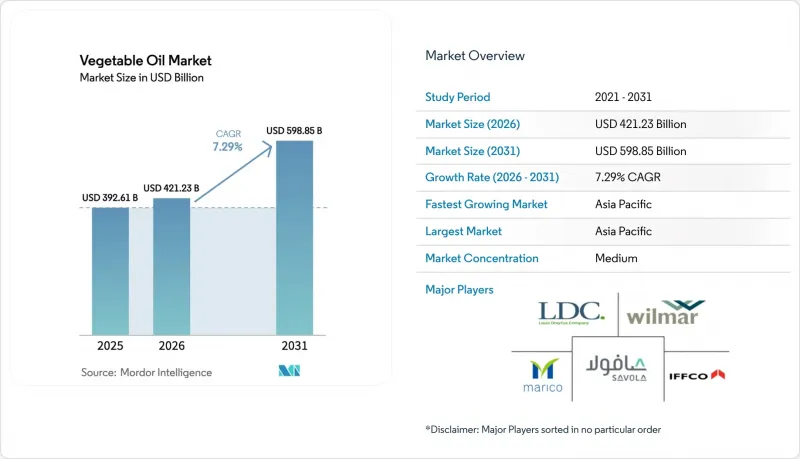
This report is Segmented by Type (Palm Oil, Soybean Oil, and More), Nature (Conventional and Organic), Packaging (Bottle, Pouches, and More), Distribution Channel (HoReCa/Foodservice and Retail), and Geography (North America, Europe, Asia-Pacific, South America, and Middle East and Africa). The Market Forecasts are Provided in Terms of Value (USD) and Volume (Tons).
Global Vegetable Oil Market Trends and Insights
Health-driven replacement of animal fats
Rising health awareness remains a key factor driving the global vegetable oil market, significantly influencing consumer preferences for olive and sunflower oils over traditional fats and highly saturated oils. Increasing awareness of the connection between dietary fats, cardiovascular health, cholesterol management, and overall wellness has accelerated the shift toward oils recognized for their heart-health benefits and superior nutritional profiles. Olive oil, particularly extra virgin varieties, is highly regarded for its strong association with the Mediterranean diet, its abundant monounsaturated fat content, and natural antioxidants that support overall health and longevity. Similarly, sunflower oil is extensively favored for its low saturated fat levels, high vitamin E content, and mild flavor, making it a versatile and practical choice for everyday cooking. This health-driven transformation is not only reshaping household consumption patterns but also compelling food manufacturers to reformulate products, aligning with increasing consumer demands for healthier alternatives, clean-label transparency, and reduced saturated fat content.
Rising shift toward plant-based diets
The growing shift toward plant-based diets is a significant driver of the global vegetable oil market, as consumers increasingly replace animal-derived fats with plant-based alternatives in cooking and processed foods. The rising adoption of vegetarian, vegan, and flexitarian eating habits has positioned vegetable oils as key dietary fat sources, essential for preparing plant-based meals, meat substitutes, dairy alternatives, and ready-to-eat products. Plant-based diets emphasize cholesterol-free, sustainable, and ethically sourced ingredients, aligning vegetable oils with consumer preferences for health, environmental sustainability, and clean-label formulations. This dietary trend is becoming mainstream, supporting sustained demand growth. For example, according to the Good Food Institute, 59% of United States households purchased plant-based foods in 2024, illustrating the rapid normalization of plant-based consumption. This expanding consumer base is driving increased use of vegetable oils in plant-based meat alternatives, dairy-free spreads, vegan bakery products, and ready meals, where oils serve as essential functional components.
Volatility in raw material supply
Volatility in raw material supply serves as a significant restraint on the global vegetable oil market. Production is highly reliant on agricultural outputs, which are subject to climatic variability, extreme weather events, pest infestations, crop diseases, and seasonal yield fluctuations. Oilseed crops, in particular, are highly sensitive to factors such as rainfall patterns, temperature stress, and soil conditions, resulting in unpredictable supply levels across different growing regions. This unpredictability disrupts production planning for processors and refiners, causing inconsistent input availability, fluctuating utilization rates, and difficulties in maintaining stable supply contracts with food manufacturers and foodservice operators. Additionally, the uncertainty in raw material supply impacts pricing stability, leading to increased costs for manufacturers and consumers. For markets heavily dependent on imports, supply uncertainty is further exacerbated by crop failures, production shortfalls, export restrictions, and geopolitical tensions in major producing countries, further complicating the global supply chain.
Other drivers and restraints analyzed in the detailed report include:
- Urbanization drives higher edible oil demand
- Rising awareness of sustainability and traceability
- Competition from alternative fats and oils
For complete list of drivers and restraints, kindly check the Table Of Contents.
Segment Analysis
In 2025, palm oil accounted for 28.63% of the vegetable oil market, maintaining its leading position due to its functional versatility, supply efficiency, and wide range of applications. Its high yield per hectare establishes it as the most efficient oilseed crop, ensuring consistent large-scale availability. Palm oil's semi-solid nature at room temperature, natural oxidative stability, and high smoke point make it particularly suitable for frying, bakery shortenings, confectionery coatings, and margarine formulations. These properties reduce the need for hydrogenation, aligning with the requirements for reducing trans fats. In the food industry, palm oil's neutral taste, extended shelf life, and cost-effective functionality enable manufacturers to maintain product consistency across various geographies and climates, further driving its adoption in packaged and processed foods.
Sunflower oil is projected to grow at the fastest CAGR of 7.31% through 2031, emerging as a significant growth driver in the global vegetable oil market. This growth is primarily attributed to its strong health positioning, versatility across applications, and increasing global acceptance. Sunflower oil is widely regarded as heart-friendly due to its low saturated fat content and high levels of vitamin E and polyunsaturated fats, making it a preferred choice for everyday cooking, food manufacturing, and health-focused formulations. Its nutritional profile aligns with the rising consumer demand for lighter, cleaner-label, and cholesterol-conscious edible oils, supporting its growing adoption in both household and commercial foodservice sectors. The segment's robust growth is further reinforced by increasing global consumption volumes. According to the US Department of Agriculture, global sunflower seed oil consumption reached 20.27 million metric tons in the 2024/25 crop year, underscoring its growing significance in the global vegetable oil market.
Conventional oils accounted for 93.56% of the vegetable oil market in 2025 and continue to dominate the market due to their widespread availability, scalability, and integration across food and non-food industries. These oils benefit from established large-scale farming systems, mature processing infrastructure, and efficient refining technologies, ensuring a consistent supply and uniform quality at the volumes required by mass-market food manufacturers and foodservice operators. Their extensive use in processed foods, frying applications, and institutional cooking reinforces their dominance, as these applications prioritize performance characteristics such as heat stability, shelf-life extension, and formulation consistency, areas where conventional oils are highly optimized. Additionally, the cost-effectiveness of conventional oils compared to alternatives further strengthens their position, making them a preferred choice for large-scale operations and budget-conscious manufacturers.
Organic vegetable oils, projected to grow at a robust CAGR of 9.12% through 2031, are emerging as the fastest-growing segment in the global vegetable oil market. This growth is driven by increasing consumer preference for clean-label, chemical-free, and sustainably produced edible oils. Organic oils are gaining popularity due to concerns about pesticide residues, synthetic fertilizers, and intensive refining practices associated with conventional oils. This trend is particularly pronounced among health-conscious consumers, premium food manufacturers, and specialty foodservice operators seeking traceable, minimally processed, and non-GMO oil solutions. For example, according to the Agricultural and Processed Food Products Export Development Authority, India produced approximately 3.6 million metric tons of certified organic products in 2024, spanning various food categories, including oilseeds used for organic vegetable oil production . The growing availability of certified organic raw materials is enhancing supply consistency and encouraging greater participation from oil processors and exporters.
Complete Report Scope:
- By Type
- Palm Oil
- Soybean Oil
- Rapeseed Oil
- Sunflower Oil
- Peanut Oil
- Coconut Oil
- Olive Oil
- Other Types
- By Nature
- Conventional
- Organic
- By Packaging
- Bottle
- Pouches
- Jar
- Can
- Others
- By Distribution Channel
- HoReCa/Foodservice
- Retail
- Supermarkets/Hypermarkets
- Convenience Stores/Grocery Stores
- Online Retail Stores
- Other Distribution Channels
- By Geography
- North America
- United States
- Canada
- Mexico
- Rest of North America
- Europe
- Germany
- United Kingdom
- Italy
- France
- Spain
- Netherlands
- Poland
- Belgium
- Sweden
- Rest of Europe
- Asia-Pacific
- China
- India
- Japan
- Australia
- Indonesia
- South Korea
- Thailand
- Singapore
- Rest of Asia-Pacific
- South America
- Brazil
- Argentina
- Colombia
- Chile
- Peru
- Rest of South America
- Middle East and Africa
- South Africa
- Saudi Arabia
- United Arab Emirates
- Nigeria
- Egypt
- Morocco
- Turkey
- Rest of Middle East and Africa
- North America
Geography Analysis
Asia-Pacific accounted for 48.76% of the vegetable oil market share in 2025 and is projected to grow at a CAGR of 8.98% through 2031, making it the largest and fastest-growing regional market. This growth is driven by strong household consumption, extensive food processing activities, and increasing foodservice demand in emerging economies. India's efforts toward oilseed self-sufficiency, focusing on boosting domestic production, improving yields, and reducing import dependence, are contributing to this trend. Indonesia plays a dual role as the largest global producer of palm oil and a significant domestic consumer. According to Statistics Indonesia, the country's oil palm production was estimated at 47.47 million metric tons in 2024, highlighting its importance in global supply dynamics. In contrast, mature markets such as Japan, South Korea, and Australia exhibit stable per-capita consumption, with demand influenced by product quality, health-focused positioning, and specialty oils rather than volume growth.
Europe remains a key consumption hub, with Germany, France, Spain, and Italy as the largest markets, supported by strong culinary traditions and a robust packaged food industry. However, the region's vegetable oil market is increasingly influenced by sustainability and regulatory factors, particularly the European Union's Deforestation Regulation. This regulation is shaping sourcing strategies, traceability requirements, and supplier selection, driving a shift toward certified, deforestation-free, and sustainably sourced oils. These changes are impacting palm oil imports while boosting demand for alternative oils such as sunflower, rapeseed, and olive oil.
North America, led by the United States, Canada, and Mexico, demonstrates steady demand for vegetable oils, driven by processed foods, foodservice recovery, and industrial applications. There is also a growing focus on high-oleic and functionally stable oils. South America, particularly Brazil and Argentina, serves as both a major producer and consumer, with soybean oil anchoring regional supply and export flows. Meanwhile, the Middle East and Africa are experiencing rising vegetable oil consumption due to urbanization, expanding foodservice infrastructure, and increased reliance on imported edible oils to meet growing demand.
- The Savola Group
- Bunge Limited
- Marico Limited
- Louis Dreyfus Company B.V.
- Wilmar International Ltd.
- IFFCO Group
- Sime Darby Plantation Berhad
- Fuji Oil Holdings Inc.
- Patanjali Ayurveda Limited
- PT Astra Agro Lestari Tbk
- The Nisshin Oillio Group, Ltd.
- Pompeian
- KTC
- Ottogi Co., Ltd.
- Bhushan Oils & Fats Pvt. Ltd.
- Agro Tech Foods Limited
- Avril Group
- Golden Agri-Resources
- Kuala Lumpur Kepong Berhad
- PT Indofood Sukses Makmur Tbk
Additional Benefits:
- The market estimate (ME) sheet in Excel format
- 3 months of analyst support
TABLE OF CONTENTS
1 INTRODUCTION
- 1.1 Study Assumptions and Market Definition
- 1.2 Scope of the Study
2 RESEARCH METHODOLOGY
3 EXECUTIVE SUMMARY
4 MARKET LANDSCAPE
- 4.1 Market Overview
- 4.2 Market Drivers
- 4.2.1 Health awareness drives preference for olive and sunflower oils.
- 4.2.2 Rising shift toward plant-based diets
- 4.2.3 Urbanization drives higher edible oil demand
- 4.2.4 Rising awareness of sustainability and traceability
- 4.2.5 Innovation in oil processing and refining technologies
- 4.2.6 Growth in food processing and fast-food industries drives oil consumption
- 4.3 Market Restraints
- 4.3.1 Volatility in raw material supply
- 4.3.2 Competition from alternative fats and oils
- 4.3.3 Allergen and sensitivity issues
- 4.3.4 Regulatory restrictions on certain oil types
- 4.4 Supply Chain Analysis
- 4.5 Regulatory Landscape
- 4.6 Technological Outlook
- 4.7 Porter's Five Forces Analysis
- 4.7.1 Threat of New Entrants
- 4.7.2 Bargaining Power of Buyers
- 4.7.3 Bargaining Power of Suppliers
- 4.7.4 Threat of Substitutes
- 4.7.5 Intensity of Competitive Rivalry
5 MARKET SIZE AND GROWTH FORECASTS (VALUE AND VOLUME)
- 5.1 By Type
- 5.1.1 Palm Oil
- 5.1.2 Soybean Oil
- 5.1.3 Rapeseed Oil
- 5.1.4 Sunflower Oil
- 5.1.5 Peanut Oil
- 5.1.6 Coconut Oil
- 5.1.7 Olive Oil
- 5.1.8 Other Types
- 5.2 By Nature
- 5.2.1 Conventional
- 5.2.2 Organic
- 5.3 By Packaging
- 5.3.1 Bottle
- 5.3.2 Pouches
- 5.3.3 Jar
- 5.3.4 Can
- 5.3.5 Others
- 5.4 By Distribution Channel
- 5.4.1 HoReCa/Foodservice
- 5.4.2 Retail
- 5.4.2.1 Supermarkets/Hypermarkets
- 5.4.2.2 Convenience Stores/Grocery Stores
- 5.4.2.3 Online Retail Stores
- 5.4.2.4 Other Distribution Channels
- 5.5 By Geography
- 5.5.1 North America
- 5.5.1.1 United States
- 5.5.1.2 Canada
- 5.5.1.3 Mexico
- 5.5.1.4 Rest of North America
- 5.5.2 Europe
- 5.5.2.1 Germany
- 5.5.2.2 United Kingdom
- 5.5.2.3 Italy
- 5.5.2.4 France
- 5.5.2.5 Spain
- 5.5.2.6 Netherlands
- 5.5.2.7 Poland
- 5.5.2.8 Belgium
- 5.5.2.9 Sweden
- 5.5.2.10 Rest of Europe
- 5.5.3 Asia-Pacific
- 5.5.3.1 China
- 5.5.3.2 India
- 5.5.3.3 Japan
- 5.5.3.4 Australia
- 5.5.3.5 Indonesia
- 5.5.3.6 South Korea
- 5.5.3.7 Thailand
- 5.5.3.8 Singapore
- 5.5.3.9 Rest of Asia-Pacific
- 5.5.4 South America
- 5.5.4.1 Brazil
- 5.5.4.2 Argentina
- 5.5.4.3 Colombia
- 5.5.4.4 Chile
- 5.5.4.5 Peru
- 5.5.4.6 Rest of South America
- 5.5.5 Middle East and Africa
- 5.5.5.1 South Africa
- 5.5.5.2 Saudi Arabia
- 5.5.5.3 United Arab Emirates
- 5.5.5.4 Nigeria
- 5.5.5.5 Egypt
- 5.5.5.6 Morocco
- 5.5.5.7 Turkey
- 5.5.5.8 Rest of Middle East and Africa
- 5.5.1 North America
6 COMPETITIVE LANDSCAPE
- 6.1 Market Concentration
- 6.2 Strategic Moves
- 6.3 Market Positioning Analysis
- 6.4 Company Profiles (includes Global level Overview, Market level overview, Core Segments, Financials as available, Strategic Information, Market Rank/Share for key companies, Products and Services, and Recent Developments)
- 6.4.1 The Savola Group
- 6.4.2 Bunge Limited
- 6.4.3 Marico Limited
- 6.4.4 Louis Dreyfus Company B.V.
- 6.4.5 Wilmar International Ltd.
- 6.4.6 IFFCO Group
- 6.4.7 Sime Darby Plantation Berhad
- 6.4.8 Fuji Oil Holdings Inc.
- 6.4.9 Patanjali Ayurveda Limited
- 6.4.10 PT Astra Agro Lestari Tbk
- 6.4.11 The Nisshin Oillio Group, Ltd.
- 6.4.12 Pompeian
- 6.4.13 KTC
- 6.4.14 Ottogi Co., Ltd.
- 6.4.15 Bhushan Oils & Fats Pvt. Ltd.
- 6.4.16 Agro Tech Foods Limited
- 6.4.17 Avril Group
- 6.4.18 Golden Agri-Resources
- 6.4.19 Kuala Lumpur Kepong Berhad
- 6.4.20 PT Indofood Sukses Makmur Tbk
7 MARKET OPPORTUNITIES AND FUTURE OUTLOOK

