PUBLISHER: Mordor Intelligence | PRODUCT CODE: 2115814

PUBLISHER: Mordor Intelligence | PRODUCT CODE: 2115814
Asia-Pacific Pharmaceutical Logistics - Market Share Analysis, Industry Trends & Statistics, Growth Forecasts (2026 - 2031)
According to Mordor Intelligence, the Asia-Pacific pharmaceutical logistics market size was valued at USD 163 billion in 2025 and estimated to grow from USD 173.76 billion in 2026 to reach USD 238.99 billion by 2031, at a CAGR of 6.60% during the forecast period (2026-2031).
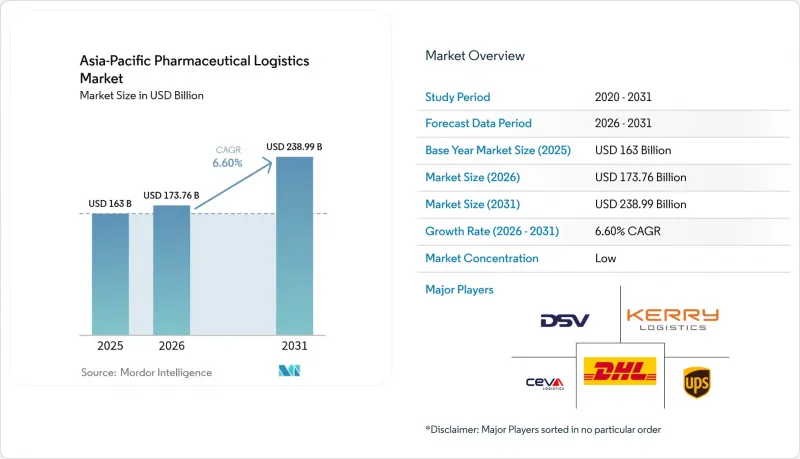
This report is Segmented by Service Type (Transportation, Warehousing & Storage, Value-Added Services and Others), Mode of Operation (Cold-Chain Logistics, Non-Cold-Chain Logistics), Product Type (Prescription Drugs, OTC Drugs, Clinical Trial Materials, and More), and Geography (China, India, Japan, South Korea, and More). The Market Forecasts are Provided in Terms of Value (USD).
Asia-Pacific Pharmaceutical Logistics Market Trends and Insights
Rising biologics and vaccine volumes
Demand for biologics reshapes infrastructure requirements across the Asia Pacific pharmaceutical logistics market as manufacturers commission modular plants capable of switching among multiple vaccine programs. Sanofi's USD 595 million Modulus facility in Singapore illustrates the region's capacity build-up and the consequent need for end-to-end cryogenic logistics capable of maintaining critical quality attributes.Samsung Biologics added 180,000 L of capacity at its fifth plant in 2025, while BioNTech chose Singapore for a regional mRNA hub, both exerting upward pressure on specialized storage and real-time monitoring networks. Such investments raise the baseline for temperature assurance, documentation, and security in the Asia Pacific pharmaceutical logistics market.
Expansion of regional pharma manufacturing hubs
Continued consolidation in China and India spreads manufacturing volumes across purpose-built industrial zones, prompting a redesign of distribution corridors. China's centralized procurement now covers 500 medicines, pushing logistics providers to handle larger shipment lots at lower per-unit prices while ensuring service levels. India, targeting USD 350 billion in pharmaceutical exports by 2047, increases finished-dose and API throughput that must move efficiently to ports and airports. New biologics plants in South Korea and specialized peptide facilities underline the breadth of manufacturing activity. These developments heighten demand for harmonized quality processes, customs facilitation, and multimodal connectivity in the Asia Pacific pharmaceutical logistics market.
High cold-chain infrastructure cost
Specialized storage rooms, validated reefers, and multi-temperature warehouses require significant capital, challenging smaller operators. Although AI-based forecasting lowers capacity wastage, the absolute upfront spend remains high, slowing network roll-out in emerging markets. Rural pilots that tested freeze-preventive boxes underscored performance benefits yet revealed payload weight penalties that limited wide uptake. Higher adoption of reusable thermal packaging addresses waste but necessitates investment in cleaning and reverse logistics circuits.
Other drivers and restraints analyzed in the detailed report include:
- Growth of e-commerce pharma distribution
- National essential-drug hub reforms (China, India)
- Complex multi-country regulatory compliance
For complete list of drivers and restraints, kindly check the Table Of Contents.
Segment Analysis
Transportation services represented 62.45% of the Asia Pacific pharmaceutical logistics market revenue in 2025, underscoring the region's heavy reliance on multimodal distribution networks that link dense manufacturing clusters with hospitals, pharmacies, and export gateways. Road freight captured the bulk of domestic flows thanks to flexible scheduling and last-mile reach, while air networks handled time-critical biologics under active temperature control. Sea freight volumes grew as manufacturers shifted slower-moving products to lower-carbon lanes, and rail connections provided an alternate corridor along the China-Europe axis. Digital control towers integrating GPS, IoT, and blockchain tools now orchestrate modal transfers, enhancing visibility and regulatory compliance across the Asia Pacific pharmaceutical logistics market.
Value-added services expanded to a 4.55% CAGR and included inventory optimization, regulatory documentation, and quality assurance. Pharmaceutical shippers require GDP-certified warehousing that offers controlled ambient, refrigerated, and frozen zones within single facilities, as well as secondary packaging and labeling services. Real-time temperature dashboards, automated picking systems, and predictive replenishment algorithms elevate service expectations. As a result, logistics providers increasingly pursue end-to-end contracts that bundle transport, storage, and compliance, moving the Asia Pacific pharmaceutical logistics market toward integrated supply-chain orchestration.
Complete Report Scope:
- By Service Type
- Transportation
- Road Freight
- Air Freight
- Sea Freight
- Rail Freight
- Warehousing & Storage
- Value-added Services and Others
- Transportation
- By Mode of Operation
- Cold-Chain Logistics
- Non-Cold-Chain Logistics
- By Product Type
- Prescription Drugs
- OTC Drugs
- Biologics & Biosimilars
- Vaccines & Blood Products
- Clinical Trail Materials
- Cell & Gene Therapies
- Medical Devices & Diagnostics
- Veterinary Medicine
- Others
- By Country
- China
- India
- Japan
- South Korea
- Singapore
- Australia
- Indonesia
- Thailand
- Vietnam
- Rest of Asia Pacific
List of Companies Covered in this Report:
- DHL
- Kuehne + Nagel
- DSV
- UPS
- CEVA Logistics
- Kerry Logistics
- Sinotrans
- Yusen Logistics
- Nippon Express
- Toll Group
- SF Express
- Linfox
- Geodis
- Biocair
- NAF Pharma
- SEKO Logistics
- AIT Worldwide Logistics
- Clinigen Group PLC
- Nichirei Logistics Group Inc
- LX Pantos
Additional Benefits:
- The market estimate (ME) sheet in Excel format
- 3 months of analyst support
TABLE OF CONTENTS
1 Introduction
- 1.1 Study Assumptions & Market Definition
- 1.2 Scope of the Study
2 Research Methodology
3 Executive Summary
4 Market Landscape
- 4.1 Market Overview
- 4.2 Market Drivers
- 4.2.1 Rising biologics & vaccine volumes
- 4.2.2 Expansion of regional pharma manufacturing hubs
- 4.2.3 Growth of e-commerce pharma distribution
- 4.2.4 National Essential-Drugs hub reforms (China, India)
- 4.2.5 ASEAN GDP enforcement accelerating cold-chain upgrades
- 4.2.6 AI-enabled route-optimization lowering spoilage rates
- 4.3 Market Restraints
- 4.3.1 High cold-chain infrastructure cost
- 4.3.2 Complex multi-country regulatory compliance
- 4.3.3 Scarcity of biologics-trained staff in Tier-2 cities
- 4.3.4 Carbon-emissions scrutiny on air freight corridors
- 4.4 Value / Supply-Chain Analysis
- 4.5 Regulatory Landscape
- 4.6 Technological Outlook
- 4.7 Porter's Five Forces
- 4.7.1 Bargaining Power of Suppliers
- 4.7.2 Bargaining Power of Buyers
- 4.7.3 Threat of New Entrants
- 4.7.4 Threat of Substitutes
- 4.7.5 Intensity of Competitive Rivalry
- 4.8 Impact of COVID-19 and Geo-Political Events
5 Market Size & Growth Forecasts (Value)
- 5.1 By Service Type
- 5.1.1 Transportation
- 5.1.1.1 Road Freight
- 5.1.1.2 Air Freight
- 5.1.1.3 Sea Freight
- 5.1.1.4 Rail Freight
- 5.1.2 Warehousing & Storage
- 5.1.3 Value-added Services and Others
- 5.1.1 Transportation
- 5.2 By Mode of Operation
- 5.2.1 Cold-Chain Logistics
- 5.2.2 Non-Cold-Chain Logistics
- 5.3 By Product Type
- 5.3.1 Prescription Drugs
- 5.3.2 OTC Drugs
- 5.3.3 Biologics & Biosimilars
- 5.3.4 Vaccines & Blood Products
- 5.3.5 Clinical Trail Materials
- 5.3.6 Cell & Gene Therapies
- 5.3.7 Medical Devices & Diagnostics
- 5.3.8 Veterinary Medicine
- 5.3.9 Others
- 5.4 By Country
- 5.4.1 China
- 5.4.2 India
- 5.4.3 Japan
- 5.4.4 South Korea
- 5.4.5 Singapore
- 5.4.6 Australia
- 5.4.7 Indonesia
- 5.4.8 Thailand
- 5.4.9 Vietnam
- 5.4.10 Rest of Asia Pacific
6 Competitive Landscape
- 6.1 Market Concentration
- 6.2 Strategic Moves
- 6.3 Market Share Analysis
- 6.4 Company Profiles {(includes Global level Overview, Market level overview, Core Segments, Financials as available, Strategic Information, Market Rank/Share, Products & Services, Recent Developments)}
- 6.4.1 DHL
- 6.4.2 Kuehne + Nagel
- 6.4.3 DSV
- 6.4.4 UPS
- 6.4.5 CEVA Logistics
- 6.4.6 Kerry Logistics
- 6.4.7 Sinotrans
- 6.4.8 Yusen Logistics
- 6.4.9 Nippon Express
- 6.4.10 Toll Group
- 6.4.11 SF Express
- 6.4.12 Linfox
- 6.4.13 Geodis
- 6.4.14 Biocair
- 6.4.15 NAF Pharma
- 6.4.16 SEKO Logistics
- 6.4.17 AIT Worldwide Logistics
- 6.4.18 Clinigen Group PLC
- 6.4.19 Nichirei Logistics Group Inc
- 6.4.20 LX Pantos
7 Market Opportunities & Future Outlook
- 7.1 White-Space & Unmet-Need Assessment

