PUBLISHER: Mordor Intelligence | PRODUCT CODE: 2116116

PUBLISHER: Mordor Intelligence | PRODUCT CODE: 2116116
Bio-Pharma Logistics - Market Share Analysis, Industry Trends & Statistics, Growth Forecasts (2026 - 2031)
According to Mordor Intelligence, the bio-Pharma logistics market size was valued at USD 139.41 billion in 2025 and estimated to grow from USD 152.04 billion in 2026 to reach USD 234.58 billion by 2031, at a CAGR of 9.06% during the forecast period (2026-2031).
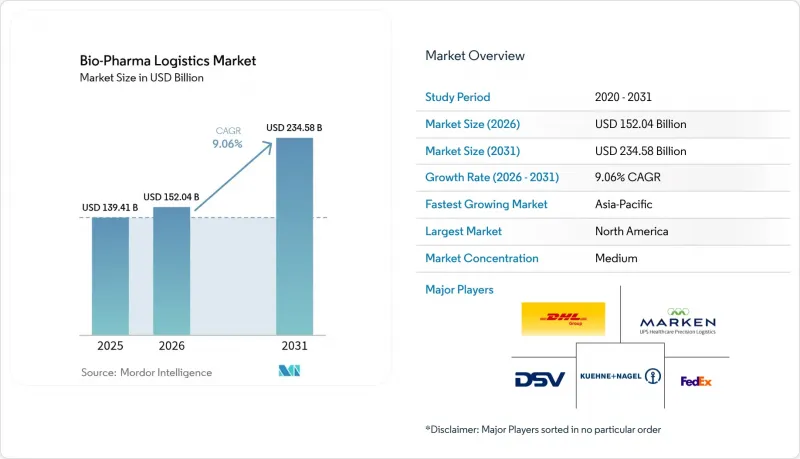
This report is Segmented by Service (Transportation, Warehousing, and Distribution, and More), by Temperature Range (Cold Chain, and Non-Cold Chain), by Product Type (Vaccines & Immunotherapies, Cell & Gene Therapies, and More), and Geography (North America, Europe, Asia-Pacific, South America, and Middle-East and Africa). The Market Forecasts are Provided in Terms of Value (USD).
Global Bio-Pharma Logistics Market Trends and Insights
Surge in High-Value Biologicals & Specialty Pharma Elevating Cold-Chain Demand
Cold-chain failures cost the sector USD 35 billion annually, underscoring the financial imperative for resilient temperature management. Logistics providers deploy AI-driven predictive analytics to foresee excursion risks, while security upgrades counter rising counterfeit threats. Frontier Scientific Solutions invested USD 1.5 billion in Foreign Trade Zone infrastructure around Wilmington and Shannon airports to cut transit times and safeguard high-value biologics .
Advanced Therapies Growth (mRNA, Cell & Gene) Necessitating Ultra-Low-Temperature Logistics
mRNA and viral-vector products require storage as low as -150 °C. Cryoport and SK Pharmteco launched an integrated platform spanning manufacturing and distribution tailored to such therapies. Research into thermostable lipids that preserve mRNA at standard refrigeration may ease dependence on deep-freeze networks, yet current pipelines still rely heavily on cryogenic infrastructure. DHL's acquisition of CRYOPDP, handling more than 600,000 ultra-cold consignments annually, illustrates consolidation around specialized capacity.
Capacity Constraints in Temperature-Controlled Airfreight & LN2/Dry-Ice Supply Driving Cost Volatility
Dry-ice shortages during the COVID-19 vaccine rollout revealed a fragile supply base. Air separation units wrestle with high energy prices, while airfreight belly-hold capacity competes with e-commerce. Vienna Airport's Pharma Handling Center doubled cold-chain space, yet forward bookings still exceed slot availability, causing rate spikes and forcing mode shifts.
Other drivers and restraints analyzed in the detailed report include:
- Globalization & Decentralization of Clinical Trials Accelerating Direct-to-Patient Shipments
- Stringent Worldwide GDP/GxP Compliance Mandating Outsourcing to Certified 3PLs
- Divergent Global Regulatory & Customs Requirements Causing Delays and Excursion Risk
For complete list of drivers and restraints, kindly check the Table Of Contents.
Segment Analysis
Transportation accounted for 70.12% of bio pharma logistics market revenue in 2025, anchored by road networks for last-mile and air corridors for time-critical biologics. Nonetheless, value-added services are forecast to grow 10.77% annually to 2031 as clients demand labeling, kitting, and qualified-person release alongside core transport. Providers leverage AI in warehouses to anticipate capacity peaks and prevent temperature deviations. Catalent's FastChain platform illustrates the shift toward demand-led fulfilment, pairing real-time inventory with regional depots. The bio pharma logistics market size for value-added services is projected to widen steadily, reflecting regulatory complexity and patient-centric packaging needs. Transportation will retain scale but face pricing pressure as supply tightens in temperature-controlled trucking and airfreight.
Within transport, road logistics remains dominant for sub-zero deliveries across continental networks, while air plays a critical role in ultra-cold gene-therapy consignments despite ongoing capacity constraints. Sea freight gains modest share as sustainability targets drive modal shifts for stable biologics. Warehousing growth tracks with clients' off-site storage preferences, particularly in Europe where new GMP-compliant cold rooms unlock cross-border distribution.
Cold chain services captured 68.40% of the bio pharma logistics market in 2025 and will expand fastest at 10.49% CAGR. Refrigerated (2-8 °C) lanes underpin vaccines and insulin flows, yet ultra-cold (-20 °C to -150 °C) emerges as the star sub-segment for mRNA and cell & gene therapies. The bio pharma logistics market size tied to ultra-cold shipments is forecast to nearly double by 2031. Providers invest in vacuum-insulated panels, phase-change materials, and nitrogen-based dry shippers with IoT beacons for live temperature feeds.
Ambient (15-25 °C) networks continue to serve traditional oral solids but grow slower as formularies tilt toward biologics. Frozen (0 °C to -20 °C) remains niche for specific APIs and long-term stockpiles. Sustainability imperatives accelerate a pivot to reusable shippers and electrified reefers, creating hybrid models pairing green power with dense thermal mass. Blockchain pilots track chain-of-custody events to assure compliance.
Complete Report Scope:
- By Service
- Transportation
- Road
- Rail
- Sea/Ocean
- Air
- Warehousing & Distribution
- Value-Added Services (Labelling, Kitting, QP Release)
- Transportation
- By Temperature Range
- Cold Chain
- Ambient (15-25 °C)
- Refrigerated (2-8 °C)
- Frozen (0 °C to -20 °C)
- Ultra-Cold / Cryogenic (-20 °C to -150 °C)
- Non Cold Chain
- Cold Chain
- By Product Type
- Vaccines & Immunotherapies
- Cell & Gene Therapies
- APIs & Bulk Biologics
- Finished Dose Biologics
- Others
- By End-user
- Bio-Pharma Manufacturers
- CROs (Contract Research Organizations) & CMOs (Contract Manufacturing Organizations)
- Hospitals & Clinical-Trial Sites
- Other End Users
- By Geography
- North America
- United States
- Canada
- Mexico
- South America
- Brazil
- Peru
- Chile
- Argentina
- Rest of South America
- Asia-Pacific
- India
- China
- Japan
- Australia
- South Korea
- South East Asia (Singapore, Malaysia, Thailand, Indonesia, Vietnam, and Philippines)
- Rest of Asia-Pacific
- Europe
- United Kingdom
- Germany
- France
- Spain
- Italy
- BENELUX (Belgium, Netherlands, and Luxembourg)
- NORDICS (Denmark, Finland, Iceland, Norway, and Sweden)
- Rest of Europe
- Middle East And Africa
- United Arab Emirates
- Saudi Arabia
- South Africa
- Nigeria
- Rest of Middle East And Africa
- North America
Geography Analysis
North America retained 41.20% share of the bio pharma logistics market in 2025 on the back of entrenched pharmaceutical manufacturing, dense GDP-certified networks, and the early adoption of IoT-enabled monitoring. Major capex programs, such as UPS's USD 1.6 billion acquisition of Andlauer Healthcare Group, deepen regional infrastructure and reinforce standards leadership.
Asia-Pacific is projected to grow at 11.06% CAGR and will account for the majority of the incremental market value through 2031. Chinese innovators are relocating vector production to Singapore and Thailand to diversify risk, while India expands injectables output under revised GMP rules. Singapore's new multi-tenant pharma hub embodies the region's push for high-grade cold storage and cross-border rapid clearance. As a result, the bio-pharma logistics market size related to intra-Asia trade lanes is set to accelerate.
Europe remains a powerhouse, leveraging tight regulatory compliance and extensive road-rail cold corridors. DHL's 30,000 m2 climate-neutral expansion near Frankfurt supports sub-zero warehousing down to -70 °C, reinforcing the continent's capability to manage cell & gene therapy pipelines. Ongoing consolidation raises service quality, though capacity constraints persist at key cargo gateways like Schiphol and Brussels.
South America and the Middle East & Africa exhibit emerging opportunity profiles. Government vaccine campaigns and growing chronic-disease treatment uptake catalyze the need for certified cold rooms and road-to-air interfaces. However, patchy power grids and limited GDP oversight pose service-quality challenges, slowing the pace of infrastructure upgrades.
- Deutsche Post DHL Group (DHL Global Forwarding, DHL Life Sciences & Healthcare)
- UPS Healthcare / Marken
- Kuehne + Nagel PharmaChain
- FedEx Healthcare Solutions
- Nippon Express (NX Pharma)
- DSV Panthera Life Sciences
- CEVA Logistics FORPATIENTS
- SF Express Cold-Chain
- Kerry Logistics Pharma & Healthcare
- Americold Logistics
- Lineage Logistics
- Cryoport Systems
- Yusen Logistics Healthcare
- GEODIS PharmaHealthcare
- Biocair
- Maersk Pharma Ocean & Air Services
- World Courier
- Aramex Healthcare
- Hellmann Worldwide Logistics - Healthcare
- Rhenus Logistics Pharma
- LATAM Cargo Pharma
- AIT Worldwide Logistics - Life Sciences
Additional Benefits:
- The market estimate (ME) sheet in Excel format
- 3 months of analyst support
TABLE OF CONTENTS
1 Introduction
- 1.1 Study Assumptions & Market Definition
- 1.2 Scope of the Study
2 Research Methodology
3 Executive Summary
4 Market Landscape
- 4.1 Market Overview
- 4.2 Market Drivers
- 4.2.1 Surge in High-Value Biologicals & Specialty Pharma Share Elevating Cold-Chain Demand
- 4.2.2 Advanced Therapies Growth (mRNA, Cell & Gene) Necessitating Ultra-Low-Temperature Logistics
- 4.2.3 Globalization & Decentralization of Clinical Trials Accelerating Direct-to-Patient Shipments
- 4.2.4 Stringent Worldwide GDP/GxP Compliance Mandating Outsourcing to Certified 3PLs
- 4.2.5 E-commerce & D2C Distribution of Specialty Medicines Boosting Last-Mile Temperature-Controlled Delivery
- 4.2.6 Emerging-Market Biologics Manufacturing Expansion Increasing Cross-Border Cold-Chain Flows
- 4.3 Market Restraints
- 4.3.1 Capacity Constraints in Temperature-Controlled Airfreight & LN?/Dry-Ice Supply Driving Cost Volatility
- 4.3.2 Divergent Global Regulatory & Customs Requirements Causing Delays and Excursion Risk
- 4.3.3 High Carbon Footprint of Cold-Chain Operations Prompting Costly Sustainability Investments
- 4.3.4 Scarcity of Skilled Workforce & GDP-Certified Infrastructure in Emerging Regions Limiting Reliability
- 4.4 Value / Supply-Chain Analysis
- 4.5 Technological Innovations in the Industry
- 4.6 Government Regulations and Policies
- 4.7 Porter's Five Forces
- 4.7.1 Bargaining Power of Suppliers
- 4.7.2 Bargaining Power of Buyers
- 4.7.3 Threat of New Entrants
- 4.7.4 Threat of Substitutes
- 4.7.5 Competitive Rivalry
- 4.8 Spotlight on the Bio-Pharmaceutical Industry
- 4.9 Logistics & Distribution Cost Analysis
- 4.10 Refrigerated Warehouse Infrastructure Insights
- 4.11 Cold-Chain Packaging Market Brief
- 4.12 Impact of Geopolitical Events on the Market
5 Market Size & Growth Forecasts (Value & Volume)
- 5.1 By Service
- 5.1.1 Transportation
- 5.1.1.1 Road
- 5.1.1.2 Rail
- 5.1.1.3 Sea/Ocean
- 5.1.1.4 Air
- 5.1.2 Warehousing & Distribution
- 5.1.3 Value-Added Services (Labelling, Kitting, QP Release)
- 5.1.1 Transportation
- 5.2 By Temperature Range
- 5.2.1 Cold Chain
- 5.2.1.1 Ambient (15-25 °C)
- 5.2.1.2 Refrigerated (2-8 °C)
- 5.2.1.3 Frozen (0 °C to -20 °C)
- 5.2.1.4 Ultra-Cold / Cryogenic (-20 °C to -150 °C)
- 5.2.2 Non Cold Chain
- 5.2.1 Cold Chain
- 5.3 By Product Type
- 5.3.1 Vaccines & Immunotherapies
- 5.3.2 Cell & Gene Therapies
- 5.3.3 APIs & Bulk Biologics
- 5.3.4 Finished Dose Biologics
- 5.3.5 Others
- 5.4 By End-user
- 5.4.1 Bio-Pharma Manufacturers
- 5.4.2 CROs (Contract Research Organizations) & CMOs (Contract Manufacturing Organizations)
- 5.4.3 Hospitals & Clinical-Trial Sites
- 5.4.4 Other End Users
- 5.5 By Geography
- 5.5.1 North America
- 5.5.1.1 United States
- 5.5.1.2 Canada
- 5.5.1.3 Mexico
- 5.5.2 South America
- 5.5.2.1 Brazil
- 5.5.2.2 Peru
- 5.5.2.3 Chile
- 5.5.2.4 Argentina
- 5.5.2.5 Rest of South America
- 5.5.3 Asia-Pacific
- 5.5.3.1 India
- 5.5.3.2 China
- 5.5.3.3 Japan
- 5.5.3.4 Australia
- 5.5.3.5 South Korea
- 5.5.3.6 South East Asia (Singapore, Malaysia, Thailand, Indonesia, Vietnam, and Philippines)
- 5.5.3.7 Rest of Asia-Pacific
- 5.5.4 Europe
- 5.5.4.1 United Kingdom
- 5.5.4.2 Germany
- 5.5.4.3 France
- 5.5.4.4 Spain
- 5.5.4.5 Italy
- 5.5.4.6 BENELUX (Belgium, Netherlands, and Luxembourg)
- 5.5.4.7 NORDICS (Denmark, Finland, Iceland, Norway, and Sweden)
- 5.5.4.8 Rest of Europe
- 5.5.5 Middle East And Africa
- 5.5.5.1 United Arab Emirates
- 5.5.5.2 Saudi Arabia
- 5.5.5.3 South Africa
- 5.5.5.4 Nigeria
- 5.5.5.5 Rest of Middle East And Africa
- 5.5.1 North America
6 Competitive Landscape
- 6.1 Market Concentration
- 6.2 Strategic Moves
- 6.3 Market Share Analysis
- 6.4 Company Profiles (includes Global-level Overview, Market-level Overview, Core Segments, Financials as available, Strategic Information, Market Rank/Share, Products & Services, Recent Developments)
- 6.4.1 Deutsche Post DHL Group (DHL Global Forwarding, DHL Life Sciences & Healthcare)
- 6.4.2 UPS Healthcare / Marken
- 6.4.3 Kuehne + Nagel PharmaChain
- 6.4.4 FedEx Healthcare Solutions
- 6.4.5 Nippon Express (NX Pharma)
- 6.4.6 DSV Panthera Life Sciences
- 6.4.7 CEVA Logistics FORPATIENTS
- 6.4.8 SF Express Cold-Chain
- 6.4.9 Kerry Logistics Pharma & Healthcare
- 6.4.10 Americold Logistics
- 6.4.11 Lineage Logistics
- 6.4.12 Cryoport Systems
- 6.4.13 Yusen Logistics Healthcare
- 6.4.14 GEODIS PharmaHealthcare
- 6.4.15 Biocair
- 6.4.16 Maersk Pharma Ocean & Air Services
- 6.4.17 World Courier
- 6.4.18 Aramex Healthcare
- 6.4.19 Hellmann Worldwide Logistics - Healthcare
- 6.4.20 Rhenus Logistics Pharma
- 6.4.21 LATAM Cargo Pharma
- 6.4.22 AIT Worldwide Logistics - Life Sciences
7 Market Opportunities & Future Outlook
- 7.1 White-space & Unmet-Need Assessment

