PUBLISHER: Mordor Intelligence | PRODUCT CODE: 2119700

PUBLISHER: Mordor Intelligence | PRODUCT CODE: 2119700
United Kingdom Pharmaceutical Logistics - Market Share Analysis, Industry Trends & Statistics, Growth Forecasts (2026 - 2031)
According to Mordor Intelligence, the United Kingdom pharmaceutical logistics market size is expected to grow from USD 11.28 billion in 2025 to USD 11.74 billion in 2026 and is forecast to reach USD 14.32 billion by 2031 at 4.06% CAGR over 2026-2031.
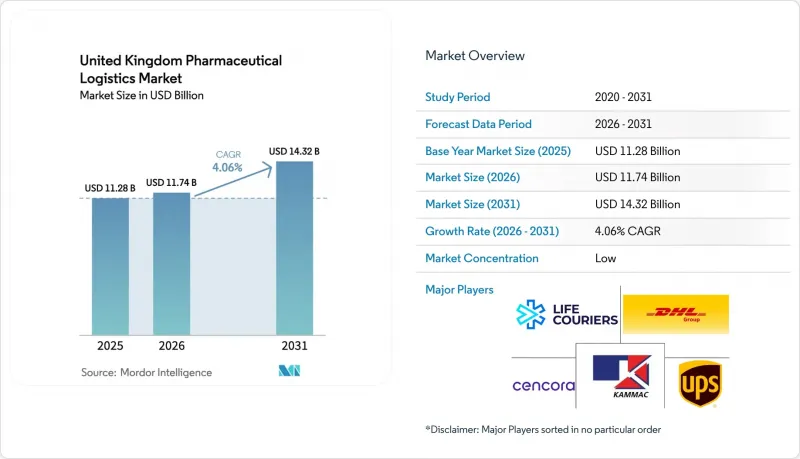
This report is Segmented by Service Type (Transportation, Warehousing & Storage, Value-Added Services and Others), Mode of Operation (Cold-Chain Logistics, Non-Cold-Chain Logistics), Product Type (Prescription Drugs, OTC Drugs, Biologics & Biosimilars, Vaccines & Blood Products, Clinical Trial Materials, and More). The Market Forecasts are Provided in Terms of Value (USD).
United Kingdom Pharmaceutical Logistics Market Trends and Insights
Growing Online Pharmacy and E-commerce Growth
NHS partnerships with Uber and Royal Mail illustrate a systemic pivot toward direct-to-patient delivery, enabling real-time prescription tracking and cutting dispensing errors through electronic verification. AI-assisted demand forecasting now underpins stock-replenishment cycles, shrinking inventory buffers and freeing warehouse space for higher-value biologics. These digital workflows elevate data-security requirements, pushing carriers to integrate secure APIs and two-factor authentication for patient data interchange. Last-mile complexity is rising because controlled drugs and temperature-sensitive biologics must meet both security and GDP parameters during doorstep hand-off. The result is growing uptake of IoT-enabled lockboxes and time-stamped delivery validation tools, making digitally native logistics providers attractive partners for NHS trusts pursuing home-care expansion.
Strict MHRA GDP Compliance
Brexit has ended automatic recognition of EU GDP certificates, obliging every inbound shipment to demonstrate UK compliance documentation and triggering systems retrofits among carriers. Transition from Parallel Distribution Notices to Parallel Import Licences requires data-capture upgrades across warehouse management systems, adding near-term cost but sharpening competitive advantages for large operators with mature quality-management frameworks. MHRA's point-of-care manufacturing guidance furthers complexity; logistics firms must add validated clean-room transfer protocols to carry freshly compounded personalized doses directly from hospital labs to bedside within narrow stability windows. Compliance spend is cascading into workforce training, with carriers expanding GDP curricula to include cyber-security and data-integrity modules that address electronic chain-of-custody mandates.
Talent Shortage of GDP-Compliant Drivers
Immigration curbs post-Brexit reduced the heavy-goods-vehicle workforce pool, and GDP qualifications add an extra training layer of 6-12 months, delaying talent replenishment. Salary premiums for certified drivers rose 14% year-over-year in 2024, squeezing smaller carriers that operate thin margin refrigerated fleets. Rural pharmacies report missed delivery windows during seasonal peaks, compelling NHS trusts to engage multi-stop consolidation services that lengthen lead times. While apprenticeship grants have been introduced, uptake remains modest due to long qualification pathways. Over time, semi-autonomous truck pilots could mitigate dependency, yet regulatory hurdles push commercial deployment beyond the forecast horizon.
Other drivers and restraints analyzed in the detailed report include:
- NHS Personalised-Medicine Initiatives
- Brexit-Driven Domestic Logistics Investment
- Rising Energy & Fuel Costs
For complete list of drivers and restraints, kindly check the Table Of Contents.
Segment Analysis
Transportation maintained 60.55% share of the UK pharmaceutical logistics market in 2025, translating to a UK pharmaceutical logistics market size contribution of USD 6.83 billion. Road freight leads due to its geographic reach across 1,250+ NHS hospital and community-pharmacy delivery points, allowing same-day replenishment cycles for critical medicines. The sub-segment leverages GPS-enabled telematics that feed shipment-status data directly into NHS Electronic Prescription Service dashboards, heightening transparency. Value-added services, albeit smaller, are rising at a 4.78% CAGR as clients seek inventory optimization analytics, relabeling, and returns-management functions within one contract, notably under NHS digitalization mandates.
Technology investments continue to reshape service-type economics. AI-driven route-optimization trims average empty mileage by 8%, offsetting fuel-cost volatility. Air freight, though <8% of value, is pivotal for ATMP imports from the United States and rapid vaccine deployment, but runway curfews at regional airports constrain uplift. Warehousing, particularly temperature-controlled space, experiences single-digit growth as sterile-manufacturing expansion pads demand for validated clean-storage chambers. The convergence of transportation and value-added services into platform models signals an evolving competitive dynamic where carriers monetize data as much as miles traveled.
Complete Report Scope:
- By Service Type
- Transportation
- Road Freight
- Air Freight
- Sea Freight
- Rail Freight
- Warehousing and Storage
- Value-added Services and Others
- Transportation
- By Mode of Operation
- Cold-Chain Logistics
- Non-Cold-Chain Logistics
- By Product Type
- Prescription Drugs
- OTC Drugs
- Biologics and Biosimilars
- Vaccines and Blood Products
- Clinical Trail Materials
- Cell and Gene Therapies
- Medical Devices and Diagnostics
- Veterinary Medicine
- Others
List of Companies Covered in this Report:
- DHL Supply Chain
- Life Couriers UK (Formerly Vision Logistics)
- Kammac
- Cencora, Inc.
- UPS
- Movianto
- Cool Cargo
- Yusen Logistics
- Circle Express UK
- DFS Worldwide
- CDL Logistics Group
- HANNON PharmaLink (HPL)
- Cavalier Logistics UK Limited
- LF&E Temperature Controlled Logistics
- Jan de Rijk Logistics
- W.H. Bowker Limited
- SEKO Logistics
- Kuehne Nagel
- Pulleyn Transport Ltd
- DSV
Additional Benefits:
- The market estimate (ME) sheet in Excel format
- 3 months of analyst support
TABLE OF CONTENTS
1 Introduction
- 1.1 Study Assumptions and Market Definition
- 1.2 Scope of the Study
2 Research Methodology
3 Executive Summary
4 Market Landscape
- 4.1 Market Overview
- 4.2 Market Drivers
- 4.2.1 Growing online pharmacy and e-commerce growth
- 4.2.2 Strict MHRA GDP compliance
- 4.2.3 NHS personalised-medicine initiatives
- 4.2.4 Brexit-driven domestic logistics investment
- 4.2.5 Growth in ATMP clinical trials (ultra-cold chain)
- 4.2.6 Expansion of NHS pharmacy home-delivery services
- 4.3 Market Restraints
- 4.3.1 Talent shortage of GDP-compliant drivers
- 4.3.2 Rising energy and fuel costs
- 4.3.3 Limited capacity at regional airports for pharma cargo
- 4.3.4 Cyber-security risks in IoT-enabled cold chain
- 4.4 Value / Supply-Chain Analysis
- 4.5 Regulatory Landscape
- 4.6 Technological Outlook
- 4.7 Porter's Five Forces
- 4.7.1 Threat of New Entrants
- 4.7.2 Bargaining Power of Buyers
- 4.7.3 Bargaining Power of Suppliers
- 4.7.4 Threat of Substitute Products
- 4.7.5 Intensity of Competitive Rivalry
- 4.8 Insights into 3PL Market in United Kingdom
- 4.9 Impact of Geopolitics and Pandemic on the Market
5 Market Size and Growth Forecasts (Value)
- 5.1 By Service Type
- 5.1.1 Transportation
- 5.1.1.1 Road Freight
- 5.1.1.2 Air Freight
- 5.1.1.3 Sea Freight
- 5.1.1.4 Rail Freight
- 5.1.2 Warehousing and Storage
- 5.1.3 Value-added Services and Others
- 5.1.1 Transportation
- 5.2 By Mode of Operation
- 5.2.1 Cold-Chain Logistics
- 5.2.2 Non-Cold-Chain Logistics
- 5.3 By Product Type
- 5.3.1 Prescription Drugs
- 5.3.2 OTC Drugs
- 5.3.3 Biologics and Biosimilars
- 5.3.4 Vaccines and Blood Products
- 5.3.5 Clinical Trail Materials
- 5.3.6 Cell and Gene Therapies
- 5.3.7 Medical Devices and Diagnostics
- 5.3.8 Veterinary Medicine
- 5.3.9 Others
6 Competitive Landscape
- 6.1 Market Concentration
- 6.2 Strategic Moves
- 6.3 Market Share Analysis
- 6.4 Company Profiles (includes Global level Overview, Market level overview, Core Segments, Financials as available, Strategic Information, Market Rank/Share for key companies, Products and Services, and Recent Developments)
- 6.4.1 DHL Supply Chain
- 6.4.2 Life Couriers UK (Formerly Vision Logistics)
- 6.4.3 Kammac
- 6.4.4 Cencora, Inc.
- 6.4.5 UPS
- 6.4.6 Movianto
- 6.4.7 Cool Cargo
- 6.4.8 Yusen Logistics
- 6.4.9 Circle Express UK
- 6.4.10 DFS Worldwide
- 6.4.11 CDL Logistics Group
- 6.4.12 HANNON PharmaLink (HPL)
- 6.4.13 Cavalier Logistics UK Limited
- 6.4.14 LF&E Temperature Controlled Logistics
- 6.4.15 Jan de Rijk Logistics
- 6.4.16 W.H. Bowker Limited
- 6.4.17 SEKO Logistics
- 6.4.18 Kuehne Nagel
- 6.4.19 Pulleyn Transport Ltd
- 6.4.20 DSV
7 Market Opportunities and Future Outlook
- 7.1 White-space and Unmet-need Assessment
8 Appendix
- 8.1 Macroeconomic Indicators (GDP Distribution by Activity)
- 8.2 Economic Statistics-Transport and Storage Sector Contribution
- 8.3 External Trade Statistics-Exports and Imports by Product and Country

