PUBLISHER: Mordor Intelligence | PRODUCT CODE: 2115852

PUBLISHER: Mordor Intelligence | PRODUCT CODE: 2115852
North America Pharmaceutical Logistics - Market Share Analysis, Industry Trends & Statistics, Growth Forecasts (2026 - 2031)
According to Mordor Intelligence, the North America pharmaceutical logistics market size was valued at USD 181.70 billion in 2025 and estimated to grow from USD 192.27 billion in 2026 to reach USD 255.09 billion by 2031, at a CAGR of 5.82% during the forecast period (2026-2031).
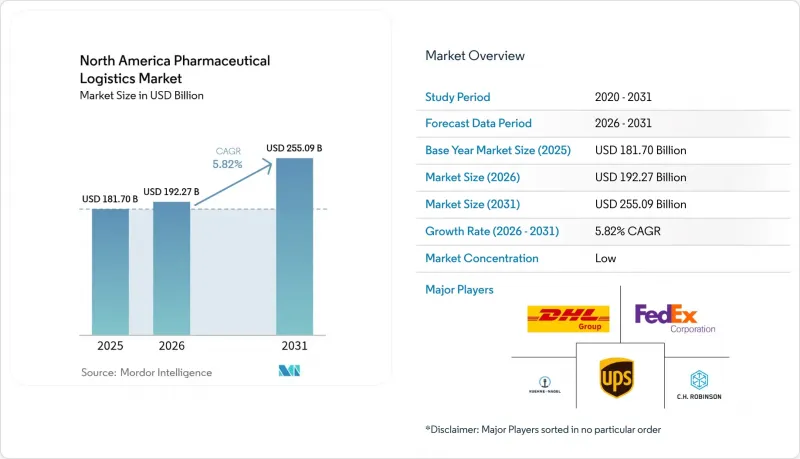
This report Segments by Service Type (Transportation, Warehousing & Storage and Value-Added Services and Others), by Mode of Operation (Cold-Chain Logistics and Non-Cold-Chain Logistics), by Product Type (Prescription Drugs, OTC Drugs, Biologics & Biosimilars, and More), by Country (United States, Canada and Mexico). The Market Forecasts are Provided in Terms of Value (USD).
North America Pharmaceutical Logistics Market Trends and Insights
Surge in Cell & Gene Therapy Clinical Trials Requiring Ultra-Cold Distribution Infrastructure
Advanced therapy trials are scaling rapidly, prompting investment in storage solutions that keep cellular material stable at temperatures as low as -196 °C. OmniaBio's 120,000 square-foot facility in Hamilton, Ontario, now the largest of its kind in Canada, signals growing regional capacity for these therapies. The U.S. FDA's new Platform Technology Designation for CRISPR-based products simplifies validation steps and shortens review cycles, thus raising shipment volumes that must meet stringent chain-of-custody rules. Logistics providers able to offer validated cryogenic fleets, redundant power back-ups and real-time excursion alerts are well placed to win contracts. Partnerships between manufacturers and 3PLs are also expanding to embed capacity in multi-tenant campuses near research clusters. These dynamics elevate the North America pharmaceutical logistics market as a critical enabler of precision medicine scale-up.
Rise of Direct-to-Patient Models in U.S. Specialty Pharmacy Channel
Manufacturers are building proprietary portals that send high-value drugs directly to patient homes, trimming intermediaries and improving adherence. The direct-to-patient healthcare logistics segment is growing alongside telehealth, which handled over 18% of U.S. outpatient visits in 2024. Last-mile couriers equipped with temperature-verified packaging extend reach to rural areas while blockchain audit trails document custody events for DSCSA compliance. Retail chains are retrofitting clinics to support decentralized clinical trials that rely on just-in-time drug delivery. Automated micro-fulfilment centers near metropolitan zones shorten lead times further. As these practices mature they contribute to recurring revenue streams within the North America pharmaceutical logistics market.
Chronic Driver Shortages Limiting Domestic Road Capacity for Time-Critical Shipments
The American Trucking Associations estimate the shortfall could reach 160,000 drivers by 2030, straining time-definite lanes for healthcare cargo. Manufacturing plants already cite labour gaps at 20.6%, and higher transportation prices in December 2024 marked the steepest rise since April 2022. Driver turnover erodes on-time performance, pushing shippers to use premium air options or build buffer inventories. Potential immigration restrictions could tighten labour pools further. These pressures inflate operating costs and temper the otherwise strong outlook for the North America pharmaceutical logistics market.
Other drivers and restraints analyzed in the detailed report include:
- Expansion of U.S.-Mexico Near-Shore Fill-Finish Facilities Creating Cross-Border Cold-Chain Flows
- Canada's Biologics Manufacturing Incentives Boosting Demand for GMP Warehousing
- High Cost of Dry-Ice & Liquid-Nitrogen Compliance for <=-70 °C Modalities
For complete list of drivers and restraints, kindly check the Table Of Contents.
Segment Analysis
Transportation captured 71.35% of the North America pharmaceutical logistics market share in 2025, reflecting the centrality of air, road and multimodal services for timely deliveries across a vast region. Domestic truck routes connect more than USD 1.6 trillion in U.S.-Canada-Mexico trade, while Boeing forecasts 4.1% annual expansion in air-cargo traffic driven by e-commerce and high-value goods, including medicines.
Warehousing and storage, though smaller, is set to grow at.5 6.38% CAGR as manufacturers create inventory buffers for critical drugs and as advanced therapies demand controlled environments. Robotic picking systems and automated cold rooms shorten order cycles and raise accuracy, while ISO-certified clean rooms support secondary packaging and kitting. Labour scarcity accelerates capital investment in automation, and value-added services such as late-stage customisation and regulatory support differentiate providers within the North America pharmaceutical logistics industry.
Complete Report Scope:
- By Service Type
- Transportation
- Road Freight
- Air Freight
- Sea Freight
- Rail Freight
- Warehousing & Storage
- Value-added Services and Others
- Transportation
- By Mode of Operation
- Cold-Chain Logistics
- Non-Cold-Chain Logistics
- By Product Type
- Prescription Drugs
- OTC Drugs
- Biologics & Biosimilars
- Vaccines & Blood Products
- Clinical Trail Materials
- Cell & Gene Therapies
- Medical Devices & Diagnostics
- Veterinary Medicine
- Others
- By Country
- United States
- Canada
- Mexico
List of Companies Covered in this Report:
- DHL Group
- United Parcel Service, Inc.
- FedEx
- Kuehne + Nagel International AG
- DSV (DB Schenker)
- CEVA Logistics
- Lineage Logistics
- Expeditors International
- XPO Logistics
- Americold Logistics
- AIT Worldwide Logistics
- Ryder Supply Chain Solutions
- Yusen Logistics (NYK line)
- Nippon Express
- SEKO Logistics
- Schneider
- C.H. Robinson
- Penske Logistics
- GEODIS*
Additional Benefits:
- The market estimate (ME) sheet in Excel format
- 3 months of analyst support
TABLE OF CONTENTS
1 Introduction
- 1.1 Study Assumptions & Market Definition
- 1.2 Scope of the Study
2 Research Methodology
3 Executive Summary
4 Market Landscape
- 4.1 Market Overview
- 4.2 Market Drivers
- 4.2.1 Surge in Cell- & Gene-Therapy Clinical Trials Requiring Ultra-Cold Distribution Infrastructure
- 4.2.2 Rise of Direct-to-Patient (DtP) Models in U.S. Specialty Pharmacy Channel
- 4.2.3 Expansion of U.S.-Mexico Near-shore Fill-Finish Facilities Creating Cross-Border Cold-Chain Flows
- 4.2.4 Canada's Biologics Manufacturing Incentives Boosting Demand for GMP Warehousing
- 4.2.5 Growing Adoption of Real-Time IoT Temperature-Monitoring Mandated by U.S. DSCSA 2024 Milestone
- 4.2.6 Sustainability Push for Re-Usable Passive Shippers to Slash Airfreight Carbon Footprint
- 4.3 Market Restraints
- 4.3.1 Chronic Driver Shortages Limiting Domestic Road Capacity for Time-Critical Shipments
- 4.3.2 High Cost of Dry-Ice & Liquid-Nitrogen Compliance for <=-70 °C Modalities
- 4.3.3 Fragmented Mexican Cold-Chain Regulations Elevating In-Transit Risk
- 4.3.4 Border Congestion Impacting On-Time Performance of Cross-Border Truckloads
- 4.4 Value / Supply-Chain Analysis
- 4.5 Regulatory & Technological Outlook
- 4.6 Porter's Five Forces
- 4.6.1 Bargaining Power of Buyers
- 4.6.2 Bargaining Power of Suppliers
- 4.6.3 Threat of Substitutes
- 4.6.4 Threat of New Entrants
- 4.6.5 Competitive Rivalry
5 Market Size & Growth Forecasts (Value, USD Billion)
- 5.1 By Service Type
- 5.1.1 Transportation
- 5.1.1.1 Road Freight
- 5.1.1.2 Air Freight
- 5.1.1.3 Sea Freight
- 5.1.1.4 Rail Freight
- 5.1.2 Warehousing & Storage
- 5.1.3 Value-added Services and Others
- 5.1.1 Transportation
- 5.2 By Mode of Operation
- 5.2.1 Cold-Chain Logistics
- 5.2.2 Non-Cold-Chain Logistics
- 5.3 By Product Type
- 5.3.1 Prescription Drugs
- 5.3.2 OTC Drugs
- 5.3.3 Biologics & Biosimilars
- 5.3.4 Vaccines & Blood Products
- 5.3.5 Clinical Trail Materials
- 5.3.6 Cell & Gene Therapies
- 5.3.7 Medical Devices & Diagnostics
- 5.3.8 Veterinary Medicine
- 5.3.9 Others
- 5.4 By Country
- 5.4.1 United States
- 5.4.2 Canada
- 5.4.3 Mexico
6 Competitive Landscape
- 6.1 Market Concentration
- 6.2 Strategic Moves
- 6.3 Market Share Analysis
- 6.4 Company Profiles {(includes Global level Overview, Market level overview, Core Segments, Financials as available, Strategic Information, Market Rank/Share for key companies, Products & Services, and Recent Developments)}
- 6.4.1 DHL Group
- 6.4.2 United Parcel Service, Inc.
- 6.4.3 FedEx
- 6.4.4 Kuehne + Nagel International AG
- 6.4.5 DSV (DB Schenker)
- 6.4.6 CEVA Logistics
- 6.4.7 Lineage Logistics
- 6.4.8 Expeditors International
- 6.4.9 XPO Logistics
- 6.4.10 Americold Logistics
- 6.4.11 AIT Worldwide Logistics
- 6.4.12 Ryder Supply Chain Solutions
- 6.4.13 Yusen Logistics (NYK line)
- 6.4.14 Nippon Express
- 6.4.15 SEKO Logistics
- 6.4.16 Schneider
- 6.4.17 C.H. Robinson
- 6.4.18 Penske Logistics
- 6.4.19 GEODIS*
7 Market Opportunities & Future Outlook

