PUBLISHER: Mordor Intelligence | PRODUCT CODE: 2116702

PUBLISHER: Mordor Intelligence | PRODUCT CODE: 2116702
Thailand Luxury Goods - Market Share Analysis, Industry Trends & Statistics, Growth Forecasts (2026 - 2031)
According to Mordor Intelligence, the Thailand luxury goods market size stands at USD 2.72 billion in 2026 growing from 2025 value of USD 2.55 billion and is projected to reach USD 3.74 billion by 2031, reflecting a 6.6% CAGR as the nation consolidates its role as Southeast Asia's premium-consumption hub.
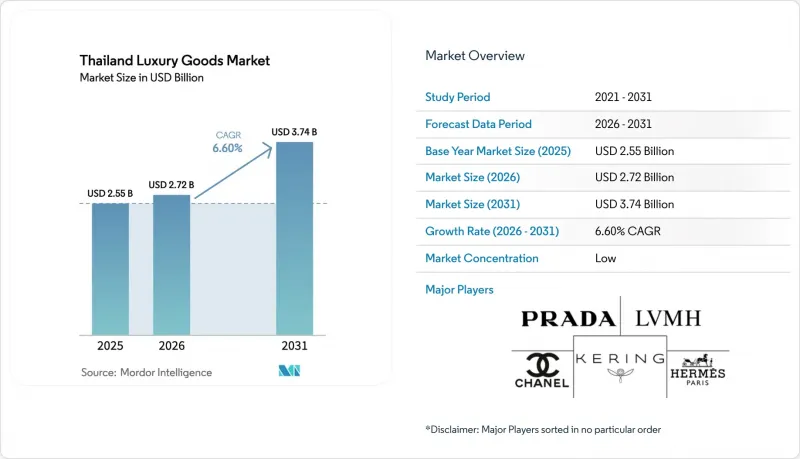
This report is Segmented by Product Type (Clothing and Apparel, Footwear, and More), End User (Men, Women, and Unisex), and Distribution Channel (Single-Branded Stores, Multi-Brand Stores, and More). The Market Forecasts are Provided in Terms of Value (USD).
Thailand Luxury Goods Market Trends and Insights
Rising affluence among gen-Z and young professionals
As of 2024, data from the Thailand Board of Investment reveals that individuals aged 15-24 constitute 12.24% of the nation's total population. This demographic is reshaping consumption patterns, favoring experiential luxury and digital-first brand interactions over traditional status symbols. In response, brands are shifting focus from heritage narratives to highlight product utility, sustainability, and resale value qualities that resonate with a generation wary of overt displays of wealth. Demand for luxury goods among Thai men is surging at a 7.32% CAGR, fueled by young professionals who view watches, leather goods, and grooming products as markers of career success. According to the Bangkok Post, Gen-Z's discretionary spending on experiences rose to 56% in 2024, up from 45% in 2023. This trend underscores the need for luxury brands to weave in food and beverage, wellness, and cultural elements into their retail spaces. In a move highlighting this shift, Jim Thompson is channeling THB 100-150 million (USD 2.9-4.3 million) over the next 3-5 years to boost its store count from 25 to 30-35. This includes a prominent 500-square-meter duplex at One Bangkok and the introduction of a Maison Jim Thompson homeware line by 2026, signaling a strategic pivot towards lifestyle ecosystems to capture Gen-Z's loyalty.
Inbound tourism rebound and flagship mall boom
Thailand's luxury goods market is thriving, buoyed by a resurgence in tourism. The government, aiming high, targets 39 million international visitors and a foreign tourism revenue of 2.23 trillion THB by 2025, as highlighted by its public relations department in May 2025. The Tourism Authority of Thailand (TAT) Newsroom reports a significant milestone: over 35 million visitors graced Thailand in 2024, underscoring the nation's tourism revival. This resurgence has revitalized traffic at airport duty-free shops, resort boutiques, and urban flagship stores. Illustrating the trend, Central Group's THB 21 billion "The Central", King Power's "One Bangkok", and Prada's expansive 597-square-meter flagship in Central Phuket showcase the collaborative investments of developers and brands. They're keenly targeting a growing mix of tourists, predominantly from the Middle East, India, and independent travelers from China. Resort destinations are elevating their offerings, evident with bespoke services like Cartier's custom eyewear lounge, solidifying their premium market stance. Prime malls in Bangkok are witnessing double-digit rent growth, a testament to landlords' confidence in Thailand's luxury goods market. These strategic investments are not only drawing in tourists but also appealing to resident expatriates, fueling a surge in near-term sales.
Proliferation of counterfeit goods
In 2023-2024, authorities seized 4.2 million counterfeit luxury items in Thailand, valued at a staggering THB 12 billion. These fakes siphoned off 8-12% of the market's addressable demand, significantly undermining brand equity and consumer trust. Key vendors have established operations in prominent locations such as Chatuchak, MBK Center, and Patpong, leveraging Thailand's strategic logistics network to facilitate the import of counterfeit goods from China and Vietnam. While blockchain-based authentication solutions, like LVMH's Aura, provide a robust defense against counterfeits, they come at an added cost of USD 5-10 per item. This additional expense tightens profit margins, particularly for entry-level luxury products, making it challenging for brands to maintain competitive pricing. Customs officers, already stretched thin, inspect approximately 2 million parcels monthly, limiting their ability to curb the influx of counterfeit goods effectively. Consequently, counterfeiting continues to pose a significant challenge to Thailand's luxury goods market, emphasizing the critical need for scalable technological innovations and strengthened legal frameworks to address this persistent issue.
Other drivers and restraints analyzed in the detailed report include:
- Social-commerce and celebrity influence surge
- Sustainability-led material innovation
- Lagging return of Chinese group tours and FX swings
For complete list of drivers and restraints, kindly check the Table Of Contents.
Segment Analysis
In 2025, clothing and apparel dominated Thailand's luxury goods market, seizing 26.73% of total sales, driven by robust demand from both local consumers and tourists in pursuit of premium fashion. Leather goods, seen as aspirational entry points, trailed closely with about 22% of the category's value, thanks to the enduring allure of designer bags and accessories that convey status without exorbitant price tags. Meanwhile, luxury footwear and eyewear capitalized on the rising athleisure and wellness trends. Notably, sneaker resale volumes surged by 18% in 2024, as collectors eagerly pursued limited drops. Swiss mechanical watches, witnessing double-digit volume increases, emerged as coveted safe-haven investments amidst economic fluctuations. These segments, anchored by urban retail expansions and deepening e-commerce penetration in Bangkok and other tourist hotspots, collectively bolster the market's stability.
Jewelry emerged as the fastest-growing segment in Thailand's luxury market, boasting a 6.96% CAGR through 2031. Expatriates, medical tourists, and locals gravitated towards high-value pieces, viewing them as hedges against currency fluctuations, all while honoring a cultural affinity for gold. Duty-free operators sweetened the deal with gemstone-grading kiosks and private viewing lounges, enhancing accessibility at key airports and resorts. Beauty and personal care mirrored this growth with a steady 6.2% rise, driven by K-beauty trends and targeted omnichannel strategies from giants like Estee Lauder and L'Oreal, focusing on younger audiences. Brands capitalized on scarcity, rolling out limited-edition sneaker collaborations and custom eyewear. Apparel, facing slowdowns, pivoted to upcycled fabrics, appealing to eco-conscious shoppers. Watches, bolstered by events like Bangkok Watch Week, reinforced their investment status, underscoring Thailand's burgeoning prominence as a luxury horology hub in the region.
Complete Report Scope:
- By Product Type
- Clothing and Apparel
- Footwear
- Eyewear
- Leather Goods
- Jewelry
- Watches
- Beauty and Personal care
- End User
- Men
- Women
- Unisex
- Distribution Channel
- Single Brand Stores
- Multi Brand Stores
List of Companies Covered in this Report:
- LVMH Moet Hennessy Louis Vuitton SE
- Kering SA
- Chanel SA
- Hermes International SA
- Compagnie Financiere Richemont SA
- The Swatch Group Ltd
- Prada SpA
- PVH Corp
- Rolex SA
- Ralph Lauren Corp
- Estee Lauder Companies Inc.
- Burberry Group plc
- Capri Holdings Ltd
- Tapestry Inc.
- L'Oreal SA
- Jim Thompson Thai Silk Co.
- King Power International Co.
- Sretsis Co. Ltd
- Disaya Co. Ltd
- Busardi Co. Ltd
- Cortina Watch (Thailand) Co.
- Siam Swiss Co. Ltd
Additional Benefits:
- The market estimate (ME) sheet in Excel format
- 3 months of analyst support
TABLE OF CONTENTS
1 INTRODUCTION
- 1.1 Study Assumptions and Market Definition
- 1.2 Scope of the Study
2 RESEARCH METHODOLOGY
3 EXECUTIVE SUMMARY
4 MARKET LANDSCAPE
- 4.1 Market Overview
- 4.2 Market Drivers
- 4.2.1 Rising affluence among Gen-Z and young professionals
- 4.2.2 Inbound tourism rebound and flagship mall boom
- 4.2.3 Social-commerce and celebrity influence surge
- 4.2.4 Sustainability-led material innovation
- 4.2.5 Visa-free long-stay programmes attracting HNW expats
- 4.2.6 Medical-tourism hubs driving Middle-East luxury spend
- 4.3 Market Restraints
- 4.3.1 Proliferation of counterfeit goods
- 4.3.2 Price-sensitive mass affluent segment
- 4.3.3 Macroeconomic and inflation volatility
- 4.3.4 Lagging return of Chinese group tours and FX swings
- 4.4 Consumer Behavior Analysis
- 4.5 Regulatory Landscape
- 4.6 Porter's Five Forces
- 4.6.1 Bargaining Power of Suppliers
- 4.6.2 Bargaining Power of Buyers
- 4.6.3 Threat of New Entrants
- 4.6.4 Threat of Substitutes
- 4.6.5 Competitive Rivalry
5 MARKET SIZE AND GROWTH FORECASTS (VALUE)
- 5.1 By Product Type
- 5.1.1 Clothing and Apparel
- 5.1.2 Footwear
- 5.1.3 Eyewear
- 5.1.4 Leather Goods
- 5.1.5 Jewelry
- 5.1.6 Watches
- 5.1.7 Beauty and Personal care
- 5.2 End User
- 5.2.1 Men
- 5.2.2 Women
- 5.2.3 Unisex
- 5.3 Distribution Channel
- 5.3.1 Single Brand Stores
- 5.3.2 Multi Brand Stores
6 COMPETITIVE LANDSCAPE
- 6.1 Market Concentration
- 6.2 Strategic Moves
- 6.3 Market Positioning Analysis
- 6.4 Company Profiles (includes Global level Overview, Market level overview, Core Segments, Financials as available, Strategic Information, Market Rank/Share for key companies, Products and Services, and Recent Developments)
- 6.4.1 LVMH Moet Hennessy Louis Vuitton SE
- 6.4.2 Kering SA
- 6.4.3 Chanel SA
- 6.4.4 Hermes International SA
- 6.4.5 Compagnie Financiere Richemont SA
- 6.4.6 The Swatch Group Ltd
- 6.4.7 Prada SpA
- 6.4.8 PVH Corp
- 6.4.9 Rolex SA
- 6.4.10 Ralph Lauren Corp
- 6.4.11 Estee Lauder Companies Inc.
- 6.4.12 Burberry Group plc
- 6.4.13 Capri Holdings Ltd
- 6.4.14 Tapestry Inc.
- 6.4.15 L'Oreal SA
- 6.4.16 Jim Thompson Thai Silk Co.
- 6.4.17 King Power International Co.
- 6.4.18 Sretsis Co. Ltd
- 6.4.19 Disaya Co. Ltd
- 6.4.20 Busardi Co. Ltd
- 6.4.21 Cortina Watch (Thailand) Co.
- 6.4.22 Siam Swiss Co. Ltd
7 MARKET OPPORTUNITIES AND FUTURE OUTLOOK

