PUBLISHER: Mordor Intelligence | PRODUCT CODE: 2116762

PUBLISHER: Mordor Intelligence | PRODUCT CODE: 2116762
UK Luxury Goods - Market Share Analysis, Industry Trends & Statistics, Growth Forecasts (2026 - 2031)
According to Mordor Intelligence, UK luxury goods market size in 2026 is estimated at USD 27.43 billion, growing from 2025 value of USD 26.32 billion with 2031 projections showing USD 33.71 billion, growing at 4.22% CAGR over 2026-2031.
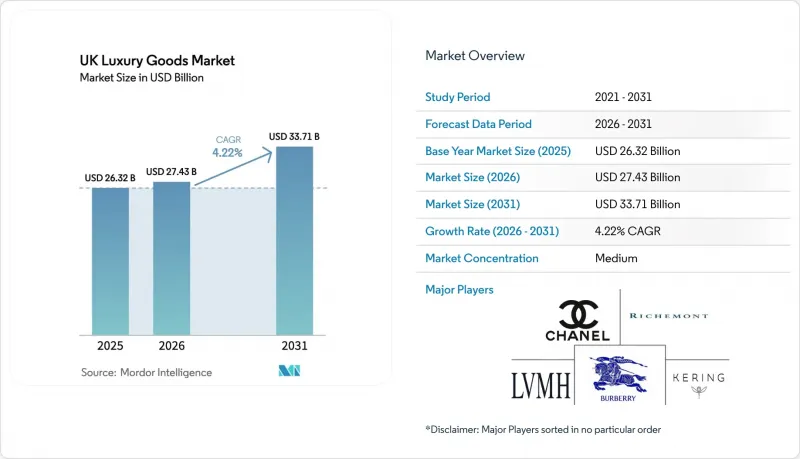
This report Segments the Industry by Product Type (Clothing and Apparel, Footwear, Eyewear, Leather Goods, Jewelry, Watches, and Beauty and Personal Care) by End User (Men, Women, and Unisex) and by Distribution Channel (Single Brand Stores, Multi Brand Stores, and Online Stores). The Market Forecasts are Provided in Terms of Value (USD).
UK Luxury Goods Market Trends and Insights
Product innovation in terms of raw material and design
In the UK, luxury brands are merging time-honored craftsmanship with a commitment to sustainability, reshaping the landscape of high-end goods. Brands are adopting innovative materials that balance design excellence with environmental responsibility. A notable instance is Uncaged Innovations, which unveiled 'Elevate' in November 2024. This bio-based leather alternative boasts a remarkable 95% reduction in greenhouse gas emissions, 93% less water consumption, and 72% lower energy use compared to its traditional counterpart. Furthermore, Uncaged's collaboration with ten independent fashion labels, including the UK-based Stow, reflects a growing shift in the industry. Sustainability-led innovation is no longer confined to major luxury houses. Independent, design-driven labels are also finding creative ways to merge aesthetics with accountability. As the EU gears up to enforce its Ecodesign for Sustainable Products Regulation, mandating Digital Product Passports for textiles by mid-2027, UK luxury houses are taking proactive steps . Many of these efforts also reflect strategic foresight, ensuring continued access to European markets post-Brexit.
Influence of social media and celebrity endorsement
In the UK luxury market, brand perception and purchase intent are increasingly swayed by celebrity endorsements, especially among the digitally-savvy younger audience. Short-form celebrity-led content on platforms such as Instagram and TikTok now plays a pivotal role in shaping brand image and influencing purchase intent. A 2024 University of Portsmouth survey indicated that 60% of consumers trusted influencer recommendations, while nearly half of all purchasing decisions were influenced by these endorsements . Campaigns like Burberry's "Art of the Trench" underscore the potency of digital engagement in bolstering brand equity and nurturing customer loyalty. These campaigns highlight the growing importance of social media integration in luxury marketing, translating digital engagement into measurable business outcomes.
Availablity of counterfeit products
Counterfeit products are posing a growing challenge to brand integrity and revenues in the UK. Improved imitation quality has made them harder to detect, heightening risks for both brands and consumers, posing a significant threat to the luxury market. Social media platforms further amplify the issue by providing a space for counterfeit promotion. According to research from the Intellectual Property Office, as of February 2024, 24% of male consumers, influenced by social media endorsements, are inclined to purchase counterfeit goods, compared to only 10% of female consumers . The study highlights four main reasons why people buy counterfeit products which includes influence from trusted figures like influencers, personal justifications for the purchase, lack of awareness about the risks involved, and a higher willingness to take risks. Younger males aged 16-33 are particularly vulnerable to these influences. Moreover, the widening income inequality has led some consumers to attribute an 'egalitarian value' to counterfeit goods.
Other drivers and restraints analyzed in the detailed report include:
- Increasing strategic investment and initiatives propelling the market
- Consumer emphasis on sustainability
- Lesser demand from price sensitive consumers
For complete list of drivers and restraints, kindly check the Table Of Contents.
Segment Analysis
In 2025, clothing and apparel took center stage in the UK's luxury goods market, seizing a dominant 37.43% share. This dominance reflects apparel's central role in personal luxury, serving as both a symbol of status and a means of self-expression. British consumers are increasingly linking luxury apparel with top-notch quality and artisanal craftsmanship. Moreover, the sector is undergoing a digital metamorphosis, with e-commerce now commanding major segment in the market. Augmented reality and virtual try-on tools are enriching the digital shopping experience, driving engagement, and reshaping how consumers purchase luxury products.
Leather goods are carving out a significant niche in the UK luxury scene, with projections indicating a CAGR of 4.56% from 2026 to 2031. This growth trajectory is largely attributed to innovations in sustainable materials, especially bio-based leather alternatives. These alternatives boast a staggering reduction in greenhouse gas emissions, less water consumption, and decreased energy use compared to their conventional counterparts. Responding to this trend, traditional players are pivoting. Gruppo Mastrotto, for instance, launched its FW25/26 line themed "Leather Forward," emphasizing sustainability, nature-centric design, and ethical principles.
Complete Report Scope:
- By Product Type
- Clothing and Apparel
- Footwear
- Eyewear
- Leather Goods
- Jewelry
- Watches
- Beauty and Personal Care
- By End User
- Men
- Women
- Unisex
- By Distribution Channel
- Single Brand Stores
- Multi Brand Stores
- Online Stores
List of Companies Covered in this Report:
- LVMH Moet Hennessy Louis Vuitton SE
- Compagnie Financiere Richemont SA
- Kering S.A
- Chanel Limited.
- Hermes International SCA
- Burberry Group plc
- The Estee Lauder Companies Inc.
- L'Oreal S.A
- Capri Holdings Ltd.
- Tapestry Inc.
- Swatch Group AG
- Patek Philippe SA
- Ralph Lauren Corporation
- Prada SpA
- Audemars Piguet Holding SA
- Mulberry Group plc
- Hugo Boss AG
- Max Mara Fashion Group Srl
- Bremont Watch Company Limited
- Asprey London Limited
Additional Benefits:
- The market estimate (ME) sheet in Excel format
- 3 months of analyst support
TABLE OF CONTENTS
1 INTRODUCTION
- 1.1 Study Assumptions & Market Definition
- 1.2 Scope of the Study
2 RESEARCH METHODOLOGY
3 EXECUTIVE SUMMARY
4 MARKET LANDSCAPE
- 4.1 Market Overview
- 4.2 Market Drivers
- 4.2.1 Product innovation in terms of raw material and design
- 4.2.2 Influence of social media and celebrity endorsement
- 4.2.3 Increasing strategic investment and initiatives propelling the market
- 4.2.4 Consumer emphasis on sustainability
- 4.2.5 Digital transformation and e-commerce adoption enhance accessibility for affluent consumers.
- 4.2.6 Technology integration in luxury retail improves shopping experiences.
- 4.3 Market Restraints
- 4.3.1 Availablity of counterfeit products
- 4.3.2 Lesser demand from price sensitive consumers
- 4.3.3 Brexit-related trade barriers increase operational costs and retail prices.
- 4.3.4 Labor shortages in specialized craftsmanship
- 4.4 Consumer Behavior Analysis
- 4.5 Regulatory Outlook
- 4.6 Porter's Five Forces
- 4.6.1 Bargaining Power of Suppliers
- 4.6.2 Bargaining Power of Buyers
- 4.6.3 Threat of New Entrants
- 4.6.4 Threat of Substitutes
- 4.6.5 Intensity of Competitive Rivalry
5 MARKET SIZE AND GROWTH FORECASTS (VALUE)
- 5.1 By Product Type
- 5.1.1 Clothing and Apparel
- 5.1.2 Footwear
- 5.1.3 Eyewear
- 5.1.4 Leather Goods
- 5.1.5 Jewelry
- 5.1.6 Watches
- 5.1.7 Beauty and Personal Care
- 5.2 By End User
- 5.2.1 Men
- 5.2.2 Women
- 5.2.3 Unisex
- 5.3 By Distribution Channel
- 5.3.1 Single Brand Stores
- 5.3.2 Multi Brand Stores
- 5.3.3 Online Stores
6 COMPETITIVE LANDSCAPE
- 6.1 Market Concentration
- 6.2 Strategic Moves
- 6.3 Market Share Analysis
- 6.4 Company Profiles (includes Global level Overview, Market level overview, Core Segments, Financials as available, Strategic Information, Market Rank/Share for key companies, Products & Services, and Recent Developments)
- 6.4.1 LVMH Moet Hennessy Louis Vuitton SE
- 6.4.2 Compagnie Financiere Richemont SA
- 6.4.3 Kering S.A
- 6.4.4 Chanel Limited.
- 6.4.5 Hermes International SCA
- 6.4.6 Burberry Group plc
- 6.4.7 The Estee Lauder Companies Inc.
- 6.4.8 L'Oreal S.A
- 6.4.9 Capri Holdings Ltd.
- 6.4.10 Tapestry Inc.
- 6.4.11 Swatch Group AG
- 6.4.12 Patek Philippe SA
- 6.4.13 Ralph Lauren Corporation
- 6.4.14 Prada SpA
- 6.4.15 Audemars Piguet Holding SA
- 6.4.16 Mulberry Group plc
- 6.4.17 Hugo Boss AG
- 6.4.18 Max Mara Fashion Group Srl
- 6.4.19 Bremont Watch Company Limited
- 6.4.20 Asprey London Limited
7 MARKET OPPORTUNITIES AND FUTURE OUTLOOK

