PUBLISHER: Mordor Intelligence | PRODUCT CODE: 2116726

PUBLISHER: Mordor Intelligence | PRODUCT CODE: 2116726
Singapore Luxury Goods - Market Share Analysis, Industry Trends & Statistics, Growth Forecasts (2026 - 2031)
According to Mordor Intelligence, the Singapore luxury goods market size is expected to grow from USD 10.45 billion in 2025 to USD 11.08 billion in 2026 and is forecast to reach USD 14.82 billion by 2031 at 6.03% CAGR over 2026-2031.
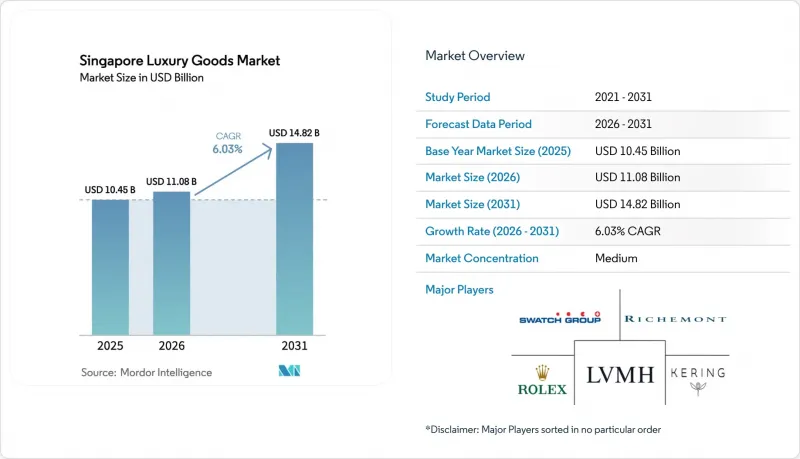
This report is Segmented by Product Type (Clothing and Apparel, Footwear, Eyewear, Jewelry, Leather Goods, Watches, and Other Types), End User (Men, Women, and Unisex), and Distribution Channel (Single Brand Stores, Multi Brand Stores, Online Stores, and Other Distribution Channels). The Market Forecasts are Provided in Terms of Value (USD).
Singapore Luxury Goods Market Trends and Insights
Rising wealth and HNWIs population
Growing affluence and an increasing population of high-net-worth individuals (HNWIs) are significant drivers of the Singapore luxury goods market. The rise in disposable income and wealth accumulation among individuals has led to a higher demand for premium and luxury products. According to the Credit Suisse Research Institute, in 2024, Singapore is home to 330,752 high-net-worth (HNW) individuals and 1,739 ultra-high-net-worth (UHNW) individuals . This substantial concentration of wealth not only boosts the consumption of luxury goods but also encourages the entry of global luxury brands into the market to cater to this affluent demographic. Singapore, being a global financial hub, attracts a significant number of HNWIs and UHNWIs, further fueling the market's growth. Additionally, the country's stable economy, favorable tax policies, and robust retail infrastructure create an ideal environment for the luxury goods market to thrive. The presence of high-end shopping districts, luxury boutiques, and exclusive retail experiences further enhances the appeal of luxury goods among affluent consumers, solidifying Singapore's position as a key market for luxury products in the Asia-Pacific region.
Influence of social media and celebrity endorsements
Social media and celebrity endorsements significantly drive the Singapore luxury goods market. The widespread use of social media platforms has transformed how consumers discover and engage with luxury brands. Platforms like Instagram, Facebook, and TikTok serve as key channels for showcasing luxury products, enabling brands to reach a broader audience and create aspirational value. Celebrity endorsements further amplify this influence by leveraging the credibility and appeal of well-known personalities. Celebrities often act as trendsetters, and their association with luxury brands enhances brand perception and desirability among consumers. In Singapore, where social media penetration is high, and consumers are highly brand-conscious, these endorsements play a pivotal role in shaping purchasing decisions. According to the Department of Singapore Statistics, the mobile penetration rate in Singapore was observed to be 165% in 2024 , highlighting the extensive reach of digital platforms. Additionally, the integration of influencer marketing, where social media influencers promote luxury goods, has become a critical strategy for brands. Influencers with a strong following and niche appeal can effectively target specific consumer segments, driving engagement and sales.
Intense market competition
Fierce competition dominates the market landscape, acting as a significant restraint in the Singapore Luxury Goods Market. The presence of numerous established players and new entrants intensifies the rivalry, making it challenging for companies to differentiate their offerings. This competitive environment often leads to aggressive pricing strategies, promotional activities, and innovation races, which can strain profit margins. Additionally, the high level of competition compels businesses to invest heavily in marketing and branding efforts to maintain their market position, further increasing operational costs. Such dynamics create a challenging environment for market players, impacting their growth potential and overall market performance. Furthermore, the market's saturation with luxury brands and products makes it difficult for new entrants to establish a foothold, while existing players face the constant pressure of retaining customer loyalty. The evolving preferences of consumers, who increasingly seek personalized and unique experiences, further complicate the competitive landscape.
Other drivers and restraints analyzed in the detailed report include:
- Expansion of luxury e-commerce platforms
- Affluent younger demographic
- Availability of counterfeit products
For complete list of drivers and restraints, kindly check the Table Of Contents.
Segment Analysis
In 2025, jewelry maintained its dominance in the Singapore luxury goods market, securing a commanding 26.05% share of the overall industry. This leadership position underscores Singapore's role as a regional hub for luxury trade, drawing both local consumers and international buyers. The city-state's strategic location and strong financial infrastructure make it an ideal gateway for precious metals and high-value products. Beyond trade dynamics, jewelry also carries deep cultural importance across Asia, where gold and other precious metals symbolize security, prosperity, and long-term wealth preservation. For many affluent consumers in Singapore and the surrounding region, jewelry purchases are not only seen as lifestyle choices but also as investments that hold intrinsic financial value.
The watches category is projected to be the fastest-growing segment, expanding at a CAGR of 6.92% through 2031. This growth trajectory reflects shifting consumer preferences, as high-net-worth individuals increasingly view luxury timepieces as both status symbols and collectible assets. Global demand for rare and limited-edition watches has surged, and Singapore's luxury retail ecosystem positions it well to capture this momentum. The city's reputation for authenticity, transparency, and access to leading Swiss and European brands enhances consumer trust in high-value purchases. Additionally, younger affluent buyers are showing keen interest in luxury watches, reflecting expanding aspirational consumption alongside traditional investment-driven purchases.
Complete Report Scope:
- By Product Type
- Clothing and Apparel
- Footwear
- Eyewear
- Jewelry
- Leather Goods
- Watches
- Other Types
- By End User
- Men
- Women
- Unisex
- By Distribution Channel
- Single Brand Stores
- Multi Brand Stores
- Online Stores
- Other Distribution Channels
List of Companies Covered in this Report:
- LVMH Moet Hennessy Louis Vuitton
- Kering SA
- Richemont SA
- The Swatch Group Ltd
- Rolex SA
- Chanel SA
- PVH Corp
- The Estee Lauder Companies
- Ralph Lauren Corporation
- Prada SpA
- Hermes International S.A.
- Burberry Group plc
- Audemars Piguet Holding SA
- Patek Philippe SA
- Tapestry Inc
- Tiffany & Co
- Bottega Veneta
- Chow Tai Fook Jewellery Group
- Balenciaga SA
- Capri Holdings Limited
Additional Benefits:
- The market estimate (ME) sheet in Excel format
- 3 months of analyst support
TABLE OF CONTENTS
1 INTRODUCTION
- 1.1 Study Assumptions and Market Definition
- 1.2 Scope of the Study
2 RESEARCH METHODOLOGY
3 EXECUTIVE SUMMARY
4 MARKET LANDSCAPE
- 4.1 Market Overview
- 4.2 Market Drivers
- 4.2.1 Rising wealth and HNWIs population
- 4.2.2 Influence of social media and celebrity endorsements
- 4.2.3 Expansion of luxury e-commerce platforms
- 4.2.4 Affluent younger demographic
- 4.2.5 Consumer inclination towards limited edition products
- 4.2.6 Globalization of luxury brands
- 4.3 Market Restraints
- 4.3.1 Escalating prime-retail rents
- 4.3.2 Intense market competition
- 4.3.3 Availability of counterfeit products
- 4.3.4 Sustainability-driven shift from new goods to resale
- 4.4 Consumer Behavior Analysis
- 4.5 Regulatory Landscape
- 4.6 Technological Outlook
- 4.7 Porter's Five Forces
- 4.7.1 Bargaining Power of Buyers/Consumers
- 4.7.2 Bargaining Power of Suppliers
- 4.7.3 Threat of New Entrants
- 4.7.4 Threat of Substitute Products
- 4.7.5 Intensity of Competitive Rivalry
5 MARKET SIZE AND GROWTH FORECASTS (VALUE)
- 5.1 By Product Type
- 5.1.1 Clothing and Apparel
- 5.1.2 Footwear
- 5.1.3 Eyewear
- 5.1.4 Jewelry
- 5.1.5 Leather Goods
- 5.1.6 Watches
- 5.1.7 Other Types
- 5.2 By End User
- 5.2.1 Men
- 5.2.2 Women
- 5.2.3 Unisex
- 5.3 By Distribution Channel
- 5.3.1 Single Brand Stores
- 5.3.2 Multi Brand Stores
- 5.3.3 Online Stores
- 5.3.4 Other Distribution Channels
6 COMPETITIVE LANDSCAPE
- 6.1 Market Concentration
- 6.2 Strategic Moves
- 6.3 Market Share Analysis
- 6.4 Company Profiles (includes Global Overview, Market-level Overview, Core Segments, Financials, Strategic Information, Market Rank/Share, Products & Services, Recent Developments)
- 6.4.1 LVMH Moet Hennessy Louis Vuitton
- 6.4.2 Kering SA
- 6.4.3 Richemont SA
- 6.4.4 The Swatch Group Ltd
- 6.4.5 Rolex SA
- 6.4.6 Chanel SA
- 6.4.7 PVH Corp
- 6.4.8 The Estee Lauder Companies
- 6.4.9 Ralph Lauren Corporation
- 6.4.10 Prada SpA
- 6.4.11 Hermes International S.A.
- 6.4.12 Burberry Group plc
- 6.4.13 Audemars Piguet Holding SA
- 6.4.14 Patek Philippe SA
- 6.4.15 Tapestry Inc
- 6.4.16 Tiffany & Co
- 6.4.17 Bottega Veneta
- 6.4.18 Chow Tai Fook Jewellery Group
- 6.4.19 Balenciaga SA
- 6.4.20 Capri Holdings Limited
7 MARKET OPPORTUNITIES AND FUTURE OUTLOOK

