PUBLISHER: Mordor Intelligence | PRODUCT CODE: 2116879

PUBLISHER: Mordor Intelligence | PRODUCT CODE: 2116879
United Kingdom ICT - Market Share Analysis, Industry Trends & Statistics, Growth Forecasts (2026 - 2031)
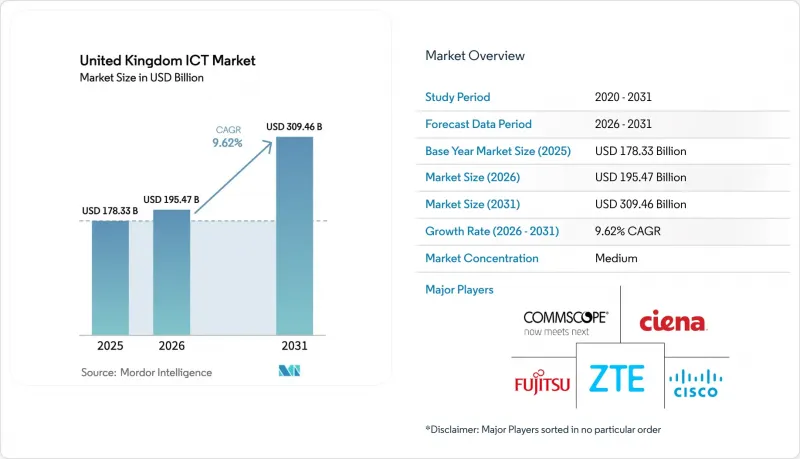
According to Mordor Intelligence, United Kingdom ICT market size in 2026 is estimated at USD 195.47 billion, growing from 2025 value of USD 178.33 billion with 2031 projections showing USD 309.46 billion, growing at 9.62% CAGR over 2026-2031.
[1] Department for Science, Innovation & Technology, "National Semiconductor Strategy," gov.uk The growth outperforms traditional infrastructure categories because public- and private-sector buyers treat technology as a value generator rather than a cost center. This report is Segmented by Product Type (IT Hardware, IT Software, IT Services, IT Infrastructure, IT Security, Communication Services), Enterprise Size (Small and Medium Enterprises, Large Enterprises), and End-User Industry Vertical (Government and Public Administration, BFSI, Energy and Utilities, and More). The Market Forecasts are Provided in Terms of Value (USD).
United Kingdom ICT Market Trends and Insights
Rapid Surge in Demand for Software-as-a-Service (SaaS)
SaaS adoption extends from office productivity to mission-critical finance, HR, and supply-chain processes, rewriting procurement models that once favored perpetual licenses. The Help to Grow Digital program issued GBP 5,000 (USD 6,749.0) software vouchers to an addressable base of 1.2 million firms, creating a digitally enabled SME segment that now supports recurring SaaS revenues. Roughly 90% of UK companies used at least one cloud service in 2024, up from 78% in 2022, and vendors are pivoting to verticalized offerings addressing strict sectoral regulations. Freemium entry tiers, in-product AI assistants, and consumption-based billing make SaaS attractive to budget-conscious firms, while integrations with HMRC and Companies House APIs eliminate manual compliance effort.
Rise in Digital Technology Adoption Across Healthcare
Only 63% of NHS trusts had foundational electronic patient-record functionality in 2024, leaving a GBP 23.98 billion (USD 32.36 billion ) investment gap that is now earmarked for fulfillment by 2026 NHS.UK. Spending priorities encompass interoperable data warehouses, AI-assisted diagnostics, and zero-trust security layers to safeguard sensitive health information. Remote-monitoring pilots demonstrated 26% readmission reductions, encouraging scaling across integrated care systems. Vendors specializing in HL7-FHIR integration, medical-grade cloud hosting, and federated learning see accelerated procurement cycles as trusts move from proof of concept to production deployments. Telehealth services, normalized during COVID-19, remain above 30% of outpatient consultations, sustaining demand for secure video, IoT wearables, and analytics platforms.
Semiconductor Supply-Chain Volatility and Inflationary Pressure
The UK sources 98% of advanced chips from Asia, exposing data-center builds and device refresh cycles to prolonged lead times and 12-18% price inflations. Domestic revenue of GBP 9.6 billion (USD 12.95 billion) represents just 2% of the global semiconductor market, so the National Semiconductor Strategy directs GBP 1 billion (USD 1.34 billion) to design tools, compound fabs, and advanced packaging over ten years. Still, capacity additions will not mature before 2028, forcing integrators to redesign bill-of-materials around more readily available nodes and to expand die redistribution partnerships in Europe.
Other drivers and restraints analyzed in the detailed report include:
- Expansion of 5G Infrastructure Nationwide
- Escalating Cyber-Security Spending by UK Enterprises
- High Prevalence of Data Theft and Ransomware Incidents
For complete list of drivers and restraints, kindly check the Table Of Contents.
Segment Analysis
The United Kingdom ICT market posted a service-heavy mix in 2025 as IT services commanded 33.78% of spending. Within this stream, managed services grew at 9.9% to mitigate skills shortages, and cloud professional services rose 12.4% on multi-cloud complexity. The convergence of infrastructure and communications produced turnkey platforms blending compute, storage, and connectivity. Hardware demand remained resilient for edge routers and ruggedized devices that support hybrid working and IoT.
The shift to subscription models redefined software cash flows, boosting the attach rate of AI inference engines and low-code platforms. Vendors monetize vertical APIs and compliance modules, turning ERP and CRM suites into ecosystems. Security, the fastest-growing type at 9.71% CAGR, now bundles threat intelligence and incident response, embedding services into licensing fees. This dynamic positions outcome-based providers to displace legacy product vendors across the United Kingdom ICT market.
Complete Report Scope:
- By Product Type
- IT Hardware
- Computer Hardware
- Networking Equipment
- Peripherals
- IT Software
- IT Services
- IT Consulting and Implementation
- IT Outsourcing (ITO)
- Business Process Outsourcing (BPO)
- Managed Security Services
- Cloud and Platform Services
- IT Infrastructure
- IT Security/Cybersecurity
- Communication Services
- IT Hardware
- By Enterprise Size
- Small and Medium-sized Enterprises
- Large Enterprises
- By End-user Industry Vertical
- Government and Public Administration
- BFSI
- IT and Telecom
- Energy and Utilities
- Retail, E-commerce, and Logistics
- Manufacturing and Industry 4.0
- Healthcare and Life Sciences
- Oil and Gas
- Gaming and E-Sports
- Other Verticals
List of Companies Covered in this Report:
- BT Group plc
- Vodafone Group Services Ltd
- Capita plc
- Computacenter plc
- Softcat plc
- Cisco Systems Inc.
- Dell Technologies Inc.
- Amazon Web Services EMEA SARL
- Microsoft Corp.
- Google Cloud UK Ltd
- IBM UK Ltd
- Fujitsu Services Ltd
- Nokia Corp.
- Juniper Networks Inc.
- Fortinet Inc.
- Palo Alto Networks Inc.
- ZTE Corp.
- Huawei Technologies Co. Ltd
- Ciena Corp.
- CommScope Holding Co. Inc.
Additional Benefits:
- The market estimate (ME) sheet in Excel format
- 3 months of analyst support
TABLE OF CONTENTS
1 INTRODUCTION
- 1.1 Study Assumptions and Market Definition
- 1.2 Scope of the Study
2 RESEARCH METHODOLOGY
3 EXECUTIVE SUMMARY
4 MARKET LANDSCAPE
- 4.1 Market Overview
- 4.2 Market Drivers
- 4.2.1 Rapid surge in demand for Software-as-a-Service (SaaS)
- 4.2.2 Rise in digital technology adoption across healthcare
- 4.2.3 Expansion of 5G infrastructure nationwide
- 4.2.4 Escalating cyber-security spending by UK enterprises
- 4.2.5 Government incentives for SME digitalisation
- 4.2.6 Growing investment in quantum-ready data-centre capacity
- 4.3 Market Restraints
- 4.3.1 Semiconductor supply-chain volatility and inflationary pressure
- 4.3.2 High prevalence of data theft and ransomware incidents
- 4.3.3 Regulatory compliance complexity post-Brexit (data localisation)
- 4.3.4 Acute shortage of advanced AI/ML talent
- 4.4 Value Chain Analysis
- 4.5 Regulatory Landscape
- 4.6 Technological Outlook
- 4.7 Porter's Five Forces Analysis
- 4.7.1 Bargaining Power of Suppliers
- 4.7.2 Bargaining Power of Buyers
- 4.7.3 Threat of New Entrants
- 4.7.4 Threat of Substitutes
- 4.7.5 Intensity of Competitive Rivalry
- 4.8 Investment Analysis
- 4.9 Impact of Macroeconomic Factors
- 4.10 Industry Stakeholder Analysis
5 MARKET SIZE AND GROWTH FORECASTS (VALUE)
- 5.1 By Product Type
- 5.1.1 IT Hardware
- 5.1.1.1 Computer Hardware
- 5.1.1.2 Networking Equipment
- 5.1.1.3 Peripherals
- 5.1.2 IT Software
- 5.1.3 IT Services
- 5.1.3.1 IT Consulting and Implementation
- 5.1.3.2 IT Outsourcing (ITO)
- 5.1.3.3 Business Process Outsourcing (BPO)
- 5.1.3.4 Managed Security Services
- 5.1.3.5 Cloud and Platform Services
- 5.1.4 IT Infrastructure
- 5.1.5 IT Security/Cybersecurity
- 5.1.6 Communication Services
- 5.1.1 IT Hardware
- 5.2 By Enterprise Size
- 5.2.1 Small and Medium-sized Enterprises
- 5.2.2 Large Enterprises
- 5.3 By End-user Industry Vertical
- 5.3.1 Government and Public Administration
- 5.3.2 BFSI
- 5.3.3 IT and Telecom
- 5.3.4 Energy and Utilities
- 5.3.5 Retail, E-commerce, and Logistics
- 5.3.6 Manufacturing and Industry 4.0
- 5.3.7 Healthcare and Life Sciences
- 5.3.8 Oil and Gas
- 5.3.9 Gaming and E-Sports
- 5.3.10 Other Verticals
6 COMPETITIVE LANDSCAPE
- 6.1 Market Concentration
- 6.2 Strategic Moves
- 6.3 Market Share Analysis
- 6.4 Company Profiles (includes Global level Overview, Market level overview, Core Segments, Financials as available, Strategic Information, Market Rank/Share for key companies, Products and Services, and Recent Developments)
- 6.4.1 BT Group plc
- 6.4.2 Vodafone Group Services Ltd
- 6.4.3 Capita plc
- 6.4.4 Computacenter plc
- 6.4.5 Softcat plc
- 6.4.6 Cisco Systems Inc.
- 6.4.7 Dell Technologies Inc.
- 6.4.8 Amazon Web Services EMEA SARL
- 6.4.9 Microsoft Corp.
- 6.4.10 Google Cloud UK Ltd
- 6.4.11 IBM UK Ltd
- 6.4.12 Fujitsu Services Ltd
- 6.4.13 Nokia Corp.
- 6.4.14 Juniper Networks Inc.
- 6.4.15 Fortinet Inc.
- 6.4.16 Palo Alto Networks Inc.
- 6.4.17 ZTE Corp.
- 6.4.18 Huawei Technologies Co. Ltd
- 6.4.19 Ciena Corp.
- 6.4.20 CommScope Holding Co. Inc.
7 MARKET OPPORTUNITIES AND FUTURE OUTLOOK
- 7.1 White-space and Unmet-need Assessment

