PUBLISHER: Mordor Intelligence | PRODUCT CODE: 2117219

PUBLISHER: Mordor Intelligence | PRODUCT CODE: 2117219
Asia-Pacific Rail Freight Transport - Market Share Analysis, Industry Trends & Statistics, Growth Forecasts (2026 - 2031)
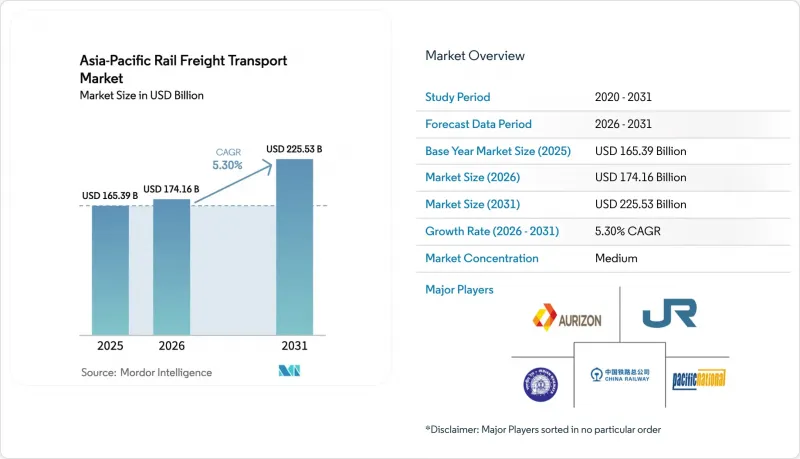
According to Mordor Intelligence, the Asia-Pacific rail freight transport market size is expected to grow from USD 165.39 billion in 2025 to USD 174.16 billion in 2026 and is forecast to reach USD 225.53 billion by 2031 at 5.30% CAGR over 2026-2031.
This report is Segmented by Service Type (Transportation and Services Allied To Transportation), Cargo Type (Containerized / Intermodal, Dry Bulk, and More), by End-User Industry (Mining & Minerals, Oil, Gas & Chemicals and More), by Traction Type (Diesel, Electric and More), and Destination (Domestic, International / Cross-Border). The Market Sizes and Forecasts are Provided in Terms of Value (USD).
Asia-Pacific Rail Freight Transport Market Trends and Insights
Rising Intra-Asia Merchandise Trade Fueling Trans-Regional Rail Corridors
Intra-Asia merchandise trade keeps climbing, and shippers increasingly choose rail to secure predictable lead times without relying on congested sea lanes. New approvals on the Kunming-Singapore axis underline confidence that rail corridors can shoulder a meaningful share of incremental flows. Inland Chinese provinces now dispatch regular block-trains to ASEAN neighbors, diversifying away from coastal gateways and demonstrating latent demand for land-based routes. Consistent schedule adherence on these services reveals that modest improvements in border protocols could unlock additional frequencies without large capital outlays, thereby reinforcing the appeal of through-train operations.
Surge in Cross-Border E-Commerce Driving High-Capacity Intermodal Rail Services
Asia-Pacific holds the largest share of global B2C e-commerce, and sellers face higher air-freight costs and longer ocean booking windows. Rail is emerging as the mid-price, mid-speed alternative, with services such as the Hanoi-Europe lane shaving about eighteen days from door-to-door time while halving greenhouse-gas emissions. Rising international container volumes confirm that companies view these lanes as scalable solutions rather than purely contingency routes. The resulting steady demand encourages terminal operators to invest in automated cranes and expanded depot space, which further elevates rail's competitiveness.
Track-Gauge Incompatibility Across ASEAN Countries
Much of continental South-East Asia runs metre-gauge track, whereas China and parts of India use broader standards. The resulting break-of-gauge forces trans-loading at borders, inflating handling cost and transit time. Research published on ScienceDirect highlights cultural and regulatory factors that complicate technical harmonisation efforts sciencedirect.com. Variable-bogie technology offers some relief for passenger trains, but freight applications remain economically marginal. Until a scalable solution emerges, operators will continue to reserve high-value, time-sensitive cargo for corridors that already provide seamless standards.
Other drivers and restraints analyzed in the detailed report include:
- Multilateral Infrastructure Funding Upgrading Trans-Asian Rail
- Region-wide Decarbonisation Targets Shifting Freight to Lower-Emission Rail
- Border Terminal Bottlenecks and Dwell-Time Issues
For complete list of drivers and restraints, kindly check the Table Of Contents.
Segment Analysis
Dry bulk commands the largest Asia-Pacific Rail Freight Transport market share at around 60.35 % in 2025, propelled by iron ore, coal, and grain flows from Australia, China, and Mongolia. Dedicated heavy-haul lines in Western Australia run trains exceeding 30,000 t gross weight, underlining rail's cost efficiency for dense commodities. Observed shipment patterns indicate that overland coal from Mongolia to northern China remains resilient, cushioning operators from maritime fuel-rate volatility. Continuous automation of train-control systems on these routes should unlock incremental capacity without large capital extensions.
Containerised and intermodal freight is the fastest-growing cargo segment, forecast to post a 7.45 % CAGR to 2031. The China-Vietnam line recorded a 1,153% year-on-year jump in 2024 container moves, demonstrating latent demand once schedules stabilise. Inland terminals are expanding crane fleets and digitising gate processes, signalling confidence in sustained box throughput. The rise of cross-border e-commerce compels logistics providers to offer near-daily departures, and that frequency improvement reinforces shipper loyalty to rail.
Transportation services represent about 87.20 % of Asia-Pacific Rail Freight Transport market size in 2025, reflecting rail's core role in moving goods across vast distances. China alone moved over 39 billion tonnes on rail in 2023, showing that main-line corridors already operate close to design capacity. Operators are testing high-speed freight sets capable of 250 km/h, illustrating the technological convergence of passenger and freight operations. Network controllers increasingly deploy AI-assisted dispatch to squeeze additional slots from crowded timetables.
Allied services-maintenance, switching and storage-are projected to grow at 6.08 % CAGR, outpacing transport volume itself. CRRC's 2023 results reported rising revenue share from service integration, indicating broader customer acceptance of bundled maintenance contracts . Predictive analytics is now standard in heavy-haul fleets, reducing unscheduled downtime and enhancing locomotive availability. This reliability feeds back into higher line-capacity utilisation, making allied services a strategic differentiator rather than a cost centre.
Complete Report Scope:
- By Cargo Type
- Containerised / Intermodal
- Dry Bulk (Coal, Ores, Grains)
- Liquid Bulk (Crude, Chemicals)
- Break-bulk & Project Cargo
- By Service Type
- Transportation
- Services Allied to Transportation (Maintenance of Railcars & Tracks, Switching, Storage)
- By End-user Industry
- Mining & Minerals
- Oil, Gas & Chemicals
- Agriculture & Food
- Manufacturing & Automotive
- Retail & FMCG
- Construction Materials & Others
- By Traction Type
- Diesel
- Electric
- Hybrid / Hydrogen & LNG
- By Destination
- Domestic
- International / Cross-border
- By Country
- China
- India
- Australia
- Japan
- Indonesia
- Thailand
- Rest of Asia-Pacific
List of Companies Covered in this Report:
- China State Railway Group Co. Ltd.
- Indian Railways
- Japan Freight Railway Co.
- Aurizon Holdings Ltd.
- Pacific National Group
- PT Kereta Api Indonesia
- Qube Holdings Ltd.
- KiwiRail Ltd.
- Sino-Trans Ltd.
- DB Cargo Asia Pacific
- RZD Logistics (Asia)
- Korea Railroad Corporation (KORAIL)
- Vietnam Railways
- Malayan Railways Berhad (KTMB)
- Genesee & Wyoming Australia
- State Railway of Thailand Logistics
- KTZ Express (KazakhstanChina Gateway)
- Myanmar Railways*
Additional Benefits:
- The market estimate (ME) sheet in Excel format
- 3 months of analyst support
TABLE OF CONTENTS
1 Introduction
- 1.1 Study Assumptions & Market Definition
- 1.2 Scope of the Study
2 Research Methodology
3 Executive Summary
4 Market Landscape
- 4.1 Market Overview
- 4.2 Market Drivers
- 4.2.1 Rising Intra-Asia Merchandise Trade Fueling Trans-Regional Rail Corridors
- 4.2.2 Surge in Cross-Border E-Commerce Driving High-Capacity Intermodal Rail Services
- 4.2.3 Multilateral Infrastructure Funding (ADB, AIIB, ASEAN-Connectivity) Upgrading Trans-Asian Rail
- 4.2.4 Region-wide Decarbonisation Targets Shifting Freight to Lower-Emission Rail
- 4.2.5 Expansion of Bulk Commodity Exports Sustaining Heavy-Haul Rail Investments
- 4.2.6 3PL/4PL Cost-Optimisation Programs Accelerating Modal Shift to Rail
- 4.3 Market Restraints
- 4.3.1 Track-Gauge Incompatibility Across ASEAN Countries
- 4.3.2 Border Terminal Bottlenecks and Dwell-Time Issues (e.g., Khorgos, Lao-Thai)
- 4.3.3 Maritime Freight Rate Competitiveness Post-2023
- 4.3.4 Limited Availability of Refrigerated Wagons for Perishables
- 4.4 Regulatory & Technological Outlook
- 4.5 Insights into Transport Corridors in Key Regions
- 4.6 Freight-by-Rail Cost Review
- 4.7 Key Trade Agreements Impacting Rail Freight
- 4.8 Impact of Geo-Political Events on Rail Freight
- 4.9 Value / Supply-Chain Analysis
- 4.10 Porters Five Forces
- 4.10.1 Threat of New Entrants
- 4.10.2 Bargaining Power of Buyers
- 4.10.3 Bargaining Power of Suppliers
- 4.10.4 Threat of Substitutes
- 4.10.5 Competitive Rivalry
5 Market Size & Growth Forecasts (Value)
- 5.1 By Cargo Type
- 5.1.1 Containerised / Intermodal
- 5.1.2 Dry Bulk (Coal, Ores, Grains)
- 5.1.3 Liquid Bulk (Crude, Chemicals)
- 5.1.4 Break-bulk & Project Cargo
- 5.2 By Service Type
- 5.2.1 Transportation
- 5.2.2 Services Allied to Transportation (Maintenance of Railcars & Tracks, Switching, Storage)
- 5.3 By End-user Industry
- 5.3.1 Mining & Minerals
- 5.3.2 Oil, Gas & Chemicals
- 5.3.3 Agriculture & Food
- 5.3.4 Manufacturing & Automotive
- 5.3.5 Retail & FMCG
- 5.3.6 Construction Materials & Others
- 5.4 By Traction Type
- 5.4.1 Diesel
- 5.4.2 Electric
- 5.4.3 Hybrid / Hydrogen & LNG
- 5.5 By Destination
- 5.5.1 Domestic
- 5.5.2 International / Cross-border
- 5.6 By Country
- 5.6.1 China
- 5.6.2 India
- 5.6.3 Australia
- 5.6.4 Japan
- 5.6.5 Indonesia
- 5.6.6 Thailand
- 5.6.7 Rest of Asia-Pacific
6 Competitive Landscape
- 6.1 Market Concentration
- 6.2 Strategic Moves
- 6.3 Market Share Analysis
- 6.4 Company Profiles {(includes Global level Overview, Market level overview, Core Segments, Financials as available, Strategic Information, Market Rank/Share for key companies, Products & Services, and Recent Developments)}
- 6.4.1 China State Railway Group Co. Ltd.
- 6.4.2 Indian Railways
- 6.4.3 Japan Freight Railway Co.
- 6.4.4 Aurizon Holdings Ltd.
- 6.4.5 Pacific National Group
- 6.4.6 PT Kereta Api Indonesia
- 6.4.7 Qube Holdings Ltd.
- 6.4.8 KiwiRail Ltd.
- 6.4.9 Sino-Trans Ltd.
- 6.4.10 DB Cargo Asia Pacific
- 6.4.11 RZD Logistics (Asia)
- 6.4.12 Korea Railroad Corporation (KORAIL)
- 6.4.13 Vietnam Railways
- 6.4.14 Malayan Railways Berhad (KTMB)
- 6.4.15 Genesee & Wyoming Australia
- 6.4.16 State Railway of Thailand Logistics
- 6.4.17 KTZ Express (KazakhstanChina Gateway)
- 6.4.18 Myanmar Railways*
7 Market Opportunities & Future Outlook
- 7.1 White-space & Unmet-Need Assessment

